Showing posts with label love. Show all posts

Friday, August 04, 2017

Pied Beauty and the Comfort of the Resurrection


That's the Bald Knob Bulldog above. In my mind it's the Bald Knob Bulldog Cafe', despite the sign calling it a restaurant. I'm not sure how that discrepancy came about, but I'm willing to bet that I'm older than that sign, so I'm guessing that it used to be called, and perhaps have a sign saying that it was, a cafe'. I just did a quick Google search and learned that other people have also searched the the Bulldog Cafe in Bald Knob, so I think it must have been called that at one time.

Anyway, I was there this evening. My daddy flew home today from a grand adventure that took him to Rome, Zagreb, Cakovec (where he stayed in our home for a couple of nights), and then a town called Cluj in Romania (where he taught English for several weeks), and to Hungary (where he visited friends made many years ago.) He came home today from all this travel in faraway places. His flight from Europe was delayed, causing him to miss his flight home last night. So he spent the night in the airport and arrived here with almost no sleep in 48 hours.

He amazed me by having the presence of mind and energy to want to go to the AT&T shop to be sure his Europe phone service was terminated, and to go by the truck dealer to schedule an oil change. I drove him on those errands, then we came home. He went out to his garden and picked tomatoes and eggplant and squash. Then we ate supper.

And then he brought up the idea of going to get a strawberry shortcake in Bald Knob. So we did it. Except I learned that they also make peach shortcakes, so I got peaches rather than strawberries. Which was a hard decision to make, because strawberries are wonderful and famous in these parts. But peaches are my favorite, so that's what I had.

A trip to the Bulldog was the perfect ending to a lovely day dedicated to coming to Arkansas. As soon as I crossed the Mississippi River, I felt that wonderful sense of freedom that comes when you see the green masses of trees, the wide open fields, the dirt and gravel roads wandering through them.

Today I was listening to lectures (a graduation gift from my thoughtful husband) on Gerard Manley Hopkins and his poetry as I drove, hearing Fr. Joseph Feeney read poems of Hopkins' Wales surroundings, the hills, the birds, the fields, the sky. And all around me were fields, sky, birds--and even lovely hills, once I came to Crowley's Ridge. It made the drive even more beautiful than usual.

And then I made a stop that made me love Arkansas even more. I wanted to get balloons as a little surprise when Daddy would arrive at his house. I was short on time, and I really wanted to avoid the crowds of WalMart if I could. So when I saw a little local florist sign in Bald Knob that said "more than flowers," I thought it was worth a try. You never know just what to expect when you go into a place like that in a small town (fewer than 3,000 people in 2010). It was actually a large-ish building for a florist, obviously a new business in an old building that used to house some other kind of activity, maybe a farm supply store, given the amount of farming in that area. It was large and fairly plain, except that the new owners had painted huge flowers on the outside of the building, giving it a whimsically charming homemade beauty. You can see a picture near the bottom of this website.

Hoping they had balloons, and that I could get some quickly, I walked in the door to see no one behind the counter. No doorbell rang, no voice called out, no one appeared. I had just begun to wonder if I should go back to the car when out of the back came a little brown-haired boy who hurried right over, looked up at me, and threw his arms around my legs to give me a hug, his head reaching a little above my knees!

I think he said something, but I don't remember what. I don't remember what I said, either. I just remember that he was terribly sweet, and even though I couldn't always understand what he said, he responded to my greetings and questions; and once I had learned that he was three years old and that his mom had gone to the store, he went back to where he had come from behind the counter, and out came a woman who I believe was his aunt.

This all took a very short time, less time than it has taken to write about it and probably less than it will take you to read it. I mention that so that no one can get the idea that he was neglected or unsupervised.  He clearly was not. He was just fast!

Happily I did order balloons that they did in fact have, and the whole time carried on a funny conversation with this sweet child, whose mother arrived during my few minutes there. When it was time to pay and go, he was in the back of the shop again. He obviously heard something I said about leaving, because he stopped talking with his mother and said, "Wait! I have to go give a hug!" And he ran out from behind the counter and hugged my legs again as before, this time looking up and blowing kisses at me. His mother and aunt gently "called him off," though of course I said it was absolutely fine with me, and that he was a sweetie pie (I think that's what I said, who knows?), and rather reluctantly, I left.

I feel sure I'll find a reason to stop there again.

Meanwhile I'm left pondering the beauty of a small town and of close circles in which a child is so loved and cared for and has no reason to feel fearful or suspicious of someone he has never seen before. Not only not fearful, but so full of love and generosity. Of course it's a messed up world, and he will learn prudent boundaries as he grows, I have no doubt. It was clear that the big people in his life love him and love life, and so I trust they will protect him appropriately.

Arkansas is a poor state, among the three poorest in the nation, according a study done two years ago. It has problems that come along with poverty. It has problems that come along with other things, too. While my drive home takes me through beautiful fields and crosses flowing rivers, it also means seeing abandoned houses, dying towns, and reminders of racial tension.

I was reading an article the other day about West Virginia, another of the three poorest states, and author John Mark Reynolds' take on some of the problems there. I couldn't help thinking about that article as I drove past some of the dying towns and wondered about the lives of the people there. I know that drugs are a problem in Arkansas, especially meth, from what I've read. Some people are desperate for meaning in their lives, and for love. Without those things, drugs become an easy choice, among the rich and the poor. And once drugs affect one person, they affect families, and then communities, and no one ever knows the full extent of the damage.

But there is beauty in this state. Incredible natural beauty. And today the beauty of a little boy who knows he is loved and cherished. And I imagine it's because of people in his life who also know that they are loved and cherished. And his little heart of love is evidence that they really believe what they have on a sign that was by the front door of the business. They haven't sold their birth right, to reference the West Virginia article. They've accepted it and are passing it on.

It's not the Memphis way of doing business, to put religious posters on the front window. It's not the big city way. It's not cool. It's probably not even allowed in some places. But who knows if having this sign on the window may not open the door to hope for some young teenage girls, leading to conversations and relationships that will save them from turning to drugs or bad relationships in search of love, or failing that, drugging numbness?

I think Hopkins would find poetry in this picture and in my afternoon encounter.  Death, disease, decay, drug addiction, dirt, and depression are as real in Arkansas as anywhere. Hopkins knew darkness and despair very well. But the Christian belief in resurrection, which he so powerfully describes in "That Nature is a Heracletean Fire and of the Comfort of the Resurrection," is paramount in his poetry and in his life. And if I am to believe that I am, ultimately, "immortal diamond," I must have opportunities and the ability to see that hope. "Across my foundering deck shone a beacon, an eternal beam." People need a beacon shining. They need to see that beam.

I hope they keep that poster there. I hope it blesses girls who need to see it. And I hope their little boy becomes a grown man who loves with passion and prudence because he knows that he is cherished, that Christ became what he is, and he will be what Christ is, and that this life is only part of a Life we can't begin to imagine. You can handle a whole lot of what life gives you when you know that.



Monday, October 20, 2014

Two Years

Wow, it has been long enough since I posted anything here that for a moment I couldn't remember how to start a new post.

Work, school, travel, and other life events have kept me from coming here for several months. But today I have to break the silence to remember my beloved piano teacher who was so much more than a piano teacher. I've written about her before, here and here.

Today marks the two-year anniversary of her death. Interestingly, at the time of her death, I was taking a class on the book of Revelation. And now I'm taking a class on the Gospel of John. Both books that talk a lot about life and death, and eternal life. And light and dark, too, especially in John. And day and night, especially in Revelation.

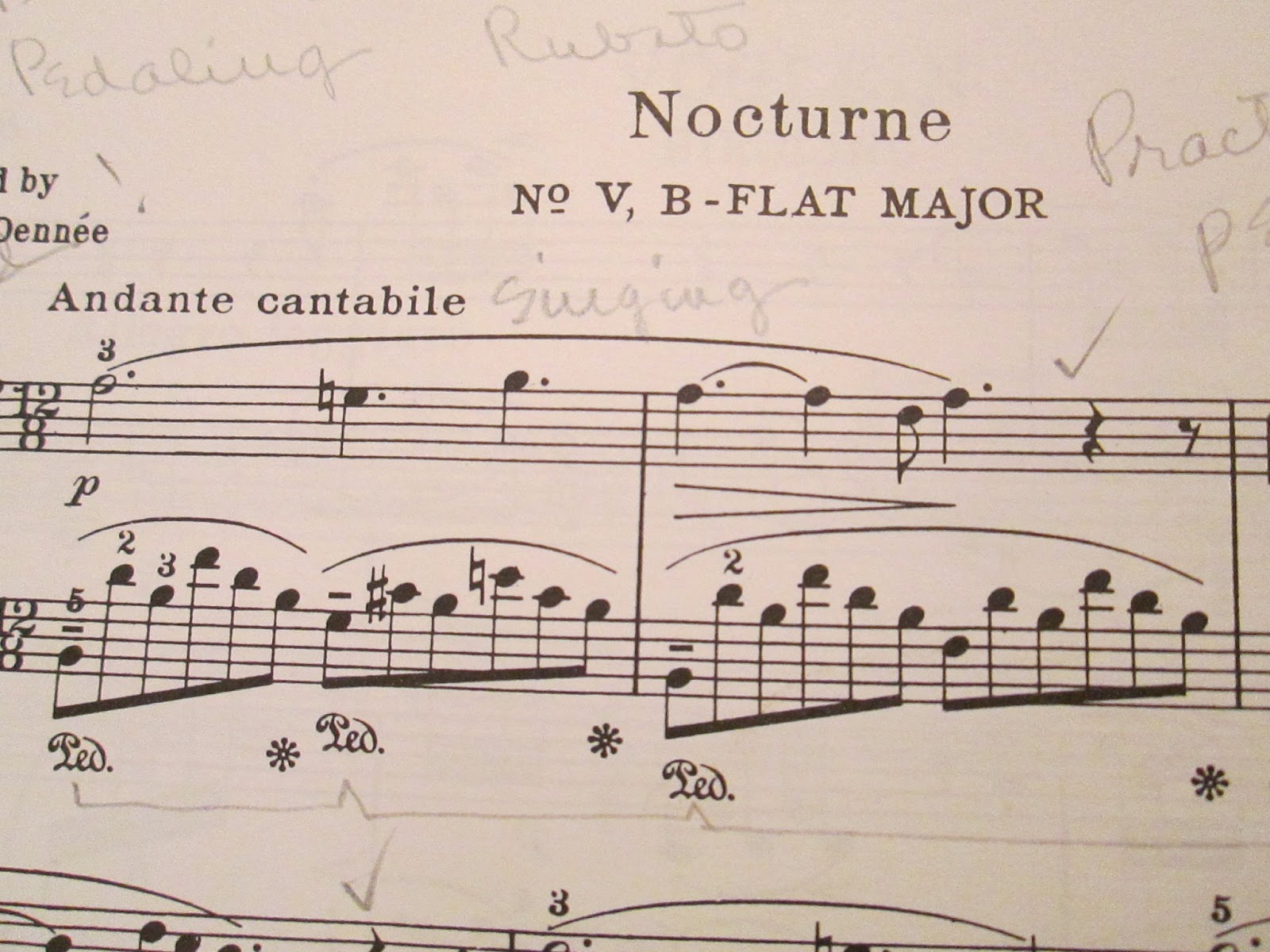
The last couple of years off her life, she was working on the Nocturnes of Francis Poulenc. She said I simply must get them and learn to play them. She would play them for me, commenting on the jazz touches that Poulenc added to his impressionistic sound.

So, sometime in the past year, I ordered the music. Making sure it came from the publisher she had recommended, the Parisian edition, not some take-off arrangement. (Some things are worth splurging on.)

A couple of months ago, I was out of town to visit a friend in Colorado and take some time off. I called a nearby college and asked if they might be able to let me use a practice room while I was in town. They said yes. I expected a small room with an old piano in it. But they gave me a huge room with a Steinway in it. A beautiful, nicely kept Steinway. Not old and out of tune, but actually wonderful.


And another time when I was out of town, at the Scarritt-Bennett Center in Nashville for a group retreat, I had access to a wonderful piano, though to be honest, I don't remember what kind it was.

Both times, just hoping I might have a chance to play, I had my music with me. The Nocturnes of Poulenc. The music that will always remind me of her and those last visits we had.

So both times I played my heart out. Not wonderful playing, because I don't have time to practice as is required to play this music wonderfully. But it was a wonderful way to connect with her and remember the many hours we spent at her wonderful piano, and all the wonderful pianos I played on for competitions she coached me through (though I never felt wonderful while doing those!)


And I wept at those wonderful pianos. Wonderful cleansing tears that I so needed to cry, because life has been so full these past two years, I have hardly had proper time to do that, to remember her well and to grieve her loss, though I feel it so often in the midst of various activities. Especially when I wish I could pick up the phone and call her.

The dark and light of a piano keyboard will always be a way of connecting with her. The "night" of the nocturnes will always bring a certain kind of "day" as I connect with her love through them.

And unlike the Steinway in Colorado Springs, which I said goodbye to and then looked at through a locked door, doubting that I'd ever see it again, because of the Gospel of John and the Book of Revelation, I do look forward to seeing her again.


And I am thankful. Thankful for her life. Thankful for eternal life. Sad right now, but thankful.


(This was one of the first pieces I ever played as her student. Nice bookends.)

Sunday, April 20, 2014

Holy Saturday: Bridegroom and Wedding


I wasn't planning to write anything today, and I won't say much, except that I was so struck by this article by Elizabeth Scalia that I've decided to share it. Struck by the piece itself and by the connection to Donne's poem that I shared a few posts ago.

Scalia begins with words from Pope Benedict,

Dear brothers and sisters, let us look at Christ pierced in the Cross! He is the unsurpassing revelation of God's love, a love in which eros and agape, far from being opposed, enlighten each other.

On the Cross, it is God Himself who begs the love of His creature: He is thirsty for the love of every one of us.


. . . and I will let you read the rest for yourself. It is worth reading.


This image of Christ as Lover and Bridegroom struck me today also as I went into an Orthodox Church nave to meet a friend. I always love being there. The space itself, with its other-wordly icons and candles and silence, is beautiful, and the people I know there are beautiful.

But today it was even more beautiful, with rose petals and other flowers carpeting the floor, and flower garlands on the doorways and other places. Just as it was when I went there for a wedding a few years ago.

My friends are there now, as I write, nearly midnight. The church is about to be completely dark, except for one candle. And then light will spread and grow, and joyous music will begin, and Alleluia's will be cried out after long weeks of none. And the people will later feast as if for a wedding, celebrating a marriage unlike any other.

The Cross began in Love and leads to Love.


Thursday, April 17, 2014

Maundy Thursday: Turning


(Caveat lector: I started writing this on the 26th day of Lent and had to leave off. Spring is now even further along than what I describe here......Just to keep it honest.)

Where we live, winter is finally turning into spring. The woods in this area have turned into a glorious celebration of new life. Grass is turning green in some places. People are turning their soil and planting things.


My jars and cups are turning into temporary vases as I bring daffodils into the house from time to time. Which turns walking through the common areas into a scent-uous delight.


I'm turning back to my routine of walking most mornings before anything else, though today we went for a walk together in the afternoon and saw the lovely magnolia pictured below.


And a huge field covered in these precious little purple wildflowers, whose name I still do not know, even though they have been a part of my life since as early as I can remember. (A quick search for "purple wildflowers that bloom in spring" tells me they are quite certainly a nettle, some type of Lamium. It's amazing how you can find things on the Internet....)


But the "turning" that has been on my mind when I'm not caught up in the glory of spring coming, is from another section of the book we've been reading most evenings during Lent, that I've quoted from in recent posts.

Following are excerpts from a sermon by Henry Drummond, of whom I know nothing beyond what the book tells me, that he was a British revivalist and preacher in the last half of the nineteenth century. He writes about the story of Peter and his betrayal of Jesus.

Tonight as I write, it is actually even more appropriate to write of this, rather than on the twenty-sixth day, as this is remembered as the night the betrayal happened. Having just returned home from a Maundy Thursday service, with the washing of feet, the sharing of bread and wine, and the almost surprisingly heartbreaking stripping of the altar--or altars, in the case of the church I was in--the story is even more poignant.

Having one's feet washed by anyone is a humbling and touching experience. Having one's feet washed by Jesus . . . I cannot imagine what it was like for Peter, for any of them. It seems to have evoked deep emotion in the disciples and especially in Peter, a deep sense of belonging, of desire to "have part in" rather than "have no part in me," as Jesus put it.

And yet . . . and yet . . . hours later, he denied knowing him.

Drummond writes,

Those of us who know the heart's deceit would surely find it difficult to judge this man--this man who had lived so long in the inner circle of fellowship with Christ, whose eyes were used to seeing miracles, who witnessed the glory of the transfiguration; this man whose ears were yet full of the most solemn words the world had ever heard, whose heart was warm still with Communion-table thoughts. We understand how he could have turned his back upon his Lord, and, almost ere the sacramental wine was dry upon his lips, curse him to his face. Such things, alas, are not strange to those of us who know the appalling tragedy of sin.

But there is something in Peter's life that is much greater than his sin. It is his repentance. We all to easily relate to Peter in his sin, but few of us grasp the wonder of his repentance. . . The real lesson in Peter's life is one of repentance. His fall is a lesson in sin that requires no teacher, but his repentance is a great lesson in salvation. And it is this great lesson that contains the only true spiritual meaning to those who have personally made Peter's discovery--that they have betrayed our God.

And then what I find especially beautiful--

What then can we learn from Peter's turning around? First, it was not Peter who turned. It was the Lord who turned and looked at Peter. When the cock crew, that might have kept Peter from falling further. But he was just in the very act of sin. And when a person is in the thick of his sin his last thought is to throw down his arms and repent. So Peter never thought of turning, but the Lord turned. And when Peter would rather have looked anywhere else than at the Lord, the Lord looked at Peter. This scarce-noticed fact is the only sermon needed to anyone who sins--that the Lord turns first.

Then he notes that it was not with a loud voice Jesus turned to him, not even with a sound at all.

A look, and that was all. . . God did not threaten . . .We misunderstand God altogether if we think he deals coarsely with our souls. If we consider what has really influenced our lives, we will find that it lies in a few silent voices that have preached to us, the winds which have passed across our soul so gently that we scarce could tell when they were come or gone. [He tells the story of Elijah and the still small voice from I Kings 19:11-12.]

When God speaks he speaks so softly that no one hears the whisper but yourself . . . Stay right where you are. Don't return into the hustle and bustle of life until the Lord has also turned and looked on you again, as he looked at the thief upon the cross, and until you have beheld the "glory of the love of God in the face of Jesus."


As winter turns to spring and hearts turn toward death and resurrection, and even flowers turn toward the sun, I am thankful for this reminder that God, through Christ, turns toward us even before we turn toward Him.


Sunday, March 23, 2014

Dvadeset i Tri na Dvadeset i Treći (Twenty-Three on the Twenty-Third)


We interrupt this Lent for a special announcement . . . Twenty-three years ago today, we were married. Like today, it was a bit overcast and windy. (In fact, we have a hilarious picture of my veil blowing in the wind at one point.) Unlike today, we were twenty-three years younger and had little idea what lay ahead.

I remember hearing before I married that every wedding has something significant go wrong, that it would be bad luck if you didn't.

Well, our expectant-mother cake-maker was ordered on strict bed rest the day before the wedding. Our music director's child got chickenpox a few days before, and his wife was in cancer treatment and couldn't be exposed to it. And during the ceremony itself, one of the groomsmen fainted, nearly taking down with him all the ivy connecting the arch and flowers.

So according to the conventional wisdom, we should have been inoculated against bad luck. On the other hand, a dear woman made a wonderfully delicous cake at the last minute--and still came to the wedding despite the lack of sleep. And the music director was able to find childcare and direct the choir, which meant the world to me, since he had been my chorus director and beloved Bible teacher. And another groomsman caught the fainting one, saving the wedding from disaster; they even revived him before the end of "Lord, Make Me an Instrument" came, most people didn't even know it ever happened, as they had heads bowed and eyes closed for that prayer/song.

So, who knows, maybe all those last-minute "saves" undid our inoculation.

Of course, it wasn't "bad luck" that caused the war in former Yugoslavia. It was much more complicated than that. It may have been coincidence that we had bought our tickets to return there the very week that the war started. And it wasn't "luck" that we came from different cultures and spoke different languages; it was very much a choice we made to marry, knowing we came from different worlds. So I wouldn't say we had bad luck. But we did have a very tough start.

I've often looked back and wondered how many people choose this hymn as wedding music. Certainly today I don't hear it at weddings, and I don't know if I ever did growing up. But I knew I wanted it at ours, and Drazen agreed to it. We really were not expecting the war, but I already knew that moving so far away from home would be hard. And we knew that neither of us had "ease" or "idleness" on our list of hopes and dreams.

Father, hear the prayer we offer,
Nor for ease that prayer shall be,
But for strength, that we may ever
Live our lives courageously.

Not forever by still waters
Would we idly, quiet stay,
But would smite the living fountains
From the rocks along our way.

Be our strength in hours of weakness,
In our wand'rings be our guide;
Through endeavor, failure, danger,
Father, be thou at our side.

Twenty-three years later, by the grace of God, here we are. And it is by the grace of God.  He heard our prayer, and hears our prayers, and has given strength and guidance and many other things needed along the way.

And, I must add, I married a patient and persevering man. I don't think I'm an easy person for an engineer to live with; I know I'm not, for him. It's almost laughable to me, now a marriage therapist, to look at our scores on various personality tests. We are both extreme in most areas, and we are opposites in our extremities--except for the "intuitive" part on the Meyer-Briggs. So maybe intuitively we both knew we could make it, even with all the reasons we might not. Whatever the case, I'm thankful that he is who he is, and that he loves me as I am.

We didn't have these words at our wedding; I just noticed today that they are a part of the hymn based on St. Francis' Canticle of the Creatures--

And all ye men of tender heart,
Forgiving others, take your part.
O sing ye! Alleluia!
Ye who long pain and sorrow bear,
Praise God and on Him cast your care!

But we did have other verses sung, and thanks to God's faithfulness in all our wanderings, it seems a good way to end this writing about our anniversary.

All creatures of our God and King,
Lift up your voice and with us sing,
Alleluia! Alleluia!....

Let all things their Creator bless,
And worship him in humbleness,
O praise him! Alleluia!
O praise the Father, praise the Son,
And praise the Spirit, Three in One!
O praise Him, O praise Him!
Alleluia! Alleluia! Alleluia!


Thursday, November 14, 2013

Letters of Love (though not exactly Love Letters)

 
Eleven years ago today the writer of these letters, and I assume the licker of these stamps, left this life for the next phase of his life's experience of Love.

I don't know what he would think or say if he knew I would be writing about him on my blog, but I think he might say that as long as I chose my words carefully, included no dangling participles, and allowed my emotion to cool before writing so that my words were recollected in tranquility, then I would have his blessing.


He was my high school English teacher, but most of the letters I have from him were written while I was in college and he was in the student role, working on a doctorate after many years of teaching high school, getting ready to move on to teaching college. (I thought it was neat that my favorite number, 26, was part of his address at Ole Miss. He would likely tease me for using the word "neat.")


My asking about something from a Frost poem about how difficult life could be winds up with his response, "All in all, I would say, there is a pretty good balance of agony and ecstasy. It takes both to make us wonderful people, you know." He was right.


He did "moan" in his letters about both his workload and the worldviews of some of his professors and how he felt their impoverished ideas did little justice to the literature he was studying. At some point in a later letter, however, he gave me permission to stop feeling sorry for him, that he was adjusting and would make it.


He writes in response to my comment that music can be so moving (referring to Barber's "Adagio for Strings"), that music often brings him to tears. Able to sing with one of the choirs at Ole Miss, he participated in a concert in Avery Fisher Hall that he wrote about more than once. Here he writes out some of the text of the "Prayers of Kierkegaard" set to music by Samuel Barber. Many years later, after his death, my own chorus sang the piece, so it will always remind me of him. I appreciated it much more as an adult than I could as a college freshman reading his letter.


In response to my suggestion of a Trivial Pursuit party, which he okayed if it were a small enough group, he writes, "I like my friendships deep, not wide." I have a perfect dozen of his letters, all at least two handwritten pages, often more, some typed and therefore even longer. At the time I was receiving these letters, I treasured them because they were from him, and they brought hope and wisdom into my life, but I didn't find it unusual that he spent time writing to me.
 
These days, working on a doctorate myself, I look at these letters with a sense of awe, knowing the sacrifice of time he took to sit and read letters from a former student and respond to them. It's clear he enjoyed writing about things, but it's also clearer to me now how much he meant the "Love" in "Love, Ray A. Wright." And I appreciate being someone he included in his not wide, but deep, circle of friends. One of the many blessings-beyond-measure in my little life.
 
(And we did have that Trivial Pursuit party, about fifteen years after the letter--just him, his wife, and me. I think we kept it small enough.)


Thursday, November 07, 2013

Happy Birthday, Grandmother

 
Today is my grandmother's birthday. A day and a life I will always celebrate, even though she has been gone for over ten years now. Depending on whether the family Bible or the official record was correct, she would have been ninety-seven or ninety-eight today. (It was late in her life that she learned they said two different things!)
 
She was a letter writer, which meant so much to me when I lived in Italy and Croatia, but the letters continued when we lived only an hour apart. When we chose the furniture we would like to have after her death, I knew I wanted to have the "housewife's desk" with its drop-down writing surface and organizing slots for stationery and such, because her letters had been such a part of our relationship.


She was an amazing cook, with a huge deep freeze full of all kinds of things that she shared generously and bountifully and beautifully.


She loved beauty in many forms, and when I left to live in Croatia, the magazine Victoria had just come out. She saw to it that I received it overseas and for many more years, until she died.


She is among my earliest memories, and she often wrote my entire name. When I married, she made a point of encouraging me to keep my last name as my middle name, because, as she said, "It's important to remember where you come from and who you are."


She had a beautiful smile. She was not a people pleaser; she did not smile because a camera was around or because she needed to impress anyone. She lived a life of courage and deep determination through many hardships. And when she smiled, you knew it was for real.


Sunday, October 27, 2013

Impressions of Beauty

When it was too late, I realized that I had only once in my life had a picture made with this woman I love so much. And that picture was across the ocean, where it had been since I framed it and set it out in our living room in our house across the ocean.
 
So, when the man I married made a trip across the ocean earlier this year, I asked him to bring the picture back so I could have it over here.
 
And he did. And here it is.


As you can see, the frame is too big for it, but it is what I had twenty-something years ago. What I didn't have back then was any normal kind of matting for it. This was wartime Yugoslavia/Croatia we were living in, and there wasn't a lot of choice about a lot of things. And decorating wasn't my top priority at the time, in any case.
 
So, odd as it seems to me now, I found some crinkledy paper that at the time matched the color of the flowers on Mama Neva's dress. And for twenty-something years, that is what was in the frame behind the photo. Over time, it had changed color and faded around the edge, and at any rate it just didn't look so great, so I took it out.
 
Being sentimental to a degree some might find pathological, I couldn't bring myself to throw the pink paper away, and it sat on my prayer desk for a couple of weeks until I decided I had to do something with it. (Meaning, it was time to throw it away.)
 
But when I actually looked at it, rather than simply looking over it or beyond it, I had a surprise:


The twenty-something years of light shining onto the photo had created a second image behind it!
 
So now I feel as if I have a sort of shroud of Turin, or something like that, and I don't know how I will bring myself to throw the paper away....or what I will do with it. This may be how hoarders get started, who knows?
 
On a more serious note, discovering this unexpected image gave me hope and resolution. The secondary image is not the same as the original photo, but it is recognizable as an impression of the original. And I know that I am not like Mrs. White in many ways. No one could ever mistake me for her. I certainly don't play piano like her, and I don't live my life as well as she did. But I hope that with the years of Light shining through her onto me, maybe there is something about me that can be recognized as a faint image of her. I would love to bear the image of her compassion, her grace, her gentleness, her joy.

I would like to be beautiful like her.
Because she was beautiful.
She was the best kind of beautiful.


Saturday, October 19, 2013

Lux Aeterna


A little over ten years ago the music above entered my life. From the first measure, I loved it. It is Morten Lauridsen's "Lux Aeterna," and we sang it in the Rhodes Mastersingers Chorale.


Here is my music, placed in front of my preludes and fugues, one of the first books of music I bought when taking piano lessons from Mrs. White back in high school. After I got a CD of the Lauridsen music, I took it to her house on a visit home, and told her she was going to love it. As we listened, during that very first long, high/low note you see above, she whispered, "I already love it!"

The night we performed it, with Lauridsen himself present, I thought about my high school English teacher, Ray Wright, and how much he would love this music. He was in a coma at the time, though I did not know it, and a few days later I attended his funeral.

I've written a whole article on that year, so I won't go into detail here. But over the next six months, my grandmother died, a precious young cousin died by suicide, an old friend was murdered, and a close friend my own age unexpectedly died shortly after giving birth.

It was a very hard year. I found odd comfort in Hopkins' comfortless sonnet:

No worst, there is none. Pitched past pitch of grief,
More pangs will, schooled at forepangs, wilder wring.
Comforter, where, where is your comforting?
Mary, mother of us, where is your relief?
My cries heave, herds-long; huddle in a main, a chief
Woe, wórld-sorrow; on an áge-old anvil wince and sing —
Then lull, then leave off. Fury had shrieked 'No ling-
ering! Let me be fell: force I must be brief."'

    O the mind, mind has mountains; cliffs of fall
Frightful, sheer, no-man-fathomed. Hold them cheap
May who ne'er hung there. Nor does long our small
Durance deal with that steep or deep. Here! creep,
Wretch, under a comfort serves in a whirlwind: all
Life death does end and each day dies with sleep.


Of course, with time and a lot of love, hearts can heal, and mine did.

Last year, nine years after that beautiful music came into my life, and those beautiful people left my life, I was working on a paper for school, and I found a way to work this Hopkins poem into it (only partially cited here):

Man, how fast his firedint, | his mark on mind, is gone!
Both are in an unfathomable, all is in an enormous dark
Drowned. O pity and indig | nation! Manshape, that shone
Sheer off, disseveral, a star, | death blots black out; nor mark
                           Is any of him at all so stark
But vastness blurs and time | beats level. Enough! the Resurrection,
A heart's-clarion! Away grief's gasping, | joyless days, dejection.
                            Across my foundering deck shone
A beacon, an eternal beam. | Flesh fade, and mortal trash
Fall to the residuary worm; | world's wildfire, leave but ash:
                            In a flash, at a trumpet crash,
I am all at once what Christ is, | since he was what I am, and
This Jack, joke, poor potsherd, | patch, matchwood, immortal diamond,
                            Is immortal diamond.

Well, the marks these people left on my mind were not gone, but I was able to find great comfort and joy in the hope of resurrection.

While working on that paper, my beloved piano teacher was in a coma, and this time I did know it. I so hoped to see her once again, but did not. Tomorrow will be the anniversary of her death.

And thus this post, as tonight I reflect and remember these beautiful people and the blessings they have been to me and to many others.

Music is everywhere, so I trust they are enjoying beautiful music even now, as we wait for the flash and the trumpet crash and the Day when all immortal diamonds will shine in splendor in the presence of the Lux Aeterna.


Sunday, August 11, 2013

Dark. And a Phenomenon of Light.

In the very early morning, lying awake when I would have preferred to be asleep, I heard the rain start. A pouring rain. I hoped it might wash away the troublesome thoughts and feelings, and maybe I could get to sleep. That didn't happen, but it felt good just to hope for it.

During church, more rain fell than I remember hearing ever while in that place. Heavy, hard, pounding rain. It couldn't wash away the troubles, either, but being at church did help. Kind hearts and hugs do make a difference, as do songs of faith, reminders that ultimately Love will heal and transform this wounded world.

But outside again, the sky was gray. The clouds were thick and heavy. It's the peak of summer, but it was dark and bleak outside.

Later in the afternoon, I sat in a Starbucks talking with a friend. One of my best listener friends.

The content of much of our conversation was dark, heavy, thick, bleak. Hard. Because of situations in this dark world that weigh heavy on me. That can't be washed away. That will never wash away. That block the light from shining through, at least much of the time. That wake me up in the early hours more days than not. Because people I love are wounded, because I am wounded, because the world is so deeply wounded.

The rain stopped. After much talking and listening, the sky was a lighter shade of gray.

At some point I looked up. I had looked up in that direction often as we talked. Through the window of Starbucks were huge electrical lines and huge boxy thing-a-ma-jiggers connected to the lines, on their tall poles, crossing the street and looking ugly. Across the street huge golden arches blared bright yellow against the gray sky. And behind them a billboard advertising something or other framed the view. Urban ugliness matched the bleakness of the weather. A wounded landscape, like so much in the city.

But at that point when I looked up . . . . it was faint, but I thought I saw a rainbow. No, I was imagining it. Or was I? As I continued to look, it became more distinct, and I could see for certain that a rainbow was forming.


(I didn't have a camera with me. These are photos from five years ago. A faint rainbow is there, just right of center above the ground.)

Soon it became full-colored and distinct, and I couldn't help but notice that while it was interrupted and blocked by the ugly wires and arches and billboard, it went way beyond them, and beyond other signs and poles,  beyond where I could see, beyond, beyond, to wherever rainbows go.

In the midst of the wounded landscape, a sign.

Love will heal and transform this wounded world.


Thursday, May 09, 2013

China, Marbles, and Memories


Our house was built in 1941. The tag on the plates in the antique shop said they were from 1941. I had been wanting some of these plates for years, and the price was better than many I had looked at over the past decade. It seemed meant to be, so I bought four of them.

I love them because they are beautiful. I love them because they are hand painted and simple. I love them because they are old. I love them because they are Franciscan.

And I love this picture because if you look closely, you can see one of my other favorite dishes in the reflection, upside down! I did not notice that when I was pressing the button on the camera!

In one photo, I am amazed at how much love I see. The wooden dish rack belonged to Grandmother. The plate reminds me of the love of St. Francis. The bowl reflected on the plate was a gift of love from my friend Carolyn, and was made in Italy, a country I love terribly much.

And even the little marble in the dish in the window has special memories of love. A few years after Grandmother's death, I was visiting the woman who now lives in her house. This woman's grandchild was playing in the room, and his toy car or ball or something rolled into the fireplace. When she (or I? I don't recall) went to retrieve the toy, looking into the far recesses of the fireplace, we found this marble. She was surprised and said they had never had any marbles since moving into the house. I said Grandmother kept marbles in this room, and they were played with quite a few years back.

So she gave the marble to me, and I treasure it as a reminder of my own childhood and the childhoods of cousins, nieces, and nephews who played in that living room over the span of decades.

Since 1941, in fact, because their house was built the same year as the one we now live in.

It pays to look closely. You perceive more love when you look closely. As Dostoevski wrote, "Love all God's creation, the whole and every grain of sand in it. Love every leaf, every ray of God's light. Love the animals, love the plants, love everything. If you love everything, you will perceive the divine mystery in things. Once you perceive it, you will begin to comprehend it better every day."

Sunday, January 13, 2013

The Accompanist


As I sat down to write about the woman pictured above, I heard Garrison Keillor's voice, the way he reads for the noon "Writer's Almanac" program. . . ."Today is the birthday of . . . ." and had the thought that her life could never be fit into that short blurb given for the writers Keillor acknowledges--and I know that her life cannot be adequately described and appreciated here by me, either.

And yet today I feel compelled to write. I have wanted to write about her since her death on October 20 this past fall. It was impossible at the time, because I was severely pressed for time, and also because I had no tranquility to temper the emotion I felt; I needed some distance for recollection. Now I have the time, and I have had some time, and I will try.

And so . . . . Today is the birthday of Neva Jane Cram White, known to me first as Mrs. White and later as Mama Neva. She would have turned 78 today.

I'm not sure when I first became aware of her presence in the town I grew up in, but I know that by seventh or eighth grade, I was convinced that she was the best piano teacher in town. Her students just seemed to play a notch above the rest of us, at least several of them.

Once I turned pages for a friend who took lessons from her. Mrs. White's house had the largest living room I had ever seen, large enough for her long Baldwin grand piano, for a full set of furniture, for ample space around the furniture and piano, and for a few steps that went up into the dining room, where all the students, along with their page turners, stood and waited their turns. The "backstage."

It's ironic that this is my earliest clear memory of this remarkable woman; the irony will become clear as you read on. On that evening, being the shy wallflower that I was back then, I was standing, you guessed it, against the wall, by the door that went into the kitchen. I was trying to be invisible, as I felt intimidated by the mostly-older kids around me--her amazing, talented students.

It was an evening recital, and the lights in the living room had been turned out, except for around the piano, so there was kind of spotlight effect. The light in the dining room was off. Until it suddenly wasn't. It came on, out of nowhere, and I remember Mrs. White, this woman with the long piano and the huge living room and the competition-winning piano students, walking into the room with a perturbed look on her face, to figure out what was going on and why the light had come on. The way I recall it, she had a stern look, and back in those days a stern look from any adult was enough to make my heart race. My heart raced faster when it was discovered that I was the cause of the light coming on! I was leaning in such a way that I'd pushed the dimmer switch and not even been aware of it!

I must have gone into a mild state of shock, because I really don't remember anything after that. I wouldn't be surprised if I teared up, because I felt like I had ruined her beautiful recital. I also wouldn't be surprised if she assured me everything was okay, that it wasn't that big a deal....but I really don't remember. I do remember thinking, "She'll never want to have me as a student now!" (Yes, I fell prey to catastrophic thinking even more back then than I do now.)

Somehow I gathered the courage a year or two later, though, to inquire. And she did take me. I started with her in the fall of ninth grade and stayed with her for four years. Four years that changed my life.


One of the first pieces I played that year was this nocturne by John Field. She chose it because I wanted to play Chopin but wasn't ready to play the pieces that I was attracted to. Field's nocturne has some style similarities to Chopin's and is not quite so demanding! I fell in love with this piece, and it wasn't long before I came to love Mrs. White.

She was in fact an excellent piano teacher. She had actually studied organ and voice in college and then went to Eastman on a voice scholarship . And she did have a beautiful voice. Later on, she taught voice lessons at the university along with piano.

But what happened at Eastman, according to her obituary, gives my post its title: "While there, her piano accompaniment ability was discovered, and she began to develop what came to be perhaps her greatest musical talent. She later was recognized by the National Association of Teachers of Singing with the Brotherton award as an outstanding accompanist." Who even knew that awards were given for accompanists? Obviously they are, and certainly should be, but I didn't realize they were, until she died.

Her excellence as a piano teacher had a huge influence on my life that has lasted for years. But her giftedness as an accompanist will last throughout my life, even if I lose the ability to play piano completely.


She accompanied me through those four years of my life like no one else could have. Those years were tumultuous in ways I won't go into here, because this is about her and not me. Suffice it to say that those four years were among the hardest of my life. As I look back at my decision to screw up my courage and ask her to take me as a student--despite my shyness, despite my uncertainty about paying for it, and despite what happened at that recital--and see what a gift she became to me, I wonder at the grace of it all, and I wonder if some Holy Spirit prompting had not been behind the strong determination I had to become her student.

She was perhaps the gentlest person I had ever known. Her voice was gentle, her teaching style was gentle, her corrections came gently. Of course she taught me how to play the keys gently and firmly--a challenge, since the piano I practiced on at home had nothing like the action of hers.

And like any good musician, she knew how to listen. I have no idea how it began. Perhaps I burst into tears at some point in a lesson, I don't know. I just know that before long, our time together was divided between musical instruction and life instruction. She would listen to me, comfort me, encourage me, sometimes hold me when I probably seemed likely to fall apart otherwise. My overall memory of piano lessons in those years is of sitting at the piano together with music in front of us always, but much more than music going on.


At some point, the money I had saved up for lessons was all gone, and I thought, with great sadness, that would be the end of it. But, no, she insisted that she would continue to teach me in exchange for my continuing to work as hard as I already did. Since her death, it has become known that she taught several of us at no charge--a minister's daughter, a friend whose widowed mother died, another friend whose single mom struggled to make ends meet. Back then, none of us told the others, but at her funeral and on Facebook, the stories came out. She was a generous as she was gentle.


Another sign of her generosity was that at some point she decided to move my lesson time so that I would always come last in her day, so that there would be time for both the lesson and for whatever else might need to be "worked on." She also provided music for me. I had several books from the set pictured above, but I really didn't have a way to make money to pay for more. Since the set didn't have much in the way of modern music, and modern pieces were sometimes required for the competitions I eventually entered, she took care of that.


When it was time to graduate and go to college, she felt it was best for me to try a new teacher, just to get a different perspective and have a fresh set of ears to hear me. So I did move to another teacher, though we continued to meet in her office (she began teaching at university the same year that I began, as I recall.)

One year I actually took her accompaniment class for credit. (I started out a music major but figured out that I didn't want to teach in a school system and wasn't likely to become a performer, so I switched majors but continued to do as much musically as I could.)

Well, Blogger has decided now that it will rotate pictures I am trying to post.....and it is getting late, and as I thought, there is no way to fit this all into one blog post. I guess it will have to be a mini-series. For now, I will share a poem I came across recently, and I'll come back for the continuation.

The Accompanist

By Dick Allen

I’ve always worried about you—the man or woman
at the piano bench,
night after night receiving only such applause
as the singer allows: a warm hand please,
for my accompanist. At concerts,
as I watch your fingers on the keys,
and how swiftly, how excellently
you turn sheet music pages,
track the singer’s notes, cover the singer’s flaws,
I worry about whole lifetimes,
most lifetimes
lived in the shadows of reflected fame;
but then the singer’s voice dies
and there are just your last piano notes,
not resentful at all,
carrying us to the end, into those heartfelt cheers
that spring up in little patches from a thrilled audience
like sudden wildflowers bobbing in a rain
of steady clapping. And I’m on my feet, also,
clapping and cheering for the singer, yes,
but, I think, partially likewise for you
half-turned toward us, balanced on your black bench,
modest, utterly well-rehearsed,
still playing the part you’ve made yours.