Showing posts with label incarnation. Show all posts

Tuesday, January 05, 2016

Light of the Incarnation

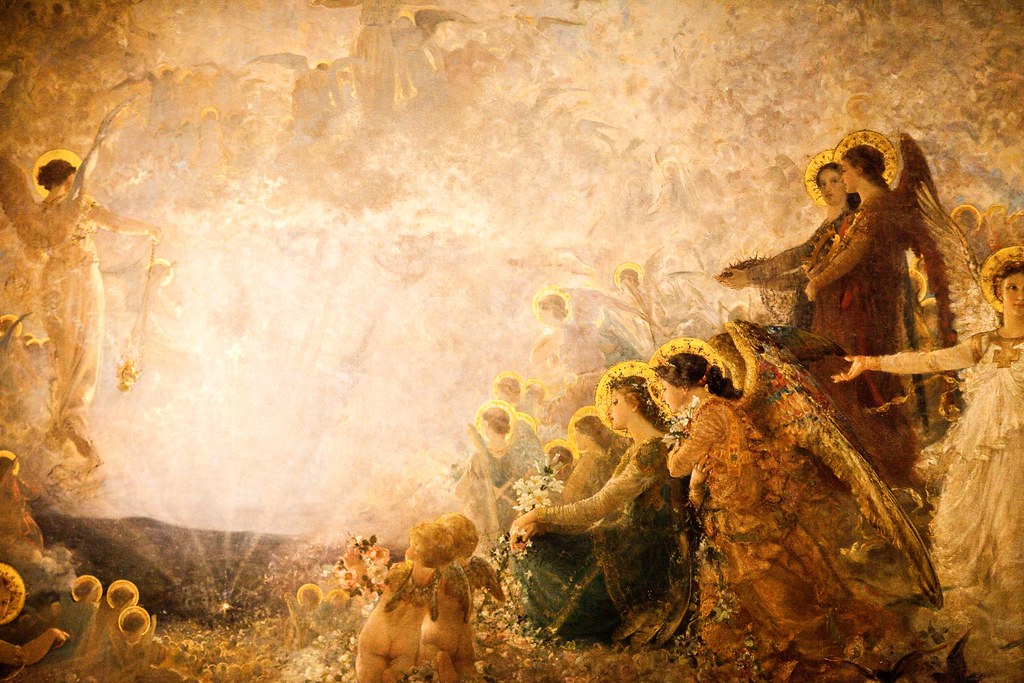
When I first saw this painting a few years ago at the Brooks Museum,
I thought it was amazingly beautiful.
It's huge (over 6.5 x 9.5 feet) and splendid, so you can't walk by without stopping to look.

(It is so large, it is hard to find a full copy of it on the Internet. The first I've posted, which comes from this lovely blog, has the whole painting; the second has better lighting but not the whole thing.)


And when I stopped and looked, I saw the title was "Light of the Incarnation."
Only then was I able to see that (almost) all the angels are looking down, way down,
to the source of light in the left-hand lower corner.
And then the painting began to say more and more, beyond
"There's a bunch of beautiful angelic figures in lovely lighting."

It brought to mind the words from Luke's gospel, after one angel had appeared to the shepherds,
announcing the birth of a baby who was a Savior.

And suddenly there was with the angel a multitude of the heavnly host
praising God and saying,

"Glory to God in the highest,
and on earth peace among men with whom he is pleased!"

It brought to mind from John's gospel, "The light shines in the darkness,
and the darkness has not comprehended it."

And that fascinating passage in I Peter,
"It was revealed to them that they were serving not themselves, but you,
in the things which have now been announced to you by those
who preached the good news to you through the Holy Spirit sent from heaven,
things into which angels long to look."

And then, looking longer at the painting, I saw that
a crown of thorns is held out by one angel, symbolizing the crucifixion;
and a golden crown, symbolizing victory.


and lilies are held by another, symbolizing the resurrection;
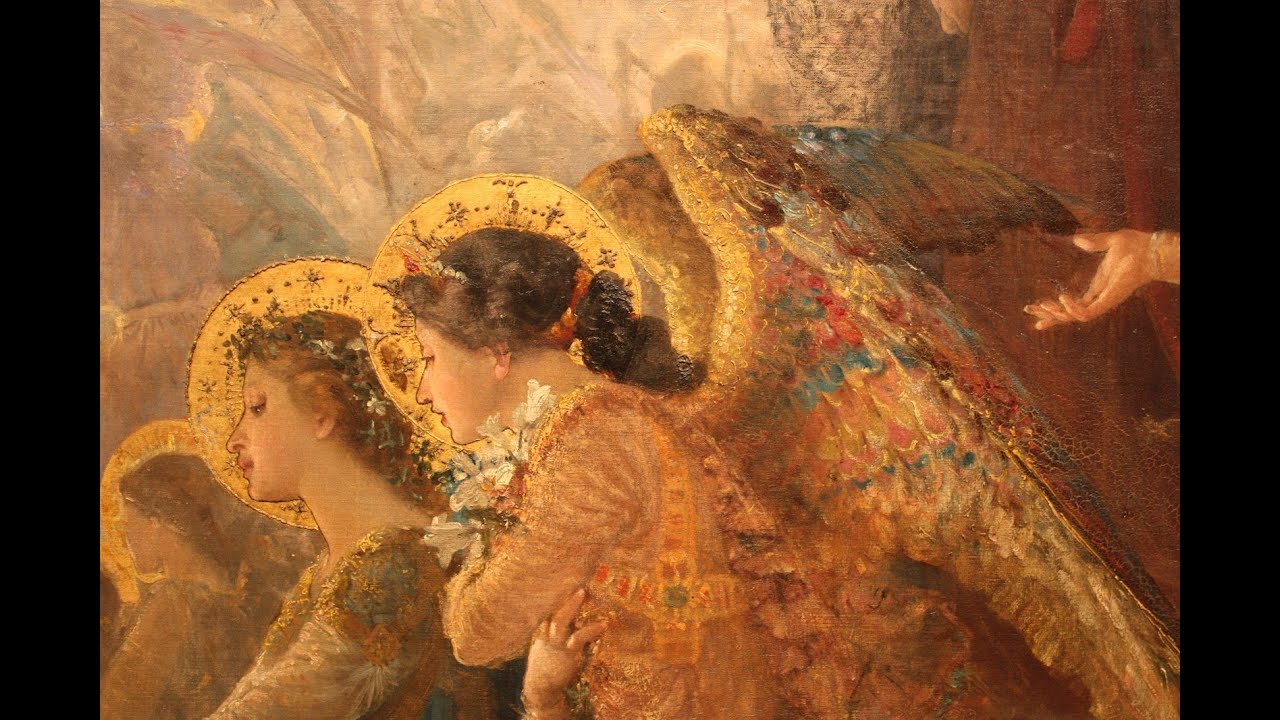


and incense by another, symbolizing prayers and the holiness of the event.
(At least I think that's what it is....)


These symbols are powerful, representing the whole story to come,
set in motion long before the moment captured by the painting.

But I think the most powerful part for me when I've seen it is simply that you can't
look anywhere without seeing angelic forms. They fade in and out as you stand and look.
(Take time to enlarge the photo and look at it closely so you can see them.)

Granted, they are more representative of beautiful women with wings than they are of
the angels described in scripture, in those few places where they are described.
But even in this romanticized form, they serve an important purpose.

We so easily fall into thinking that only what we can see or hear or taste or touch is real, 
which our own scientific approach should warn us about, since before the magnifying glass,
many things that were not known by the senses were very much real, both making life possible (oxygen) and killing people (bacteria, germs, etc.)

The fact that we did eventually develop magnifying glasses, telescopes,
and all kinds of technologies that have expanded our ability to know things through our senses,
doesn't assure that we will be able to do that for every reality that exists.

And when I read things written by those who lived before all these technologies--
those who had access to all kinds of spiritual and philosophical writing,
but not to what we today consider scientific writing--
I often think that they saw and understood more than we do today.
They knew so much about life and love, humanity and hope, purpose and peace.
Some today may laugh at them for believing in angels.
But we really don't know who will have the last laugh, do we?
I only hope it will be laughter of joyful goodness, not the cynical laughter of "See, I was right."

The very word "Incarnation,"
signifying that something that was not made of flesh is being made into flesh,
assumes that there are realities beyond what we can experience in a purely fleshly way,
through those five senses we are taught to identify and name in elementary school.
It assumes a realm that is more than flesh, or beyond flesh,
a realm that can inhabit flesh at will but is not limited to it.

The new quotation under the title of my blog comes from a man who writes often about the realness of the realm that we cannot see with our eyes in the way we think we'd like to.

And here another author shares the story of a man who seems to have had the ability to see angels. The story of his life seems to indicate that perhaps we have lost the ability to see some things
by the way we have focused so intensely on seeing certain things in certain ways,
and creating strong rules about what is possible and what is not possible.
I urge you to take the time to read it.

We trust our eyes, our sight, so much. Perhaps too much?
Today I heard a car pull into our driveway. My husband said, "Oh, here comes your friend."
Because of the circumstances, I was thinking only of friends of a particular group, and when I looked out the window and saw this woman walking towards our door,
I actually had no idea who she was. I didn't recognize her.
I didn't see her. I saw a stranger.
Once she got to the door and came in, and I heard her voice,
I knew exactly who it was, and when I saw her face, I saw her, not my ideas about her.
(She is a dear friend but not part of the group I had in mind, not what I expected.)

And so this painting, this Light of the Incarnation, has become a favorite of mine
because it is a reminder that I cannot see everything, know everything,
understand everything, explain everything.
A reminder that forces are at work that I will never know about.
That my life is part of a huge painting that I could never paint on my own.
And it is a beautiful, light-filled painting.

Painted by Carl Gutherz, a man who was born in Switzerland and lived part of his life in Memphis.
About the painting, he wrote,
"Up to the moment of the birth of Christ, the light of God came from heaven to earth--
but, God here, the light glows back from earth to heaven,
increasing in glory throughout the ages.
Beholding this, the heavenly host unite in rejoicing over the world redeemed."

(from Carl Gutherz: Poetic Vision and Academic Ideals, ed. Masler and Macini.)

Joy to the World!


Monday, April 28, 2014

Inifinity in My Lap: Healing Art


So, I spent the greater part of Thursday in a relatively small room filled with big moments. I had more fun that day than I'd had in I don't know how long. As a child, like most children, I loved to draw, color, paint, cut, paste, whatever. But in high school, we had to choose between chorus and art classes, and I always sang. And visual art, beyond photography, just didn't have much of a chance in my schedule. Then in college, I took one drawing class and fell in love with "making art," as the artists say. (For some reason, I never heard that expression until the past few years, and it still sounds a little odd to me. I tend to think of "doing art," for whatever reason....and look what I just found, piqued by curiosity about that phrasing.)

Our teacher was amazing. She has a real gift for what she does and for teaching it to others. Her warm, compassionate enthusiasm was contagious.


Of course she was teaching/lecturing part of the time, but she also gave us projects to do. And it was so neat, how people got so engrossed in what we were doing. The room just felt different when everyone was focused on their own little creation, music was playing quietly, and no one was talking.


These oil pastels were our friends for the day. I felt like I was back in elementary school. I still remember how exciting it was the first time I had a box of 64 crayons!


We partnered with the person sitting next to us and played "scribble chase." One person leads with a scribble/doodle, and the other follows. A great ice breaker.

I led on this one. My only thought was to do more than go round and round, so I did some other things. It kind of wound up looking like a face, didn't it?


My partner, who became my friend in the course of the day, led on this one. It was more relaxing, just going round and round. And I like how our pinks look together.


The next thing we did was the "inside and outside the square" piece that I described in the previous post.

And for the next one we were instructed to just doodle until she said "stop." It wasn't very long at all. My original doodle was just the curve you see below that forms the main part of the bass clef sign.

Then we were to think of three things we could make from the doodle, and not begin doing anything with it until we had three ideas. (Generating ideas, envisioning possibilities....important stuff in therapy.....)

Once we had three ideas, we were to choose one of our ideas and continue making something from our doodle.

Well, I liked two of my ideas so much that I did both of them, and the next thing I knew, I had the beginning notes of the main theme of Beehoven's Ninth and an angel together on the page, with joy in various languages, and beams of light coming from the heart of the angelic figure.

At some point I thought how strange it was, with the things going on in my life lately, that I would be creating art so full of light and joy and music. Was I in denial? I wondered. But I just kept adding beams of light and then the bass clef-y doodles to frame the piece, and I knew I was not in denial. There are hard things going on, some very hard things, but the light and joy overcome the darkness.


So then I added the "o magnum mysterium" to the mix, because it is rather mysterious how light and dark, joy and sorrow, can be so mixed in one mind and heart. And because I know that for me it is the great mystery of the Incarnation, and all that follows from it, that makes it possible.

When Lisa came around to see what we were doing and talk briefly with us about our work, she asked me, "So how far do the rays of light extend beyond the page?" I looked up at her and after a moment's pause said, "Infinitely. Because even though it looks like an angel, this is the heart of God, and the light is infinite."

And that is why I want to do more art in my therapy. Because I didn't even have that in mind when I was drawing these images. Not consciously. I was just going with the doodle and seeing what I could do. I drew hearts because I am not good at drawing faces, and  it seemed like a good way to not have to draw a face but still represent an angelic figure.

But somehow, making things with our hands has a way of going deep into our minds and heart and pulling things out.

And sometimes when doing that, infinity kind of. . . drops into one's lap.


Sunday, January 05, 2014

Poem to Start a New Week and to End the Christmas Season


I have no original thoughts. (Do any of us, really?) But today is the last day of Christmas and it is also Sunday, and this is a wonderful poem that relates to Incarnation and communion/Eucharist/Lord's Supper, and it has been in my mind all week, so I will share it here.

(The photo is from an old chapel on the grounds of Spring Hill College, in Mobile, Alabama.)


By George Herbert.

Love (III)

Love bade me welcome. Yet my soul drew back
                              Guilty of dust and sin.
But quick-eyed Love, observing me grow slack
                             From my first entrance in,
Drew nearer to me, sweetly questioning,
                             If I lacked any thing.

A guest, I answered, worthy to be here:
                             Love said, You shall be he.
I the unkind, ungrateful? Ah my dear,
                             I cannot look on thee.
Love took my hand, and smiling did reply,
                             Who made the eyes but I?

Truth Lord, but I have marred them: let my shame
                             Go where it doth deserve.
And know you not, says Love, who bore the blame?
                             My dear, then I will serve.
You must sit down, says Love, and taste my meat:
                             So I did sit and eat.


Friday, December 27, 2013

Day of the Wren


[This is a post I began writing last year on December 26 and never finished because I caught the flu and was miserable for ten days, and then life began again in full swing, and I never came back to it, though I've kept the photos of the wrens on my desktop all year.]

It's the day after Christmas.

Or you can think of it as the second day of Christmas.

I like the second option, because I like the church calendar and the possibility of extending such a beautiful celebration over a longer period of twelve days.

Today, however, I was thinking about it being St. Stephen's Day to some people. John Michael Talbot wrote something about how the day of the first martyr follows right on the heels of the day of Jesus' incarnation. And how appropriate it is, because the birth of Jesus would be pointless without the death and resurrection of Jesus. Stephen didn't die because Jesus was born, but because Jesus lived a life and died a death that changed the cosmos and upset the status quo quite terribly--or wonderfully, depending on your perspective.

So, I was thinking about the death of Stephen, and reading a little about that led to my learning that in Ireland this is also called the Day of the Wren, for very strange and sad reasons. Apparently Irish legend says that a wren betrayed Stephen to those who then stoned him. This connects with an Irish legend about how a wren betrayed Irish soldiers to the Vikings around 750 A.D., on St. Stephen's Day. From this tradition then came the practice of killing wrens on this day with stones and even carrying them around the village tied to a stick to show them off.


A very strange and sad practice. Of course I'm sure that when the Vikings raided the Irish, that made for even more strange and sad experiences, and having a scapegoat of some sort may have helped the people with their grief in some way.

When I read this at first, part of me recoiled at the idea, and it almost made me not want to even write about St. Stephen's Day. What awful thoughts for the second day of Christmas.

But, actually, it fits well for what I have been thinking about quite a bit this Christmas. Our own Christmas plans were foiled by a blizzard, so we spent the day alone. Which was nice in some ways, but it meant a good deal of uncertainty, making a tough decision, and not being with family. In my mind, the words "alone" and Christmas" just don't belong in the same sentence, except for that one year when I was too sick to go to Grandmother's house and stayed home alone.

And Christmas always brings up the sadness of missing family who have died. (Especially in our family, as our grandparents' last name was Christmas.)

And we don't see family we used to be with every year, who cannot come for reasons related to distance, work schedules, other extended family, etc.

And this year I am thinking of clients who are going through difficult situations, for whom Christmas has probably been a very hard thing. And friends who have been in the hospital over Christmas.

And Christmas for me is always a sad reminder that we do not have children, or even a child; it brings up memories and feelings connected to that. Memories and feelings that manage to lie dormant most of the year rise up and intensify when so much emphasis is placed on children and families this time of year. Even though I don't watch TV, it's unavoidable, since most people send family photos rather than traditional Christmas cards anymore. Not a photo in a card, but a photo as a card, as if Christmas were simply about their family.

And for many people, myself not excluded, this holiday more than any other brings up difficuilt memories related to our own childhoods, partly because of the difficult experiences themselves and partly because of the crazy expectation our culture sets us up for us, that Christmas should somehow defy all the laws of ordinary life and be a wonderful day.


Kind of the way some people think of heaven. A priest friend of mine once asked, "What do people think? That when you die, God will give you a pill to swallow, and suddenly you will just get along with everyone and like them?" His point was that we must learn forgiveness and reconciliation in this life if we hope to enjoy the next life; it won't happen "abracadabra" style. It's part of what the process of sanctification is all about.

But our culture does seem to promote the idea that there is some magic about December 25 that will cause us to forget our struggles and for at least that one day feel some kind of extra special feeling or something that will make us generous and warm-hearted toward everyone, even if we're not ordinarily like that. And that somehow we will feel only lovely things on this day, as if somehow it will block out all the normal things we think and feel and struggle with. Parts of our culture seem to think that being with family will work this miracle. Others that getting some tangible object ("just what you wanted") will work the magic.

My suspicion, based on my own expeience and what I hear from others, is that just the opposite occurs, at least in our culture. Because there is so much emphasis placed on the day and all the expectations of it, not to mention that it often brings together families, and families are often the literal breeding ground of many people's most painful struggles, it is a day and a season that accentuates the pain, the sorrow, the sense of loss.

And of course no material object can bring joy or peace.

[And here is where I begin writing a  year later.]

And so, a year later, it is Christmas Day. And I am alone for Christmas, for the most part. At least in the way we think of things. Due to a vertebral disc that ruptured several years ago and a month-ago dental appointment that reignited the fiery pain of one of the affected nerves, I felt compelled to forego our planned trip to Croatia for Christmas. I simply could not bear the thought of the long trip over and back, plus luggage, dealing with this pain and not knowing if it would stay the same, get better, or possibly worsen. And the risk of doing something that might cause more damage loomed in my mind as a real possibility. (If being upside in a dentist's chair did this, what would happen if someone's luggage fell out of the overhead bin onto my neck?)

So, except for that Christmas mentioned above when I stayed home sick, this is the most literally alone I've been on Christmas Day. And, sadly, the people I was going to have dinner with have a sick family member--came down with fever and aches just yesterday, bless his heart-- so I'm not going to do that.

And, yes, all those thoughts and feelings are there under the surface, just as real as the things on the surface. We still never had a child, will never have grandchildren. Won't have big extended-family gatherings, unless it's with part of the rest of the family.

And there is still all the pain associated with family that was always there. The pain that I don't go into on a public blog, because it isn't mine alone and therefore isn't up for grabs to share in a public forum. The people who know me best know. It's been one painful year, more pain than I thought human hearts could bear, even though I thought naively that last year had stretched our hearts as far as they could go.

Still the loss. I always miss Grandmother, and life with grandparents generally, more around holidays. Her birthday, Granddaddy's death, and Thanksgiving all in November. Then Christmas with its reminders of memories directly related to it, and just that their last name was Christmas. And then she died in January. There's no getting around it or away from it, no getting over it; you just go through it, and buy lots of Kleenex this time of year, and it's not just because of colds.


So this morning, when I knew that the dinner plans were off, and maybe it had something to do with music playing in the background, too, all the thoughts and feelings set in. The thoughts you rarely talk about except with very close friends, or with a therapist. Thoughts that I believe the ancient desert fathers were right to associate with demons, and that I've heard Richard Schwartz (founder of Internal Family Systems theory) might say come from "critters"--they sense a weak spot and move in and try to take over.

I was allowing the tears and resisting the thoughts, the combination that generally works best, and still feeling very alone in the struggle, when I noticed movement outside the front window, among the ivy that grows on the wall there. It distracted me because something about it was different. I've seen squirrels play around out there. And chipmunks, but they don't venture so high. So I went to the window and continued to watch as ivy poked out here and there, and it seemed something was flitting around behind it.

Eventually I clearly saw a tiny bird, and then another, and if they were not Carolina wrens, they were something very similar. They were too quick for me to get a good picture of, and I really didn't want to spend my energy on getting a picture. I just wanted to watch them, because they felt like messengers, and I wanted to hear the message.

I have been reminding my clients that the real point of Christmas is, "Behold, a virgin shall be with child, and shall bring forth a son, and they shall call his name Immanuel, which being interpreted is, God with us."

I've been reminding people and reminding myself, whatever we are facing during this Christmas season, God is with us in it.

I even met someone recently named Emmanuel, and we talked about what a beautiful name he had for this time of year.

God is with us. In the loneliness, in the family messes, in the unfulfilled dreams, in the not even knowing what to dream for. In the physical pain. He's with the poor and the sad and the broken, and  with the rich who are also often sad and broken. He knows and cares about every sparrow that falls, and we can trust that He knows what is going on in our lives, that He cares, and He will, along with the Kleenex, help us through it.

And here, just as the avalanche of dark thoughts and emotions, and the overarching thought, "You are alone," which makes all the other so much harder to bear, began its crashing cascade into my mind/heart/depths, here these little birds flew into our ivy, birds I've never seen there before, and took my mind to better places, truer places.

"Immanuel. . . .God with us."

"Thou art moved
and moved in infinite love by all things:
the need of a sparrow, even this moves Thee;
and what we scarcely see,
a human sigh,
this moves Thee, O Infinite Love!" (Kierkegaard)

"For this day paradise is unlocked, the curse is taken away, sin is removed, error driven out, truth has been brought back, the speech of kindliness diffused and spread on every side--a heavenly way of life has been implanted on the earth, angels communicate with men without fear, and we now hold speech with angels. . . . Why is this? Because God is now on earth, and man in heaven; on every side all things commingle." (St. John Chrysostom, from my earlier morning reading)

I can't prove that these little birds were "angels," messengers, sent at just the right time. I wouldn't say they were angels in the biblical sense of particular creatures that look a certain way. But in the sense of being messengers of good news, I think they were.  In the same sermon Chrysostom wrote regarding the Incarnation, "And ask not how; for where God wills, the order of nature yields." A theology professor friend of mine once said, when I had had somewhat similar experiences with hawks and an owl, "Why would God not use birds to communicate to you if He knows you pay attention to birds and will notice them?"

They certainly came at just the right time. And reminded me of just what I needed to know. And reminded me of these pictures on my desktop, and this blogpost that I never finished. And the rest of my day was different because of it. With the reminder that God was right here, right now, my mind was able to resist the dark thoughts and feelings and think more clearly. I remembered that some other friends had talked about maybe getting together later in the day. I remembered someone else who might also be alone this day. I made some calls. We wound up having a gathering time of four people who couldn't be with family this year. We were not alone.

The story is that St. Francis preached to the birds--which I've read was actually a metaphor for preaching to the poor. But it's also true that he loved animals and paid a lot of attention to them. And he was the one who started the tradition of the nativity scene, using real animals to bring to life the poem.

O great mystery,
and wonderful sacrament,
that animals should see the new-born Lord,
lying in a manger!
Blessed is the Virgin whose womb
was worthy to bear
Christ the Lord.
Alleluia!

Angel or not, on Christmas Day this year, the little bird in the picture, along with his friend, preached to me. Christ the Lord, Immanuel. God with us. Alleluia!


Sunday, September 09, 2012

Not My Typical Friday Night

Thanks to the amazing if sometimes annoying phonomenon known as Facebook, I was able to meet up with some friends.....without even using a cellphone, believe it or not!

We had agreed days before via Facebook messaging that if I got to Florence on time, I would meet them at the Piazzale Michelango at 5pm, below the David statue replica. Having this appointment made me give Google Maps a try, to see if I could get a reasonable estimate of whether I could make it or not. And in doing so, I found a shortcut that halved the time it took me to walk from the guesthouse to the piazzale.

It meant acting counter-intuitively, walking back down toward town and then making a left onto via  dei Bastioni, and then taking this little street that I'd not known about before.


Not to the right, which would go down toward the Arno River,


but instead to the left, which meant going up, and up, and up.


My eyes thanked my calves and quads once I made it to the viale and had views like that below as I walked along.


I knew the Watkins family mainly via choral connections, so it had seemed like a good idea to see if they'd like to attend the chanted vespers mass at 5:30 at the church of San Miniato, one of my favorite places in the world. They said yes. I actually did make it up the hill (and, yes, the whole fifteen minutes was uphill) by 5, we found each other, and we got ourselves to the church on time.

It turned out there were only four monks present for the service, which meant each voice played an important part. If I were a chant expert, I could say more about it. What I can say is that I love liturgy, because even if you don't know a language well, or it is hard to understand because of being sung and having very resonant acoustics down in a crypt, you know what is being said and done. And at a certain point, the "Alleluia" was sung to the very same tune used at a church I sometimes attend in my own neighborhood. I'm guessing it's an ancient setting for the Alleluia, but again, I just don't know the history enough to say. What I do know is that it was joyful to be able to sing along.

It was also joyful to witness the passionate singing of an elderly monk of the group, who unfortunately tended to pitch the sections he led too high, leading another in the group to work hard to bring the chant back down to a more singable pitch. I loved this, just the homespun nature of it, the spontaneity of centuries-old chant being sung in this centuries-old church. Of course I didn't take pictures during the worship, but here are some pictures from inside the church.


This is where we were for the chanted mass, in the crypt down below, where it was much darker than it is in this photo, which was obviously taken in the morning hours because of the light shining in these eastern windows. I did not take this photo, but found it on a website. The rest are from our evening there.


It's one of the simpler churches, in Florence, spacious and without a lot of side chapels and decorative tombs and statues that came later in history. The high walls and ceiling are the "fanciest" part. I read that the ceiling decoration was completed by 1322, the construction of the church itself having ended in 1207. It began in 1018. That's almost 200 years for the construction alone.

[The only people I know who come close to this kind of patience in building are the folks over in the Ozarks, building a castle using medieval tools and techniques. If you aren't aware of that project, you should have a look (not right now, of course!): http://ozarkmedievalfortress.com/   Update: sadly that project has been discontinued. You can read about it here.)


The arched tabernacle was added later, in the 1390's-1400's. An art historian I once met at San Miniato said the tabernacle was not part of the original plan and actually messes up the highly symbolic construction of the church, which I won't go into in detail but will say more about in a moment. Of course, the wonderful part of the tabernacle is the way the gilded walls catch the sun coming in in the evenings. That is what you're seeing, sun reflected on the gold. There were no artificial lights on in the church.


I like the way these churches help you remember how small you really are. That ceiling is way, way  up there!


St. John, the Evangelist. I include his name here because he represents well what I learned from the art historian, a Professor Fred Gettings, who was, at the time I met him, writing a book about the church and its symbolism. It was my first time ever in San Miniato; I could hardly believe I got to meet someone writing about it. He even came and lectured to our class about his research, in exchange for having us participate in some research for him, which involved staring for hours at the ceiling panels of the Uffizi museum. I don't find the San Miniato book on Amazon, or I'd refer you there, but I know it was published, because I have a copy. I see his book on cats, which we helped out with, is on Amazon.

In brief, symbols and placement of various structures within and without the church, according to Prof. Getting, were done just as they were in order to symbolically refute a gnostic heresy going around at the time the church was being built, denying the foundational Christian belief that Jesus was both human and divine. I include St. John's name above, since he is known for having written "and the Word became flesh, and dwelt among us...." and many other such words emphasizing the dual nature of the Jesus Christ.

And that is part of what I love of the memory of the monks chanting the liturgy. They were singing such spirit-oriented words, ideas and beliefs that I believe could not have come from man all on his own, and yet even in that ancient place, with that ancient, other-wordly text and music, they were completely human, struggling with the pitch of the chant, and perhaps with the hard realities of age, hearing loss, who knows what. And even as we sang "alleluia" and were caught up in beauty and awe, we also were distracted and had to stifle the impulse to giggle a little.

It was a wonderfully incarnational, joyful moment and a blessing.


 Walking out into the late afternoon light.....


which at that time of day creates such contrasts.....


and makes you want to see everything, really see it......


...and then we were outside again, where you can see the brass eagle, St. John's symbol, shining in the sun, atop the church. And if the photo were larger and I had more time, I would explain more of the symbolism and how it relates to incarnation, eucharist, and God with us.

Or perhaps you can go there yourself and buy the book and see the real thing someday, if you're interested. Or we could go together, and I could save you the trouble of buying the book.

So, this was a part of my atypical Friday night, and it's not even night yet. But the rest will have to wait, as it really is night as I'm writing, and I need to get out of these words and move my flesh into other activiites.