Showing posts with label art. Show all posts

Saturday, January 06, 2018

Epiphany Crowns and Haloes


"Adoration of the Magi," tapestry by Edward Burne-Jones and William Morris

It's fascinating how various parts of daily life can manifest themselves in ways that intersect and surprise.

With Epiphany on the horizon, my mind had been returning to my blurry memory of the image above, which I used a couple of years ago in a presentation as part of my DMin degree, comparing this image to the image woven in words by the prophet Amos in chapter 6, where wealth and complacency accompany pride and are condemned.

I put a lot of work into that and was sad because I thought I had lost it forever, since I did it on the laptop that was stolen this summer;I had looked for it a couple of times in other places without success. But this evening one more search led me to find it in my emails.

I was reminded that the final sentence of what I wrote alluded to the choice between wearing crowns or being given haloes, because one thing that struck me in the tapestry is that all three kings have removed their crowns, and the one approaching Jesus has laid his on the ground, no doubt with an eye to Revelation 4:10 scene where the 24 elders cast their crowns before Jesus.

Whether kings or not (go here for a helpful article on the identity of these men), the wise men must have been wealthy to have traveled so far, and to spend their lives studying the stars. But they used their wealth to find and worship the Light of the world rather than as a means of gaining pleasure and status like the wealthy Amos addressed.

So, feeling happy that I'd discovered a copy of my work, and also being able to look again at the beautiful tapestry after finding the name and artist, I opened the book that we've been reading from throughout Advent and Christmas, to see what the reading for today is.

Here is what I found:

The child we seek
doesn't need our gold.
On love, on love alone
he will build his kingdom.
His piercéd hand will hold no scepter,
his haloed head will wear no crown;
his might will not be built
on your toil.
Swifter than lightning
he will soon walk among us.
He will bring us new life
and receive our death,
and the keys to his city
belong to the poor.

~Gian Carlo Menotti,
from "Amahl and the Night Visitors"

And there it is--"his haloed head will wear no crown." I may have read this poem before, but I had never noticed that line until tonight. It has felt like an evening among old friends, somehow, even though I'm sick with the flu and home alone. A sweet reunion of sorts.

If we all desired the holiness of the halo over the power and prestige of the crown, what a different world it would be. Literal crowns are rare, but the desire for wealth and power certainly isn't. We can at least put down our own crowns and hope and pray for this crown-crazed world. And like the wise men, look for the light and follow it to its Source.

Postscript: I believe the way I originally discovered this tapestry was via the blog of my friend Janet a couple of years ago. Her poem based on it, which I've linked to, is worth reading, also.

Tuesday, January 05, 2016

Light of the Incarnation

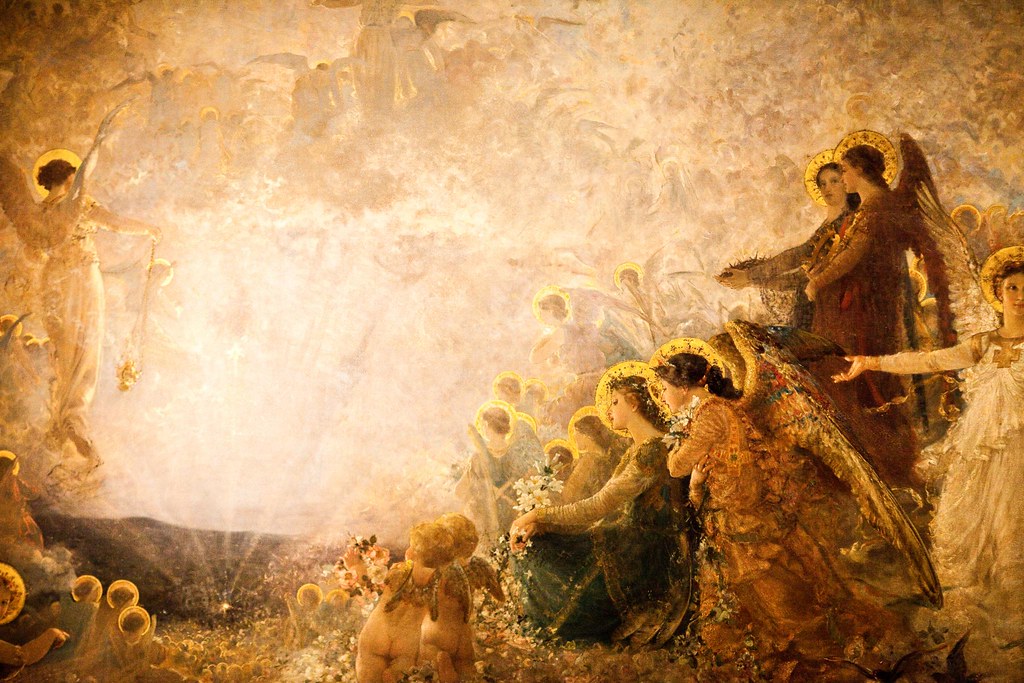
When I first saw this painting a few years ago at the Brooks Museum,
I thought it was amazingly beautiful.
It's huge (over 6.5 x 9.5 feet) and splendid, so you can't walk by without stopping to look.

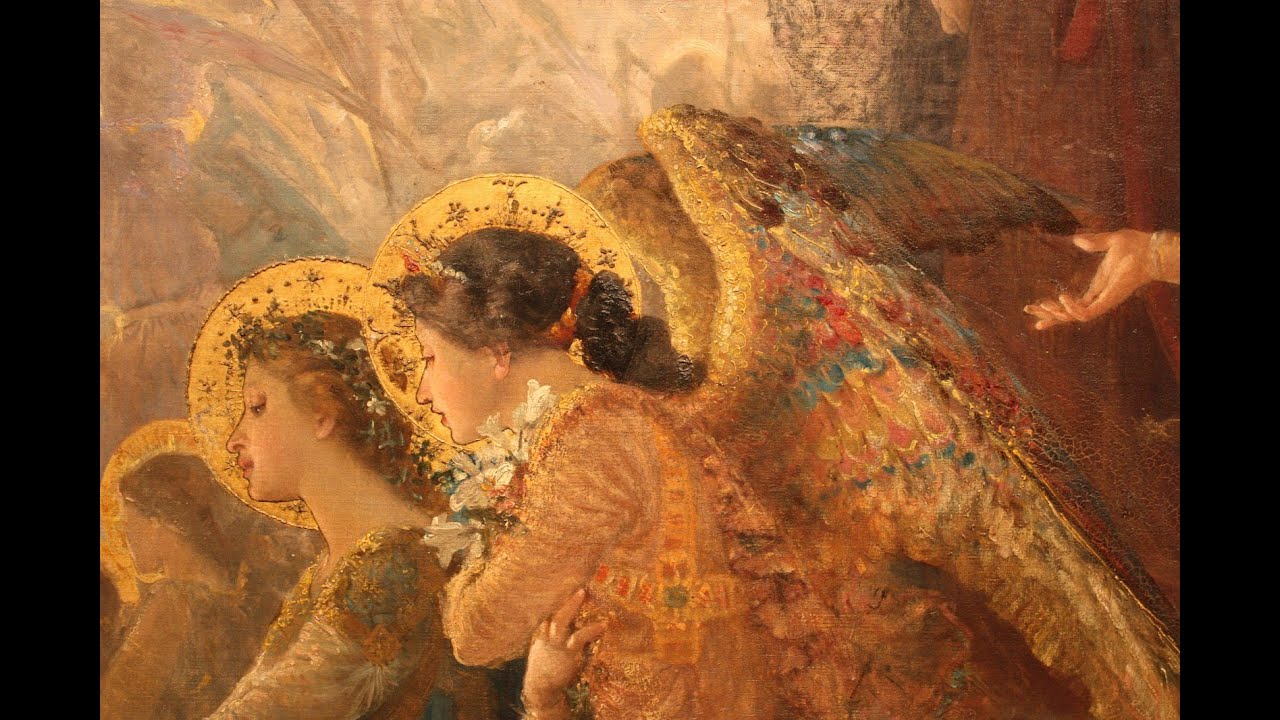
(It is so large, it is hard to find a full copy of it on the Internet. The first I've posted, which comes from this lovely blog, has the whole painting; the second has better lighting but not the whole thing.)


And when I stopped and looked, I saw the title was "Light of the Incarnation."
Only then was I able to see that (almost) all the angels are looking down, way down,
to the source of light in the left-hand lower corner.
And then the painting began to say more and more, beyond
"There's a bunch of beautiful angelic figures in lovely lighting."

It brought to mind the words from Luke's gospel, after one angel had appeared to the shepherds,
announcing the birth of a baby who was a Savior.

And suddenly there was with the angel a multitude of the heavnly host
praising God and saying,

"Glory to God in the highest,
and on earth peace among men with whom he is pleased!"

It brought to mind from John's gospel, "The light shines in the darkness,
and the darkness has not comprehended it."

And that fascinating passage in I Peter,
"It was revealed to them that they were serving not themselves, but you,
in the things which have now been announced to you by those
who preached the good news to you through the Holy Spirit sent from heaven,
things into which angels long to look."

And then, looking longer at the painting, I saw that
a crown of thorns is held out by one angel, symbolizing the crucifixion;
and a golden crown, symbolizing victory.


and lilies are held by another, symbolizing the resurrection;


and incense by another, symbolizing prayers and the holiness of the event.
(At least I think that's what it is....)


These symbols are powerful, representing the whole story to come,
set in motion long before the moment captured by the painting.

But I think the most powerful part for me when I've seen it is simply that you can't
look anywhere without seeing angelic forms. They fade in and out as you stand and look.
(Take time to enlarge the photo and look at it closely so you can see them.)

Granted, they are more representative of beautiful women with wings than they are of
the angels described in scripture, in those few places where they are described.
But even in this romanticized form, they serve an important purpose.

We so easily fall into thinking that only what we can see or hear or taste or touch is real, 
which our own scientific approach should warn us about, since before the magnifying glass,
many things that were not known by the senses were very much real, both making life possible (oxygen) and killing people (bacteria, germs, etc.)

The fact that we did eventually develop magnifying glasses, telescopes,
and all kinds of technologies that have expanded our ability to know things through our senses,
doesn't assure that we will be able to do that for every reality that exists.

And when I read things written by those who lived before all these technologies--
those who had access to all kinds of spiritual and philosophical writing,
but not to what we today consider scientific writing--
I often think that they saw and understood more than we do today.
They knew so much about life and love, humanity and hope, purpose and peace.
Some today may laugh at them for believing in angels.
But we really don't know who will have the last laugh, do we?
I only hope it will be laughter of joyful goodness, not the cynical laughter of "See, I was right."

The very word "Incarnation,"
signifying that something that was not made of flesh is being made into flesh,
assumes that there are realities beyond what we can experience in a purely fleshly way,
through those five senses we are taught to identify and name in elementary school.
It assumes a realm that is more than flesh, or beyond flesh,
a realm that can inhabit flesh at will but is not limited to it.

The new quotation under the title of my blog comes from a man who writes often about the realness of the realm that we cannot see with our eyes in the way we think we'd like to.

And here another author shares the story of a man who seems to have had the ability to see angels. The story of his life seems to indicate that perhaps we have lost the ability to see some things
by the way we have focused so intensely on seeing certain things in certain ways,
and creating strong rules about what is possible and what is not possible.
I urge you to take the time to read it.

We trust our eyes, our sight, so much. Perhaps too much?
Today I heard a car pull into our driveway. My husband said, "Oh, here comes your friend."
Because of the circumstances, I was thinking only of friends of a particular group, and when I looked out the window and saw this woman walking towards our door,
I actually had no idea who she was. I didn't recognize her.
I didn't see her. I saw a stranger.
Once she got to the door and came in, and I heard her voice,
I knew exactly who it was, and when I saw her face, I saw her, not my ideas about her.
(She is a dear friend but not part of the group I had in mind, not what I expected.)

And so this painting, this Light of the Incarnation, has become a favorite of mine
because it is a reminder that I cannot see everything, know everything,
understand everything, explain everything.
A reminder that forces are at work that I will never know about.
That my life is part of a huge painting that I could never paint on my own.
And it is a beautiful, light-filled painting.

Painted by Carl Gutherz, a man who was born in Switzerland and lived part of his life in Memphis.
About the painting, he wrote,
"Up to the moment of the birth of Christ, the light of God came from heaven to earth--
but, God here, the light glows back from earth to heaven,
increasing in glory throughout the ages.
Beholding this, the heavenly host unite in rejoicing over the world redeemed."

(from Carl Gutherz: Poetic Vision and Academic Ideals, ed. Masler and Macini.)

Joy to the World!


Monday, April 28, 2014

Inifinity in My Lap: Healing Art


So, I spent the greater part of Thursday in a relatively small room filled with big moments. I had more fun that day than I'd had in I don't know how long. As a child, like most children, I loved to draw, color, paint, cut, paste, whatever. But in high school, we had to choose between chorus and art classes, and I always sang. And visual art, beyond photography, just didn't have much of a chance in my schedule. Then in college, I took one drawing class and fell in love with "making art," as the artists say. (For some reason, I never heard that expression until the past few years, and it still sounds a little odd to me. I tend to think of "doing art," for whatever reason....and look what I just found, piqued by curiosity about that phrasing.)

Our teacher was amazing. She has a real gift for what she does and for teaching it to others. Her warm, compassionate enthusiasm was contagious.


Of course she was teaching/lecturing part of the time, but she also gave us projects to do. And it was so neat, how people got so engrossed in what we were doing. The room just felt different when everyone was focused on their own little creation, music was playing quietly, and no one was talking.


These oil pastels were our friends for the day. I felt like I was back in elementary school. I still remember how exciting it was the first time I had a box of 64 crayons!


We partnered with the person sitting next to us and played "scribble chase." One person leads with a scribble/doodle, and the other follows. A great ice breaker.

I led on this one. My only thought was to do more than go round and round, so I did some other things. It kind of wound up looking like a face, didn't it?


My partner, who became my friend in the course of the day, led on this one. It was more relaxing, just going round and round. And I like how our pinks look together.


The next thing we did was the "inside and outside the square" piece that I described in the previous post.

And for the next one we were instructed to just doodle until she said "stop." It wasn't very long at all. My original doodle was just the curve you see below that forms the main part of the bass clef sign.

Then we were to think of three things we could make from the doodle, and not begin doing anything with it until we had three ideas. (Generating ideas, envisioning possibilities....important stuff in therapy.....)

Once we had three ideas, we were to choose one of our ideas and continue making something from our doodle.

Well, I liked two of my ideas so much that I did both of them, and the next thing I knew, I had the beginning notes of the main theme of Beehoven's Ninth and an angel together on the page, with joy in various languages, and beams of light coming from the heart of the angelic figure.

At some point I thought how strange it was, with the things going on in my life lately, that I would be creating art so full of light and joy and music. Was I in denial? I wondered. But I just kept adding beams of light and then the bass clef-y doodles to frame the piece, and I knew I was not in denial. There are hard things going on, some very hard things, but the light and joy overcome the darkness.


So then I added the "o magnum mysterium" to the mix, because it is rather mysterious how light and dark, joy and sorrow, can be so mixed in one mind and heart. And because I know that for me it is the great mystery of the Incarnation, and all that follows from it, that makes it possible.

When Lisa came around to see what we were doing and talk briefly with us about our work, she asked me, "So how far do the rays of light extend beyond the page?" I looked up at her and after a moment's pause said, "Infinitely. Because even though it looks like an angel, this is the heart of God, and the light is infinite."

And that is why I want to do more art in my therapy. Because I didn't even have that in mind when I was drawing these images. Not consciously. I was just going with the doodle and seeing what I could do. I drew hearts because I am not good at drawing faces, and  it seemed like a good way to not have to draw a face but still represent an angelic figure.

But somehow, making things with our hands has a way of going deep into our minds and heart and pulling things out.

And sometimes when doing that, infinity kind of. . . drops into one's lap.


Saturday, April 26, 2014

Infinity in My Lap


"Infinity kind of...drops into one's lap."

That's Stratford Caldecott trying to describe to Ken Myers those moments when we are struck with the infinite nature of the cosmos, and how we are a part of it and are touched by it. How children seem to experience those moments more frequently, and how we as adults can learn to be more open to them.

I was listening to the interview this past Wednesday while driving from Memphis to my home town in Arkansas. This time of year the fields are piercingly green as the early evening light does its magic with their chlorophyll.

At certain moments I felt infinity dropping into my lap, perhaps bumping on the steering wheel as it came. It was early evening. The sun was still high enough to not be right in my eyes, but it was dropping, and it shone on the fields and through the trees at an angle that just made them magical. I wanted so much to stop and take pictures! But I knew if I did, I risked letting the sun get to the point that I would not be able to see, because I was driving almost due west the entire trip, and if that evening sun got any lower, I would be blinded.

So I kept driving, marvelling at the beauty. When I came near the White River and saw the red clover growing thickly all along the sides of the road, it was all I could do to just keep driving.

I was going this way partly to visit family, and also because of a professional seminar on "The Secrets to Using Art as a Healing Process," by Lisa Mitchell.  As soon as I saw the brochure about it, I knew I wanted to go.

So you probably won't be surprised at one of my pieces of art done on the following day. The instructions were simply to draw a square. Then to fill it with color, line, and texture. And then to take something from inside the square and move it outside the square. Here's what showed up on my pice of paper. . . .


The words came to me from the recesses of my mind, from a song my chorus sang in high school. If I can get it to work, you can listen to it here: