Showing posts with label Gerard Manley Hopkins. Show all posts

Monday, December 17, 2018

Watching and Waiting: Fire


(I had nearly a whole long photo essay ready to post, and somehow with a click, I lost it all. So tonight, Gerard Manley Hopkins to my rescue.From The Wreck of the Deutschland, Part 3.)


              Now burn, new born to the world,
              Doubled-nature'd name,
The heaven-flung, heart-fleshed, maiden-furled
              Miracle-in-Mary-of-flame,
Mid-numbered He in three of the thunder-throne!
Not a dooms-day dazzle in his coming not dark
                    as he came;
               Kind, but royally reclaiming his own;
A released shower, let flash to the shire, not
                    a lightning of fire hard-hurled.


Friday, August 04, 2017

Pied Beauty and the Comfort of the Resurrection


That's the Bald Knob Bulldog above. In my mind it's the Bald Knob Bulldog Cafe', despite the sign calling it a restaurant. I'm not sure how that discrepancy came about, but I'm willing to bet that I'm older than that sign, so I'm guessing that it used to be called, and perhaps have a sign saying that it was, a cafe'. I just did a quick Google search and learned that other people have also searched the the Bulldog Cafe in Bald Knob, so I think it must have been called that at one time.

Anyway, I was there this evening. My daddy flew home today from a grand adventure that took him to Rome, Zagreb, Cakovec (where he stayed in our home for a couple of nights), and then a town called Cluj in Romania (where he taught English for several weeks), and to Hungary (where he visited friends made many years ago.) He came home today from all this travel in faraway places. His flight from Europe was delayed, causing him to miss his flight home last night. So he spent the night in the airport and arrived here with almost no sleep in 48 hours.

He amazed me by having the presence of mind and energy to want to go to the AT&T shop to be sure his Europe phone service was terminated, and to go by the truck dealer to schedule an oil change. I drove him on those errands, then we came home. He went out to his garden and picked tomatoes and eggplant and squash. Then we ate supper.

And then he brought up the idea of going to get a strawberry shortcake in Bald Knob. So we did it. Except I learned that they also make peach shortcakes, so I got peaches rather than strawberries. Which was a hard decision to make, because strawberries are wonderful and famous in these parts. But peaches are my favorite, so that's what I had.

A trip to the Bulldog was the perfect ending to a lovely day dedicated to coming to Arkansas. As soon as I crossed the Mississippi River, I felt that wonderful sense of freedom that comes when you see the green masses of trees, the wide open fields, the dirt and gravel roads wandering through them.

Today I was listening to lectures (a graduation gift from my thoughtful husband) on Gerard Manley Hopkins and his poetry as I drove, hearing Fr. Joseph Feeney read poems of Hopkins' Wales surroundings, the hills, the birds, the fields, the sky. And all around me were fields, sky, birds--and even lovely hills, once I came to Crowley's Ridge. It made the drive even more beautiful than usual.

And then I made a stop that made me love Arkansas even more. I wanted to get balloons as a little surprise when Daddy would arrive at his house. I was short on time, and I really wanted to avoid the crowds of WalMart if I could. So when I saw a little local florist sign in Bald Knob that said "more than flowers," I thought it was worth a try. You never know just what to expect when you go into a place like that in a small town (fewer than 3,000 people in 2010). It was actually a large-ish building for a florist, obviously a new business in an old building that used to house some other kind of activity, maybe a farm supply store, given the amount of farming in that area. It was large and fairly plain, except that the new owners had painted huge flowers on the outside of the building, giving it a whimsically charming homemade beauty. You can see a picture near the bottom of this website.

Hoping they had balloons, and that I could get some quickly, I walked in the door to see no one behind the counter. No doorbell rang, no voice called out, no one appeared. I had just begun to wonder if I should go back to the car when out of the back came a little brown-haired boy who hurried right over, looked up at me, and threw his arms around my legs to give me a hug, his head reaching a little above my knees!

I think he said something, but I don't remember what. I don't remember what I said, either. I just remember that he was terribly sweet, and even though I couldn't always understand what he said, he responded to my greetings and questions; and once I had learned that he was three years old and that his mom had gone to the store, he went back to where he had come from behind the counter, and out came a woman who I believe was his aunt.

This all took a very short time, less time than it has taken to write about it and probably less than it will take you to read it. I mention that so that no one can get the idea that he was neglected or unsupervised.  He clearly was not. He was just fast!

Happily I did order balloons that they did in fact have, and the whole time carried on a funny conversation with this sweet child, whose mother arrived during my few minutes there. When it was time to pay and go, he was in the back of the shop again. He obviously heard something I said about leaving, because he stopped talking with his mother and said, "Wait! I have to go give a hug!" And he ran out from behind the counter and hugged my legs again as before, this time looking up and blowing kisses at me. His mother and aunt gently "called him off," though of course I said it was absolutely fine with me, and that he was a sweetie pie (I think that's what I said, who knows?), and rather reluctantly, I left.

I feel sure I'll find a reason to stop there again.

Meanwhile I'm left pondering the beauty of a small town and of close circles in which a child is so loved and cared for and has no reason to feel fearful or suspicious of someone he has never seen before. Not only not fearful, but so full of love and generosity. Of course it's a messed up world, and he will learn prudent boundaries as he grows, I have no doubt. It was clear that the big people in his life love him and love life, and so I trust they will protect him appropriately.

Arkansas is a poor state, among the three poorest in the nation, according a study done two years ago. It has problems that come along with poverty. It has problems that come along with other things, too. While my drive home takes me through beautiful fields and crosses flowing rivers, it also means seeing abandoned houses, dying towns, and reminders of racial tension.

I was reading an article the other day about West Virginia, another of the three poorest states, and author John Mark Reynolds' take on some of the problems there. I couldn't help thinking about that article as I drove past some of the dying towns and wondered about the lives of the people there. I know that drugs are a problem in Arkansas, especially meth, from what I've read. Some people are desperate for meaning in their lives, and for love. Without those things, drugs become an easy choice, among the rich and the poor. And once drugs affect one person, they affect families, and then communities, and no one ever knows the full extent of the damage.

But there is beauty in this state. Incredible natural beauty. And today the beauty of a little boy who knows he is loved and cherished. And I imagine it's because of people in his life who also know that they are loved and cherished. And his little heart of love is evidence that they really believe what they have on a sign that was by the front door of the business. They haven't sold their birth right, to reference the West Virginia article. They've accepted it and are passing it on.

It's not the Memphis way of doing business, to put religious posters on the front window. It's not the big city way. It's not cool. It's probably not even allowed in some places. But who knows if having this sign on the window may not open the door to hope for some young teenage girls, leading to conversations and relationships that will save them from turning to drugs or bad relationships in search of love, or failing that, drugging numbness?

I think Hopkins would find poetry in this picture and in my afternoon encounter.  Death, disease, decay, drug addiction, dirt, and depression are as real in Arkansas as anywhere. Hopkins knew darkness and despair very well. But the Christian belief in resurrection, which he so powerfully describes in "That Nature is a Heracletean Fire and of the Comfort of the Resurrection," is paramount in his poetry and in his life. And if I am to believe that I am, ultimately, "immortal diamond," I must have opportunities and the ability to see that hope. "Across my foundering deck shone a beacon, an eternal beam." People need a beacon shining. They need to see that beam.

I hope they keep that poster there. I hope it blesses girls who need to see it. And I hope their little boy becomes a grown man who loves with passion and prudence because he knows that he is cherished, that Christ became what he is, and he will be what Christ is, and that this life is only part of a Life we can't begin to imagine. You can handle a whole lot of what life gives you when you know that.


Tuesday, April 22, 2014

Hopkins Still Hovers


I've just come across in my inbox a long, lovely article about Gerard Manley Hopkins, his life, his faith, and his poetry. I haven't even had to time to do more than skim it, but I'm putting the link here in case you want to read it and so that I can come back and read it with no chance of losing the link.

"....Hopkins’s genius is to make a poetic virtue out of the contradiction between dogma and experience. The designs of providence, running athwart appearances (and our wishes), require the orthodox to look again at the world, to see it in new and original ways. When dogma and experience are read into and against each other, they license—they do not foreclose—an idiosyncratic and creative vision."

(I did not take the photo. It came from here, where there are several others, and they are wonderful.)

Sunday, December 15, 2013

La Nebbia

I remember foggy mornings in Arkansas. Not a whole lot, but it seems like sometimes when we went to school early, there would be fog in the valleys of the very hill-and-valley terrain between home and school. I always thought it was beautiful and mysterious.

And I really remember fog in northern Italy. Where they had to put special reflective paint and markers all along the roads for miles, because the fog was responsible for multiple deaths when drivers simply could not see well enough to realize another car was coming right at them. And then more cars could not see the accident ahead, and it would just start a pile-up.  So the markers were indications of how slow one ought to drive. (If you can see three markers, you can go x kilometers per hour, but if you can see only two, better slow to x km, and so on.)

Of course Venice in the fog was like a dream. Beautiful, mysterious, other-worldly. (And could get your clothes wet, too.)


Back in an earlier job setting, I worked with a group of people who struggled with various life situations. We would start each meeting with a check in. Rate your general mood with a number, and rate your general "brain fog" with a number. Brain fog became a frequent topic of our conversation. Because when you're depressed, not sleeping well, feeling confused and close to hopeless about your future, thinking clearly does not come easily.

Thus, brain fog.

I find that this year of my life has brought a lot of brain fog. Which is funny, because I am working on a doctorate now, so of course I have to think clearly enough to do that work. But the stress of that along with other significant stressors have made for a year with almost no consistent routine (and brains thrive on routine), along with the sorts of chemicals that stress pumps into the brain that further foggify it.

(The computer is telling me that "foggify" is not a word. It doesn't know that Gerard Manley Hopkins is my blog's patron saint, obviously, and I shall use words as I choose.)

Anyway, I went for a walk a while back (one of the routines I lost this month with some severely cold weather coinciding with a moderately severe nerve condition that makes being cold something to avoid at all costs for now.), and it was a gorgeously foggy morning.

Beautiful, mysterious, and like brain fog, made it very hard to see clearly.


And the "sacred bench," as I've come to think of it, just struck me as so beautiful.


Perhaps because it is on land surrounded by water, it showed up more clearly than most of the rest of the park. There was less fog where it was.

And even though I was there alone, the bench was a symbol to me of what had helped get me through the brain fog of this past year, and that of many other times in my life. It's the people who will sit down with you and just be there to talk and listen and share and care. That loving care helps clear the fog, brings light into the mind, makes it possible to remember the fog is temporary. The mind will return to its normal functioning.

Richard Stivers has written a fascinating book called Shades of Loneliness, in which he ponders the likelihood that our disconnected society (largely related to technologization) is at the root of much of mental illness. I think he is largely right in what he has written. If more people had sacred benches on which to sit, or people to walk with in the park, I feel sure we'd have less need for the kind of work I do.

I'm thankful for the people who walk and sit with me and help clear the fog from my brain from time to time--sometimes it takes more than once a day.

"Nebbia" is Italian for fog. Where our "nebulous" comes from. And just as fog can be yucky, like brain fog, it can also be beautiful. So I picked a nebulous title for it.

For another foggy post with more photos and a poem with much sadder sentiments, see "Im Nebel."


Saturday, October 19, 2013

Lux Aeterna


A little over ten years ago the music above entered my life. From the first measure, I loved it. It is Morten Lauridsen's "Lux Aeterna," and we sang it in the Rhodes Mastersingers Chorale.


Here is my music, placed in front of my preludes and fugues, one of the first books of music I bought when taking piano lessons from Mrs. White back in high school. After I got a CD of the Lauridsen music, I took it to her house on a visit home, and told her she was going to love it. As we listened, during that very first long, high/low note you see above, she whispered, "I already love it!"

The night we performed it, with Lauridsen himself present, I thought about my high school English teacher, Ray Wright, and how much he would love this music. He was in a coma at the time, though I did not know it, and a few days later I attended his funeral.

I've written a whole article on that year, so I won't go into detail here. But over the next six months, my grandmother died, a precious young cousin died by suicide, an old friend was murdered, and a close friend my own age unexpectedly died shortly after giving birth.

It was a very hard year. I found odd comfort in Hopkins' comfortless sonnet:

No worst, there is none. Pitched past pitch of grief,
More pangs will, schooled at forepangs, wilder wring.
Comforter, where, where is your comforting?
Mary, mother of us, where is your relief?
My cries heave, herds-long; huddle in a main, a chief
Woe, wórld-sorrow; on an áge-old anvil wince and sing —
Then lull, then leave off. Fury had shrieked 'No ling-
ering! Let me be fell: force I must be brief."'

    O the mind, mind has mountains; cliffs of fall
Frightful, sheer, no-man-fathomed. Hold them cheap
May who ne'er hung there. Nor does long our small
Durance deal with that steep or deep. Here! creep,
Wretch, under a comfort serves in a whirlwind: all
Life death does end and each day dies with sleep.


Of course, with time and a lot of love, hearts can heal, and mine did.

Last year, nine years after that beautiful music came into my life, and those beautiful people left my life, I was working on a paper for school, and I found a way to work this Hopkins poem into it (only partially cited here):

Man, how fast his firedint, | his mark on mind, is gone!
Both are in an unfathomable, all is in an enormous dark
Drowned. O pity and indig | nation! Manshape, that shone
Sheer off, disseveral, a star, | death blots black out; nor mark
                           Is any of him at all so stark
But vastness blurs and time | beats level. Enough! the Resurrection,
A heart's-clarion! Away grief's gasping, | joyless days, dejection.
                            Across my foundering deck shone
A beacon, an eternal beam. | Flesh fade, and mortal trash
Fall to the residuary worm; | world's wildfire, leave but ash:
                            In a flash, at a trumpet crash,
I am all at once what Christ is, | since he was what I am, and
This Jack, joke, poor potsherd, | patch, matchwood, immortal diamond,
                            Is immortal diamond.

Well, the marks these people left on my mind were not gone, but I was able to find great comfort and joy in the hope of resurrection.

While working on that paper, my beloved piano teacher was in a coma, and this time I did know it. I so hoped to see her once again, but did not. Tomorrow will be the anniversary of her death.

And thus this post, as tonight I reflect and remember these beautiful people and the blessings they have been to me and to many others.

Music is everywhere, so I trust they are enjoying beautiful music even now, as we wait for the flash and the trumpet crash and the Day when all immortal diamonds will shine in splendor in the presence of the Lux Aeterna.


Wednesday, September 25, 2013

Morning Has Broken


Many mornings I start the day with a walk.

This morning was no exception--except for the major exception that I am in Eureka Springs, and my walk took me from the top of an Ozark "mountain" down a long dirt-gravel road into a valley. I was the only person I could see the whole time I was out, except for the man on his porch that I saw on my way back up out at the top of the road.

So for an hour or more I walked around and saw no one else, heard no one else. Only birds, the scampering of a squirrel now and then, the insect sounds. Oh, even a crow cawing at one point. "Blackbird has spoken, like the first bird....."

How to describe the light coming through the air as it was when I took this photo? I felt like Saul on the road to Damascus, or perhaps a character in a Lord of the Rings novel. The light was alive. The morning was alive. I was alive.

Reminds me of a Hopkins poem, one of his better known. One I resonate with so much, because I live in a city and am often reminded of how "all is seared with trade; bleared, smeared with toil...." It is beautiful to be in a place where you can forget that for a while.

And morning is always a reminder that God is at work, sustaining what is, and also making things new.

Oh, morning, at the brown brink eastward, springs--
Because the Holy Ghost over the bent
     World broods with warm breast and with ah! bright wings.

 --Hopkins, "God's Grandeur"
   

Friday, May 17, 2013

Towery City


It's been a long while since I quoted any Hopkins on my blog, and many readers may not even realize that the name of my blog comes from him.

Tonight I am for whatever reason thinking of the towers of Italy, Monteriggioni (above) being perhaps the most towery city I've seen there. San Gimignano may have more towers? not sure--but Monteriggioni has the most impressive arrangement of them, still intact.

Hopkins wasn't writing of either Italian city in his poem, but of Oxford, and was imagining the time when his hero, Duns Scotus, walked those streets and breathed that air. A man who "of all men most sways my spirits to peace."

For me, thoughts of Italy often sway my spirits to peace. It's not because Italy is perfect, or especially peaceful generally. Its cities can be chaotic and maddening at times. But because in recent years my trips there have been just that--trips--they have been peaceful. I wasn't working there, I wasn't going to teach a class or do a workshop, but just being there, seeing friends, taking it in. And of course in the countryside, it is breathtakingly beautiful, a peace-inducing sort of beauty.

A few years ago I spent three days in Assisi by myself and was able to follow the footsteps of Francis and Claire. Those were tiring days (I did a lot of walking! and much of it uphill!) but also very peace-filled days.

These days, I keep a photo on my desk at work of the view from Claire's prayer garden, a place where she used to pray, and a place where I stood briefly, once upon a time.

It's funny that I wrote "once upon a time." I only meant to say that some time back I stood there. But the phrase actually hints at what I want to say about why I keep the photo on my desk. It is a professional photo. a postcard I bought, and so as a photo it is quite close to perfect. And it is in a frame, which sets it apart. And so it is easy to see it there on my desk and think of it as "once upon a time in a land far, far away," as if it were not quite real.

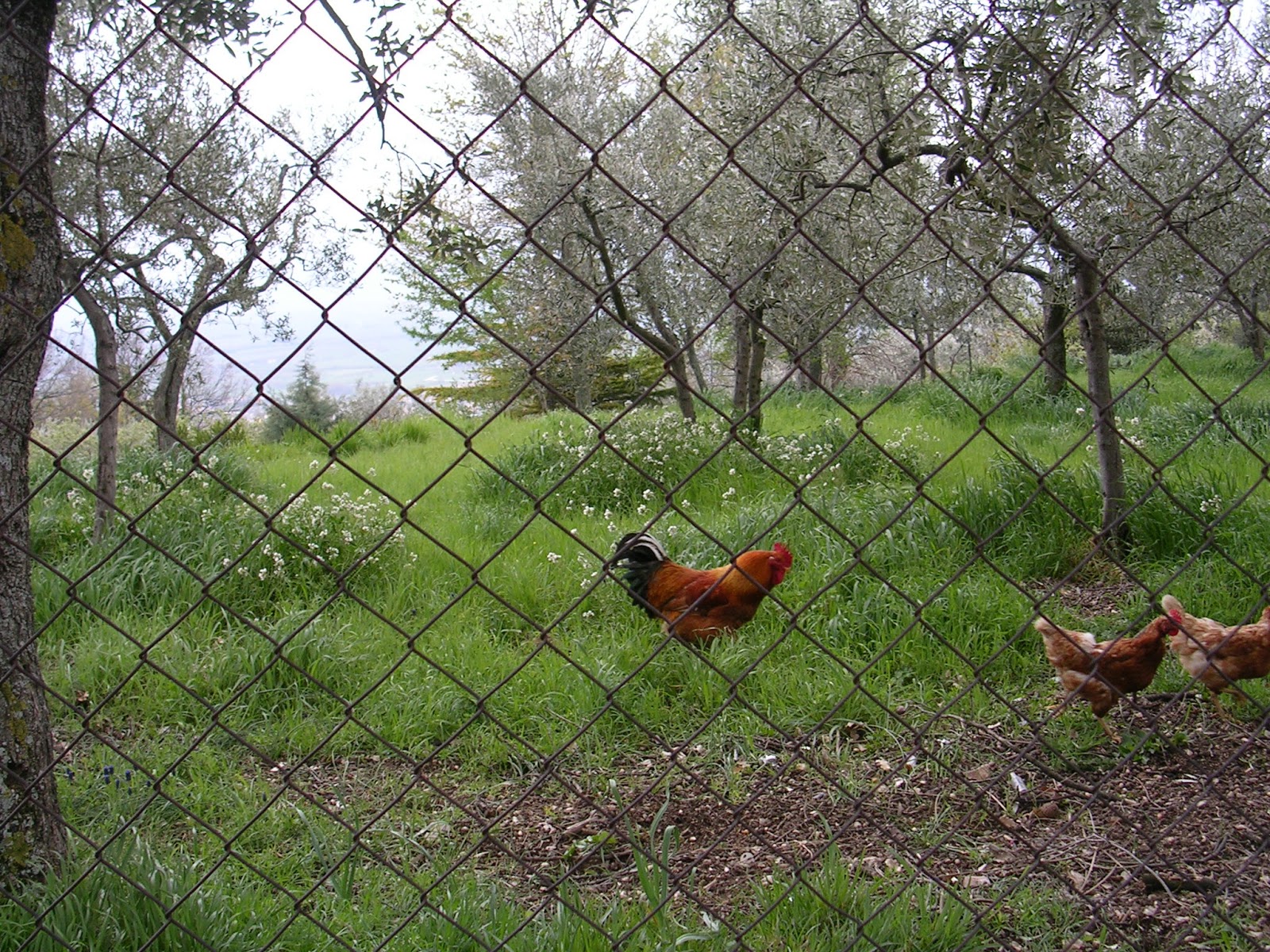
But the truth is that I stood in that very spot, could have taken that picture myself if there had not been other people around me. And it wasn't once upon a time. It was five years ago. It isn't a land far, far away. It's a real place. Francis and Claire were real people who really lived and prayed and worked there, and I really walked in that city, felt the wind blow in the olive grove, watched the chickens pecking at the grass just as they do in Arkansas or Croatia, and I really did feel the peace and exhilaration of those days in Assisi and of the rest of my trip five years ago.

So when I look at that photo on my desk, I use it as a discipline. For one thing, it reminds me to pray. For another, it reminds me that whatever is going on right now, whether in my own life or in the lives of my clients, that may be difficult, distressing, or downright awful--whatever may be going on here and now--that is only one part of reality.

I often tell my clients when they are overwhelmed by the present, or by parts of their past, that if they can remember some good time, some time when life was simpler, or more joyful, or more peaceful, then they really must believe that those times were just as real as what is going on now that is so hard. They may seem long ago and far away, but they were every bit as real as the difficult present.

And, I tell them, from a metaphysical standpoint, they may have even been more real. Because love and joy and peace are things that will last forever. Pain is not. Evil is not. Suffering is not. They will not last, so in a sense they are less real. And my clients owe it to themselves, and to truth, to remember that and be strengthened by it.

And that is why I keep that picture from Assisi on my desk.

(Even though the picture above is Monteriggioni. I suppose after going in the direction I did with my writing that I should include some of Assisi five years ago. It's a fairly towery city itself.)


And here, for those interested, is the poem from which my blog got its name:

TOWERY city and branchy between towers;
Cuckoo-echoing, bell-swarmèd, lark-charmèd, rook-racked, river-rounded;
The dapple-eared lily below thee; that country and town did
Once encounter in, here coped and poisèd powers;
 
Thou hast a base and brickish skirt there, sours       
That neighbour-nature thy grey beauty is grounded
Best in; graceless growth, thou hast confounded
Rural rural keeping—folk, flocks, and flowers.
 
Yet ah! this air I gather and I release
He lived on; these weeds and waters, these walls are what        
He haunted who of all men most sways my spirits to peace;
 
Of realty the rarest-veinèd unraveller; a not
Rivalled insight, be rival Italy or Greece;
Who fired France for Mary without spot.