Showing posts with label reality. Show all posts

Saturday, April 01, 2017

Little Things

This time of wrapping up such a huge project,
beginning to free up brain space and actual time and space,
combined with the coming of spring,
seems a perfect setup for me to be particularly attentive to little things
and how much joy they give me.

Some days I feel as if I am seeing life, really seeing it,
for the first time in a long, long time.


Like a peek into the opening of a dogwood blossom the other morning.


And the little remaining evening light falling on the chair at the piano.


And this little walkway, which, even though I know exactly where it goes, always fills me with a sense of adventure and wonder at what might lie ahead. . .


Violets that fill our yard, and these few just perfect for the tiny pitcher on the windowsill.


Also on the windowsill, there year-round,
these sweet little ones from my parents' stop in the Amsterdam airport over twenty years ago.
They are always there, but somehow recently I see them more often.
And on this evening saw their cute little shadow.

Little things are only little compared to bigger things.
And often they represent things much bigger than their physical size hints at.

I read recently that the writer Robert Brault,
about whom I know nothing,
said,
"Enjoy the little things, for one day you may look back
and realize they were the big things."

Whoever he is, I think he is right.


Tuesday, January 05, 2016

Light of the Incarnation

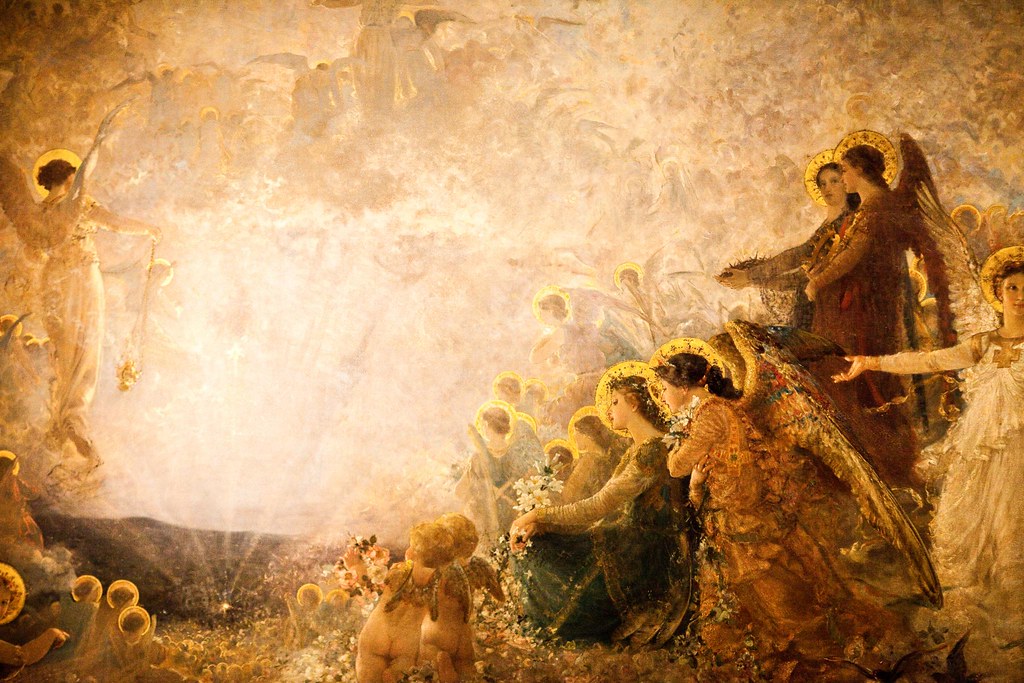
When I first saw this painting a few years ago at the Brooks Museum,
I thought it was amazingly beautiful.
It's huge (over 6.5 x 9.5 feet) and splendid, so you can't walk by without stopping to look.

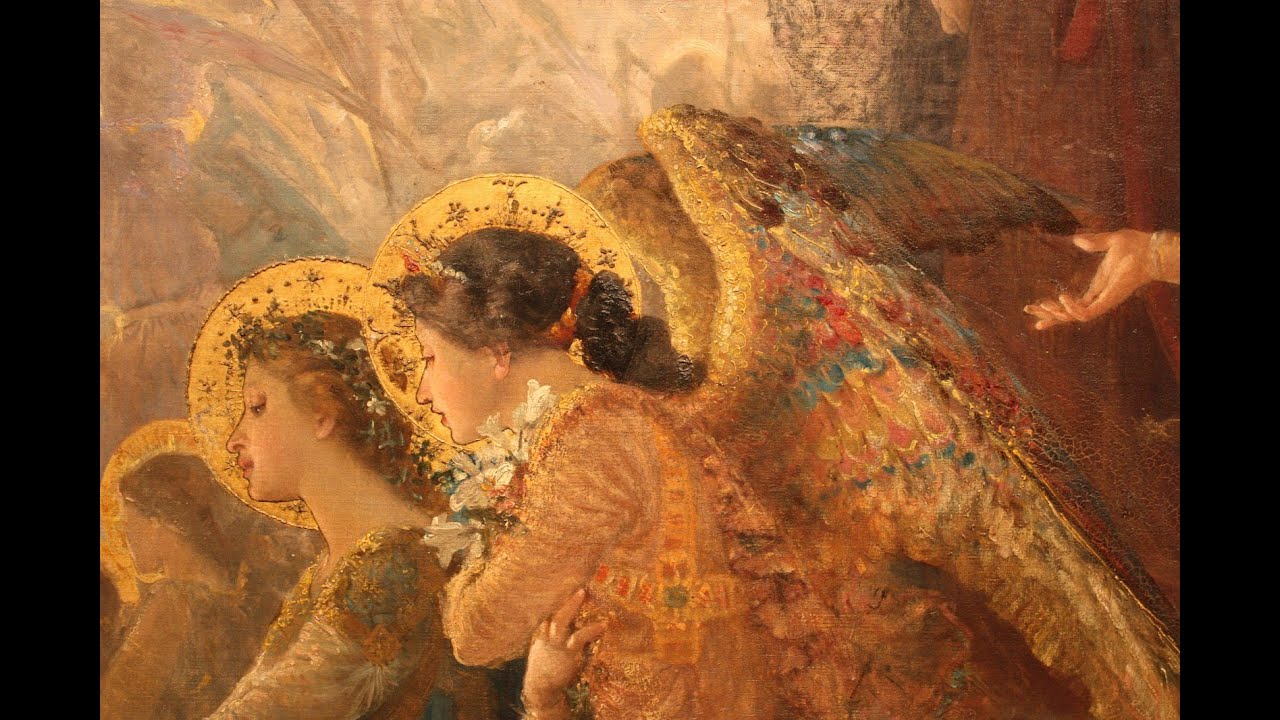
(It is so large, it is hard to find a full copy of it on the Internet. The first I've posted, which comes from this lovely blog, has the whole painting; the second has better lighting but not the whole thing.)


And when I stopped and looked, I saw the title was "Light of the Incarnation."
Only then was I able to see that (almost) all the angels are looking down, way down,
to the source of light in the left-hand lower corner.
And then the painting began to say more and more, beyond
"There's a bunch of beautiful angelic figures in lovely lighting."

It brought to mind the words from Luke's gospel, after one angel had appeared to the shepherds,
announcing the birth of a baby who was a Savior.

And suddenly there was with the angel a multitude of the heavnly host
praising God and saying,

"Glory to God in the highest,
and on earth peace among men with whom he is pleased!"

It brought to mind from John's gospel, "The light shines in the darkness,
and the darkness has not comprehended it."

And that fascinating passage in I Peter,
"It was revealed to them that they were serving not themselves, but you,
in the things which have now been announced to you by those
who preached the good news to you through the Holy Spirit sent from heaven,
things into which angels long to look."

And then, looking longer at the painting, I saw that
a crown of thorns is held out by one angel, symbolizing the crucifixion;
and a golden crown, symbolizing victory.


and lilies are held by another, symbolizing the resurrection;


and incense by another, symbolizing prayers and the holiness of the event.
(At least I think that's what it is....)


These symbols are powerful, representing the whole story to come,
set in motion long before the moment captured by the painting.

But I think the most powerful part for me when I've seen it is simply that you can't
look anywhere without seeing angelic forms. They fade in and out as you stand and look.
(Take time to enlarge the photo and look at it closely so you can see them.)

Granted, they are more representative of beautiful women with wings than they are of
the angels described in scripture, in those few places where they are described.
But even in this romanticized form, they serve an important purpose.

We so easily fall into thinking that only what we can see or hear or taste or touch is real, 
which our own scientific approach should warn us about, since before the magnifying glass,
many things that were not known by the senses were very much real, both making life possible (oxygen) and killing people (bacteria, germs, etc.)

The fact that we did eventually develop magnifying glasses, telescopes,
and all kinds of technologies that have expanded our ability to know things through our senses,
doesn't assure that we will be able to do that for every reality that exists.

And when I read things written by those who lived before all these technologies--
those who had access to all kinds of spiritual and philosophical writing,
but not to what we today consider scientific writing--
I often think that they saw and understood more than we do today.
They knew so much about life and love, humanity and hope, purpose and peace.
Some today may laugh at them for believing in angels.
But we really don't know who will have the last laugh, do we?
I only hope it will be laughter of joyful goodness, not the cynical laughter of "See, I was right."

The very word "Incarnation,"
signifying that something that was not made of flesh is being made into flesh,
assumes that there are realities beyond what we can experience in a purely fleshly way,
through those five senses we are taught to identify and name in elementary school.
It assumes a realm that is more than flesh, or beyond flesh,
a realm that can inhabit flesh at will but is not limited to it.

The new quotation under the title of my blog comes from a man who writes often about the realness of the realm that we cannot see with our eyes in the way we think we'd like to.

And here another author shares the story of a man who seems to have had the ability to see angels. The story of his life seems to indicate that perhaps we have lost the ability to see some things
by the way we have focused so intensely on seeing certain things in certain ways,
and creating strong rules about what is possible and what is not possible.
I urge you to take the time to read it.

We trust our eyes, our sight, so much. Perhaps too much?
Today I heard a car pull into our driveway. My husband said, "Oh, here comes your friend."
Because of the circumstances, I was thinking only of friends of a particular group, and when I looked out the window and saw this woman walking towards our door,
I actually had no idea who she was. I didn't recognize her.
I didn't see her. I saw a stranger.
Once she got to the door and came in, and I heard her voice,
I knew exactly who it was, and when I saw her face, I saw her, not my ideas about her.
(She is a dear friend but not part of the group I had in mind, not what I expected.)

And so this painting, this Light of the Incarnation, has become a favorite of mine
because it is a reminder that I cannot see everything, know everything,
understand everything, explain everything.
A reminder that forces are at work that I will never know about.
That my life is part of a huge painting that I could never paint on my own.
And it is a beautiful, light-filled painting.

Painted by Carl Gutherz, a man who was born in Switzerland and lived part of his life in Memphis.
About the painting, he wrote,
"Up to the moment of the birth of Christ, the light of God came from heaven to earth--
but, God here, the light glows back from earth to heaven,
increasing in glory throughout the ages.
Beholding this, the heavenly host unite in rejoicing over the world redeemed."

(from Carl Gutherz: Poetic Vision and Academic Ideals, ed. Masler and Macini.)

Joy to the World!


Monday, September 21, 2015

How Out of It I've Been and Something Funny and Lovely

It seems I have now set a new record in the length of time between blog posts. From May 31 until now would be close to four months.

It's beyond my ability right now to remember whether or not I have said anything definitive on this blog about why I have written so little in recent months and even a couple of years or more.

A rather fascinating story lies behind just about everything in life, and that's true for this as well, but for now suffice it to say that around the same time I decided to return to school to work on a doctoral degree in ministry, my mom began to have significant health problems. The combination of these things has simply (and in quite complicated ways at times) demanded my focus, my time, my energy more than I could ever have anticipated.

In late April, I turned in my last paper for school. And at some point in the summer I turned in the official prospectus for my thesis. And after that all the paperwork for approval from the Institutional Review Board. I'm now officially in the thesis phase of the degree. Since I had "levelling" work to do (extra classes because I didn't go into the degree with a Master of Divinity degree already), this means I am now freer than I have been in three years. Not free, but not continually under the pressure of huge reading lists and deadlines.

So slowly, slowly, life has been shifting to a more liveable pace. I'm returning to the routines and rhythms that were interrupted pretty severely for almost three years.

And so, at some point in the late spring or early summer, I began noticing the straggling green things out in the pots on our deck, and I thought, oh, one of these days I will have time to plant flowers again. Planting flowers has not been completely neglected, but it has not been the regulary activity that it once was, so that something was blooming pretty much all year round. Where we live, it usually means pansies in the winter and impatiens and petunias for the spring and summer.

Of course I had to get that prospectus turned in and all the IRB paperwork. But in the back of my mind I was dreaming of buying and planting petunias, at least a few, to enjoy through the heat of the summer. I also remember noticing with the peripheral vision of my awareness that those plants out in the pots still had blooms, and it seemed awfully late and hot for that. Pansies don't generally make it into the summer heat in full sun.

On July 30, I finally actually walked out there and watered and weeded, thinking there was still time to plant some petunias, if I could find any for sale that late in the summer.

And for the first time, I realized . . . these were petunias!


Which meant they had been planted early LAST summer, and that I had never planted any pansies in the fall. These guys had made it through the winter and come back to life.

So, I did of course water them, and I pulled out the amazing little weeds that find their way through the air into the pots. And I pulled off the dead blooms.


And I laughed at myself and at how crazy life can get, and smiled at how beautiful it is that these flowers made it through with absolutely no help from me or anyone--just the sunshine, the soil and whatever rain fell on them over the course of most of a year. (And this was the coldest winter we've had since we've lived here.)


It felt as if they were saying, "Surprise! Welcome back!"


"We're still alive, and so are you. It's time to stretch and breathe and grow again."


I've been watering them and pulling the occasional weeds and the spent blooms, and they've continued to grow through the heat of the summer, and as the air has begun to turn toward fall's shorter days and cooler temperatures.


The spearmint from last year made it through, too, not surprisingly. Mmmmm.....


Maybe soon I'll even clean these pots so they can be as pretty as what grows in them.

And I even dare to hope that I may manage to get pansies planted for this fall and winter.

It's hard to know how to describe the past three years. A lot has happened, a lot has had to cease for a while. "Upheaval" comes to mind as a one-word description that avoids the extreme emotional content other words would carry with them.

But these flowers bring to mind other words, words that remind me in a comforting way that while my life matters, and each person's life matters in ways we surely cannot fathom, each life is also part of a whole that gives us meaning and hope and comfort beyond what we could ever come up with on our own. These beautiful words--

While the earth remains, seedtime and harvest, cold and heat, summer and winter, day and night, shall not cease.

After three years of pursuing a "Doctor of Ministry degree in missional and spiritual formation," I may have learned more about spiritual formation from these sweet petunias that came as "missionaries" to assure me of the good news that life is much bigger than my life, and strength and resilience and beauty are everywhere in the midst of it all. Even when I'm exhausted and oblivious.

Friday, May 17, 2013

Towery City


It's been a long while since I quoted any Hopkins on my blog, and many readers may not even realize that the name of my blog comes from him.

Tonight I am for whatever reason thinking of the towers of Italy, Monteriggioni (above) being perhaps the most towery city I've seen there. San Gimignano may have more towers? not sure--but Monteriggioni has the most impressive arrangement of them, still intact.

Hopkins wasn't writing of either Italian city in his poem, but of Oxford, and was imagining the time when his hero, Duns Scotus, walked those streets and breathed that air. A man who "of all men most sways my spirits to peace."

For me, thoughts of Italy often sway my spirits to peace. It's not because Italy is perfect, or especially peaceful generally. Its cities can be chaotic and maddening at times. But because in recent years my trips there have been just that--trips--they have been peaceful. I wasn't working there, I wasn't going to teach a class or do a workshop, but just being there, seeing friends, taking it in. And of course in the countryside, it is breathtakingly beautiful, a peace-inducing sort of beauty.

A few years ago I spent three days in Assisi by myself and was able to follow the footsteps of Francis and Claire. Those were tiring days (I did a lot of walking! and much of it uphill!) but also very peace-filled days.

These days, I keep a photo on my desk at work of the view from Claire's prayer garden, a place where she used to pray, and a place where I stood briefly, once upon a time.

It's funny that I wrote "once upon a time." I only meant to say that some time back I stood there. But the phrase actually hints at what I want to say about why I keep the photo on my desk. It is a professional photo. a postcard I bought, and so as a photo it is quite close to perfect. And it is in a frame, which sets it apart. And so it is easy to see it there on my desk and think of it as "once upon a time in a land far, far away," as if it were not quite real.

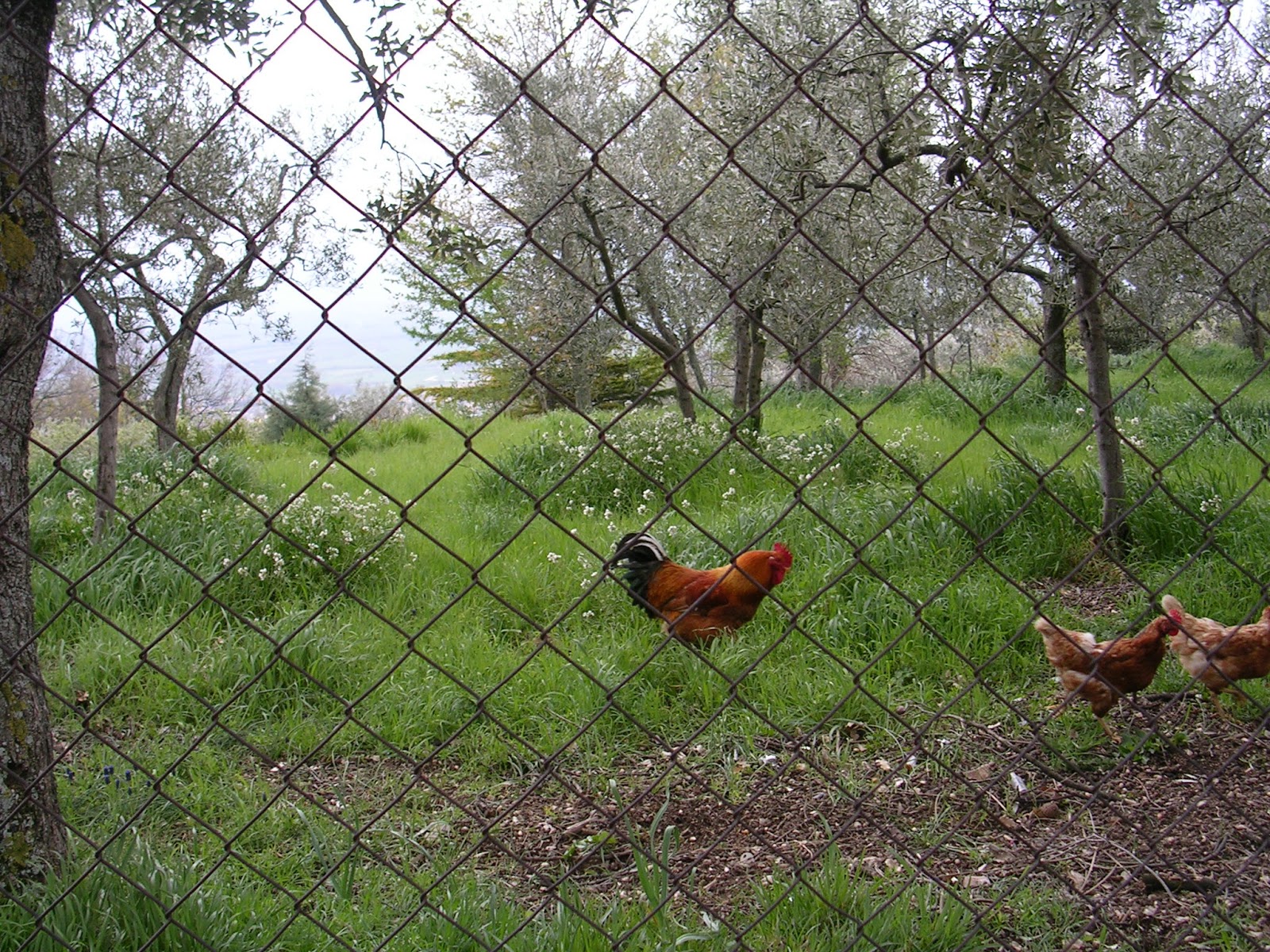
But the truth is that I stood in that very spot, could have taken that picture myself if there had not been other people around me. And it wasn't once upon a time. It was five years ago. It isn't a land far, far away. It's a real place. Francis and Claire were real people who really lived and prayed and worked there, and I really walked in that city, felt the wind blow in the olive grove, watched the chickens pecking at the grass just as they do in Arkansas or Croatia, and I really did feel the peace and exhilaration of those days in Assisi and of the rest of my trip five years ago.

So when I look at that photo on my desk, I use it as a discipline. For one thing, it reminds me to pray. For another, it reminds me that whatever is going on right now, whether in my own life or in the lives of my clients, that may be difficult, distressing, or downright awful--whatever may be going on here and now--that is only one part of reality.

I often tell my clients when they are overwhelmed by the present, or by parts of their past, that if they can remember some good time, some time when life was simpler, or more joyful, or more peaceful, then they really must believe that those times were just as real as what is going on now that is so hard. They may seem long ago and far away, but they were every bit as real as the difficult present.

And, I tell them, from a metaphysical standpoint, they may have even been more real. Because love and joy and peace are things that will last forever. Pain is not. Evil is not. Suffering is not. They will not last, so in a sense they are less real. And my clients owe it to themselves, and to truth, to remember that and be strengthened by it.

And that is why I keep that picture from Assisi on my desk.

(Even though the picture above is Monteriggioni. I suppose after going in the direction I did with my writing that I should include some of Assisi five years ago. It's a fairly towery city itself.)


And here, for those interested, is the poem from which my blog got its name:

TOWERY city and branchy between towers;
Cuckoo-echoing, bell-swarmèd, lark-charmèd, rook-racked, river-rounded;
The dapple-eared lily below thee; that country and town did
Once encounter in, here coped and poisèd powers;
 
Thou hast a base and brickish skirt there, sours       
That neighbour-nature thy grey beauty is grounded
Best in; graceless growth, thou hast confounded
Rural rural keeping—folk, flocks, and flowers.
 
Yet ah! this air I gather and I release
He lived on; these weeds and waters, these walls are what        
He haunted who of all men most sways my spirits to peace;
 
Of realty the rarest-veinèd unraveller; a not
Rivalled insight, be rival Italy or Greece;
Who fired France for Mary without spot.