Monday, December 20, 2021

Advent in Varaždin


Before writing about Varaždin, here's a picture from our neighborhood church. We got out after a night of less-than-ideal sleep and walked around to see familiar streets and houses, and to let the sunlight do its part in resetting our circadian rhythm, hoping we might sleep better the next night. (Alas, neither of us did. But we're doing okay despite that.)

It was the first time either of us had seen this wooden nativity scene, almost surely carved by some local talent. It is really nicely done, and I love seeing things made by hand. Such a refreshing break from the inflatable figures that have become so common in Memphis!


When the sun got closer to setting, we took off in the car to meet a friend who lives in nearby Varaždin, just on the other side of the bridge mentioned in yesterday's post. Varaždin's baroque architecture just made me wonder how the city might decorate for Christmas, and it wasn't disappointing. The castle was left alone, which I thought was a good idea, as it could have cost a lot to do anything that would really do justice to it. And anything less would cheapen it. It was so beautiful in the light of a nearly full moon.


The central part of the city held nothing back, though. Strung with lights, alive with stalls selling ornaments, warmed by coffee shops selling hot drinks and refreshments, it was full of people and full of life, even with temperatures requiring hats and gloves. A stage was set up with live music heard in the surrounding area. Church bells rang every so often, adding to the joyful bustle.

This is a part of Europe that I miss greatly in the States. Sometimes when I'm driving down the road, I try to imagine all the people in the cars around me as people walking by, the way it is in the cities of Europe. We miss a lot by not seeing people up close, hearing their voices, seeing parents and children holding hands, sometimes seeing expressions and eyes when close enough--all of that.

As we walked, I would look around and wonder, "Who here really knows the story of Christmas? Who knows why all this came to be?" And I just hoped that many did and prayed for all who didn't.

Because, just as in America, Christmas has been seized upon and put to use by the god of commercialization. These lovely cities and their celebrations have become tourist destinations, with marketing and awards given out. Zagreb, the capital, was chosen not long ago as the best place to go in Europe for Advent.

Which brings up another difference between Europe and America. Secular Europe, with its centuries-long history of being so heavily influenced by the Christian story and the Christian calendar, still calls this period leading up to Christmas, Advent. Christmas isn't here until December 25th, so they go by the church calendar and call all of this Advent celebration. Just as in America, it's an interesting mixture of earthly and heavenly influences at work.


This was one of my favorite light displays. So simple, so serene, so much a mix of the old and new.


Speaking of mixing old and new, we saw new-fangled flashing lights on a ferris wheel, constantly changing colors while playing music--probably not something Mr. Ferris imagined when he created the first one before 1900.


And one of the last sights we spent time admiring was this striking scene, with that very old moon shining bright above the happy scene below.

(And then we hurried to the car, because my hands were freezing, even with gloves and mittens!
That part of living here will take some getting used to again!)

All photos in this post courtesy of Mr. Vamplin.


Sunday, December 19, 2021

Over the Ocean and Through the Woods

My hopes for the "same old routine" written about in the last blog post here did not go as planned. A leak discovered by the people living below us led to a major repair/rennovation project which all the chaos such projects bring.

Life continued, nonetheless. We survived the chaos and moved forward, and what I briefly mentioned in the last post (the "big ship sailing steadily toward us," that stood for moving to Croatia) kept moving forward, too.

And so this past Friday found us in the Memphis airport yet again, having successfully passed the negative covid test. (Lately I'm refusing to capitalize that, thinking that tiny virus, along with the illness it causes, has already had more than its fair share of attention.) It was pleasantly warm in Memphis, but we had our coats at the ready for the colder temperature we expected the next day.


You gotta love a plane with "Delta Spirit" on it.


That Delta plane took us to Atlanta, where we heard lovely music from a saxophone player, a pianist, and a violinist, all in different times and places. We had some of the worst stuff called coffee I think I've ever had. We also took turns walking as much as we could, knowing how much sitting lay ahead.

This was the first time I recall seeing the moon, nearly full, out the window of a plane . . . .


Not the first, and probably not the last, time to see the sun rise from such a vantage point. It's always amazing. Flying is not generally pleasant or comfortable, but having a window seat makes for some wonderful moments of gratitude and contemplation.


We reached foggy, foggy Amsterdam on one of the smoothest transatlantic flights I've experienced, and after some much-needed walking and a pleasant couple of hours waiting, plus another hour or so of delay, we finally saw this plane out the window and knew we were almost there.


I have fond memories of the earlier Zagreb airport, old and not-so-shiny as it was. It was small, built in an older style, and you walked out of it to green grass with benches, a playground for children, and just a sense of being part of the real world, not the world of speed and traffic, hustle and bustle.

The new airport is nice, though, in its modern way. Mostly I miss the green grass. But I always enjoy seeing this welcome sign, which with its nod to handmade lace, olives, and fountain pens, does feel far from hustle and bustle and closer to the parts of life that make it worth living.


A good friend met us at the airport, and soon we were in the car, the ocean behind us and the woods before us. The drive from Zagreb to Čakovec means lots and lots of wooded hills, with houses and churches and businesses dotted here and there. Lots of smaller towns but no major cities until we get to Varaždin. And then beyond Varaždin we cross this bridge, and that means we are officially in Medimurje, the land between the rivers, the land with Čakovec as its main city.


And a land with trains, who have their own lovely bridge. The sun was setting on two sleepy travelers, making the view of the bridge even lovelier.


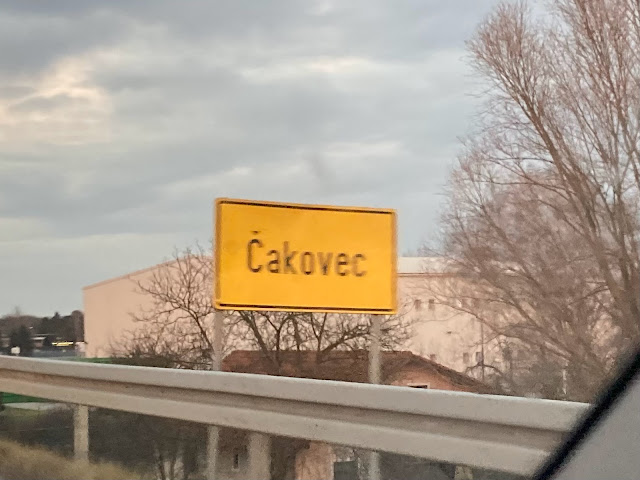
The official city limits sign of Čakovec greeted us after we passed through a couple of smaller villages.


And then the more interesting welcome came with its happy art and the reminder that Čakovec is the city of the 13th century castle that was home to the Zrinski family and others who protected this area and made possible the settlement that became a city.

And best of all, the sign was a reminder that we were almost home.


Thursday, August 12, 2021

The Same Old Routine


Coronamnesia. I don't think it's a real word. And I don't think I'm the only one to use it. But it's a real thing. Our memories are dependent on repetition and rhythm and routine, and major upheaval--getting too far from normal for too long--makes it harder to remember things.

But I do remember some things from this strange time of pandemic upheaval. Like that the last time I wrote here, I wrote about the cello. I will say more about that, but right now I'm thinking about the piano.

I also remember that back at the beginning of 2020, I wrote about the determination to write more regularly. Which did not happen. The erratic state of my blog is a reflection of the erratic state of life.

Because someone recently reminded me that I have a blog, which got me to thinking about all this, I've also been thinking about a little index card that I noticed one time in the windowsill above Grandmother's oven. Just a little white card with the words written in blue ink in her handwriting:

Thank God for the same old routine.

I don't remember my age or situation when I first noticed it, but it stuck with me because it struck me as odd that she would have that written out for herself to see. We were brought up to count our blessings, but I had never thought of "the same old routine" as a blessing to consider.

Wow, do I see that differently now. For many reasons, experiences over many years have made sense of those words and why she might write them out to remember.

"The same old routine" feels like a faraway dream to me right now. Since writing "now I begin" back in January of 2020, the pandemic broke out, changing all kinds of routines and rhythms for all of us. Additionally, we went real estate hunting, found a place, renovated "the chateau" (a condominium, but I dislike that word as a descriptor for my living space, and our complex has a French name, so I'm calling it a chateau), packed up our things and sold our lovely house, and moved into the chateau, which is lovely in ways of its own. Then within a month of that move, I learned that I would have to find a new office space for my practice. That was another upheaval. It also had a lovely outcome, but it was very stressful when I had no idea where I'd go but had to get out in a short amount of time.

And this year has had its share of smaller disruptions of rhythm, both sweet and somewhat bitter. The vaccines meant that Zoom piano lessons turned into children physically present in my living room again, which was wonderful. I began taking cello lessons, which was great fun. Resulting shoulder/arm pain led to stopping the lessons and starting a month of physical therapy to remedy the pain and, we hope, make playing cello possible again.

But I still don't know about that, because just a week after ending the PT sessions, I had foot surgery which left me largely dependent on husband, friends, and family for about a month. The following month included more mobility and physical therapy for the foot. I'm still not back to normal, but I'm starting to be able go for short walks and do some of the yoga-like exercise that was part of my same old routine before the surgery.

And now on the horizon, sailing steadily toward us, is the big ship of moving back to Croatia. I haven't written about that on my blog before, just another indication of how strange this time of life is! We've seen this ship coming for some time, but that doesn't diminish the size of it nor the amount it will disrupt and change the same old routine--what little there is of that.

I've begun a sort of rhythm in that each week I've been seeing fewer and fewer clients and going through more and more boxes. I trust both my clients and I will make this adjustment okay.

Support for that trust came to me yesterday in the form of a metronome. I'm about to get a metronome for one of my piano students and begin the process of teaching her to use it. And as I was looking at my own cute little one, a passage came back to me from my DMin thesis that gave me hope, in a week when I've had multiple moments of feeling close to overwhelm level. A few years ago, applying these ideas to a life of disciplined prayer, I wrote:


A common friend of many musicians is the metronome. A metronome helps measure time, providing a steady tempo for a musician to match. People are not born with perfect rhythm; they learn it from their environment and from practice. As a piano teacher, I have worked with many students who struggle with rhythm and who have never used a metronome. Initially, they tend to struggle mightily to stay with the metronome. It requires will, persistence, and generally significant encouragement. Most go through a period of resisting and complaining about how hard it is to keep themselves in tempo. Those who stick with the process, however, wind up realizing (and often saying) that the metronome has become a good friend. It actually helps their playing improve and helps them achieve their goals of making meaningful music. Its difficult discipline eventually frees them, allowing them to feel more clearly and confidently the spirit of the music.


And in the thesis I connected this with a wonderful passage about Dietrich Bonhoeffer, a musician himself, who wrote to a friend in Letters from Prison:

What I mean is that God wants us to love him eternally with our whole hearts [. . . . ] to provide a kind of cantus firmus to which the other melodies of life provide the counterpoint . . . . I wanted to tell you to have a good, clear cantus firmus; that is the only way to a full and perfect sound and can't come adrift or get out of tune, while remaining a distinct whole in its own right. Only a polyphony of this kind can give life a wholeness and at the same time assure us that nothing calamitous can happen as long as the cantus firmus is kept going.


Over many years of making music, and quite a few years of working as a counselor, helping people with mood disorders and people without diagnosable disorders who nonetheless struggle with moods because of temporary situations, I've come to realize the importance of actual metronomes and metaphorical ones.

And I know the value of conductors who keep a steady beat that can keep dozens or even hundreds of performers together so that what could degenerate into cacophony instead sounds beautiful or powerful.

With clients I sometimes talk about finding and creating anchors, small morning and evening practices they can make a part of each day, even if the rest of the day feels completely out of their control.

And perhaps as with the conductor, the value of staying connected to even one or two people who have a steadying effect can make all the difference between cacophony and harmony.

Especially staying connected to the Divine Conductor makes a difference. "Nothing calamitous can happen" if we do that. Bonhoeffer wrote that from prison in the midst of a savage war, and he wound up a martyr. Somehow that helps me believe I can handle what lies before me.

It's been hitting me that I need more rhythm, more anchors, more "metronome work" in my life, even if it was only yesterday the metronome itself spoke to me about this.

So I've found a way to make tomorrow a true retreat day, at a church with a beautiful nave and empty space where I can do some much-needed praying and planning. And I'm determined to work out a flexible but firm enough "rule of life" to get me through these next few months and into the new life beyond.


There's something comforting about the sound of an old-fashioned metronome. (I can't say the same for the digital ones I've used, whose sounds tend to annoy me.) The steady, resonant tick tock continues no matter how many times you get off the beat and have to start over.

And there's something comforting about looking forward to tomorrow and knowing that even with all the change, plenty of practices from my past can be reinserted into my life and carried forward. My life may be changing, but the God I pray to and the friends who love me aren't changing. The park I've walked in is still there. I can create a new rhythm with what is possible.

The old-fashioned metronomes, like old-fashioned clocks, have to be wound anew every so often, which for me is also a comforting thing, reminding me of my beloved piano teacher who occasionally had to stop her metronome and wind it during one of our lessons.

I'm ready to wind my metronome and use it more consistently. I hope writing in here will become more a part of my rhythm, even in the change-filled days ahead. I'm not ready to commit to that yet, but it's up for consideration.

I thank God for the same old routine, for this period of minimal routine, and for the new routines to come.

And I smile in the hope that Fr. Lanteri would be happy along with me. Nunc coepi. Now I begin. (Again.)


Sunday, February 14, 2021

What Do You Have that You Did Not Receive?


I don't remember exactly when I fell in love with cellos. But it was a long time ago.
It was the sound. The lower register, the smoothness, the beautiful way they somehow seemed to sound more like a human voice than any other instrument,
as far as I could tell, anyway.


And the more I went to the symphony and saw them,
the more I began to notice how beautiful they were to look at,
as all the string instruments were.
But something about their size made them the "just right" place
for that beauty--not too big, not too small, but just right.
They are human sized, as well as human sounding.

And so, many years ago, my beloved and I decided that someday we would get a cello.
I would learn to play it first, with hopes that he would too one day.
(But first he would learn piano, and we would play duets together.)

Someday. Someday.
After this degree, when I'm not working so much, after this crisis, after that surgery.
After the other surgery, after the move, after we get settled.
Someday.


Well, today was that someday.
He did it for my birthday, a few days ago.
We went up there together, met with the man with the cellos,
had a little introduction, heard the lovely sounds, chose the darker colored one with the greater resonance, signed the papers, and walked out with a cello.

A cello which is purely a gift from a man who loves me.
There are a lot of things we don't have in common. We're pretty seriously different.
But we both love beautiful music, and he decided to make a dream come true.

The longer I live, the more often I think of the speech given when I graduated,
the counseling degree graduation, a seminary counseling degree,
so the speech wasn't "you are amazing and can do anything,"
but instead was "What do you have that you did not receive?"
It was about gratitude, about a realistic perspective that everything is a gift--
life itself, with everything it includes.
(As the billboards in Memphis remind us, No One Gets a Diploma Alone.)
Well, I sure didn't get this cello alone.
It's a birthday gift from my husband.

It's also, in a very real way, a birth-day gift from my mother.
My mother, who was born on this very day many years ago
and who gave birth to me
and who is not now here to see or hear this cello.

But she is surely the reason I love music.
She is the reason we grew up experiencing singing as a normal part of life.
The reason I knew the notes on the piano before ever taking a piano lesson.
The reason I "had an ear" for music.
Without all that, who knows if I would have played piano or loved the symphony?
Would I have spent money on my first record, Pachelbel and Fasch pieces?
Would I have sung in choruses that let me be on stage with the symphony,
adding to my love of those cellos that I saw up close and personal?


I never knew before today that a cello has a heart.
Maybe that's why it sounds so human.
I guess that the other string instruments also have this feature, so that's likely not accurate.
But it's still a lovely thing, to see this little heart shape carved into the wood of the bridge.

I've loved cellos for a long time.
And now it kind of feels like this cello is loving me.
It's going to be a challenge, learning to play it. Humbling, without doubt.
But I think it will help to look down the strings and see that little heart
and to think "this is about love," and remember the ones whose love
brought this all about,
and be grateful for what I've received.

And a really wonderful thing about a cello is that it can never, ever sound quite the way
that a violin can sound in the hands of a beginner!
I tried that over thirty years ago! Eeek!

But even if not every note this cello makes will sound wonderful,
I think in its own way it will be beautiful.


Monday, January 18, 2021

The Shoulders of Giants


From what I recall being told, my grandmother was taller in her earlier years, before osteoporosis set in, than I am as an adult. You wouldn't guess it from this picture.

You also wouldn't know from this picture that she never wore a graduation gown. She wasn't able to go to college, thanks to the Great Depression and financial struggles it caused, likely complicated by the family's house burning down and her father dying when she was ten years old.

You can't tell from this picture that she never played piano or any other musical instrument. It just wasn't part of her upbringing.

But this beloved woman--despite osteoporosis, as well as two separate broken hips, both of which she recovered from and continued living independently--was always taller than I was when it comes to strength and character.

She died on this day (January 17) eighteen years ago, and for eighteen years I have thanked God for Grandmother and prayed "help me to be like her in the ways she was like You."

She and Granddaddy paid for my early piano lessons. She always encouraged me and asked me to play for her. She cut flowers from her own yard, drove them to Arkansas, and made the flowers arrangements for my senior piano recital. And bought my dress for that occasion, too.

Granddaddy and Grandmother used to give all of us a dollar for each A on our report cards. That wasn't a primary motivation for me, but it showed that they thought it was important to work hard, and that learning about the world mattered. Grandmother was a reader, and even though she seemed to spend more time in the yard and in the kitchen than she possibly could sitting with a book, the bookshelves in the house intrigued me with Gift from the Sea, The Prophet (How I wondered about that name, Kahlil Gibran!), I'm Okay-You're Okay, and always National Geographic magazines were around.

She was never a cheerleader that I'm aware of, but she certainly was my cheerleader, and I'm sure she was the same for all my siblings and cousins. It's amazing how powerful encouraging words from her were. She remembered our interests, remembered our teachers' names, and asked about them from time to time.

She taught children's Bible classes for many, many years. Her Bible stayed on the kitchen table, and we often read from it and a devotional book before meals when it was just the two of us, not a big family gathering. Before the big family gatherings we would often sing the Doxology together. It was obvious from the wear and tear on her Bible, that it was her constant companion, a strong connecting point with the God she loved and served.

And so when I see this picture, with my arm around her shoulder, even though I'm not standing on her shoulders, I know without a doubt that I would not have graduated with that counseling degree were it not for her, nor with the DMin degree years later. I know that I would never have entered piano competitions and become a piano teacher without her influence. The last time I saw her was after a choral concert, because she always encouraged my musical endeavors.

And I am quite sure that without her faith, which saw her through heart-wrenching loss and struggles of various sorts, I would not be a person of faith. I have no idea who I would be without her, really. I'm thankful I never had to find out. She was always there, always loving and serving and giving, encouraging and teaching with words and beyond words.

"Help me to be like her in the ways she was like You." Thank you, dear God, for Grandmother, a giant in mind and spirit.

Wednesday, July 01, 2020

Normal

Photo by Aaron Burden on Unsplash

Yesterday I was talking with a sort of mentor who has listened to me over the past couple of years, and I asked what advice he would have for me going forward, since I'm not sure how much more our lives will intersect.

His response: "I think you will regret it someday if you don't start writing. Writing something. Your blog, a book, whatever. I think you'll be sorry if you don't do more of that, get yourself back into it."

So, because I respect his thinking, nearly half a year after I wrote about the possibility and the power of always beginning anew, here I am on my blog, beginning anew.

I had started a post sometime in the time between January and now, to share the poem below as a way of expressing what this year so far has been like. After the January New Year's post, a good chunk of my free time was spent helping a special person in my life by proofing and editing their master's thesis. Once that was done, the free time was spent traveling to visit friends out of town as well as hosting a friend from out of town. Oh, and both a personal retreat and a group retreat. A pretty full month.

By the end of February it was becoming clear that life was about to be hit by the novel coronavirus, and March ushered in the reality of that with all its unsettling dynamics. I was closely watching the news coming from Italy, with daily death counts and pictures of coffins the stuff of surreality. We had beloved people in Bergamo, the hot spot, who became ill with flu symptoms.

Normal life here began closing down. I stocked up on groceries. Started seeing my clients through a screen. Learned that someone I had had lunch with the first week of March, had been exposed to people who had tested positive, so I stayed in for over two weeks straight just to be careful.


cracked gray concrete surface
Photo by Andrew Buchanan on Unsplash

Then one Sunday morning I woke and found a text message, "Croatia had an earthquake." It was March 22, and until I could get more details later that morning, I had no idea if people we knew were okay or not. We were so thankful to learn that as bad as it was, it could have been much worse. Then that same week two different friends in Croatia were hospitalized with serious problems.

March was an apocalyptic sort of time for everyone. Writers have been using that word to refer to the pandemic, not so much as an "end of time" word, but in the literal sense that an apocalypse is an unveiling of reality, pulling away the props and curtains we have in place in what we think of as normal life. We've been able to see serious cracks and crevices and crooked places as the veil has been pulled away. It's been a painful time in many ways.

In early April a very dear friend died. I'm sure I'll write more about that later.

Then near the end of May began the events that led up to the ongoing protests and all the difficult and painful realities and the accompanying emotions intertwined with that part of our country's story.

All to say that even though I had thought I'd be writing more in 2020, it was as if my mind went into survival mode. All my energy was needed to just keep taking the hits, as it were, and keep up the necessary functioning, working with clients and occasionally teaching for our class at church (via Zoom), learning to teach piano through a screen, helping a group tasked with making decisions about when and how our church might return to some kind of meeting in person. (We have not yet.)

The early days of the pandemic often took me back to Croatia, to the early days of the war in 1991. It was uncanny how many emotional memories I had during March. Of course a virus spreading around the world was very different from a war starting, but I repeatedly had intuitive flashes, my body and mind making connections back almost 30 years to those feelings of uncertainty, fear of the unknown, the hope that maybe it wouldn't be as bad as some predicted, the hard realization of how bad it could really be. The way time slowed down. The sense of isolation. Small things like the grocery store shelves emptying. Much bigger things like the wondering who would survive and who would be lost. Weeping at scenes of death coming through the media.

One night I sat at the piano and wept as I realized that it could be many months, possibly a couple of years, before I would sing in a chorus again. Certainly not the greatest suffering of the situation, but it represented so much more than what might seem to some a simple hobby.


Since the third grade, I have kept some kind of journal. It started in a little green diary with a lock and key and has gone on to fill bound books of various sizes and shapes, with rarely a week between writings, and sometimes daily writing for significant periods of time.

But for the years that I lived in Croatia, I have nothing in writing beyond letters and occasional notes in a planner that I've found in my desk there. I did no journaling for three full years.

I think the past few months have been something like those three years. The mind can only do so much, and my mind hasn't had the energy or ability to put things in writing.

"Poetry is the spontaneous overflow of powerful feelings; it takes its origin from emotion recollected in tranquillity," said William Wordsworth. My dear English teacher used to emphasize the importance of the "recollected in tranquillity" part of that process; one's best writing doesn't tend to come completely spontaneously, but requires some distance for reflection and a sort of absorption and assimilation. And sometimes writing at all seems to require some distance.

Perhaps I'll share one day a poem I did actually compose in those early days, before the virus had clearly arrived in our area. But for now I will share a poem by someone else. I've shared this poem with many of my clients over the years, people struggling when life events have taken them so far from what they had called normal before. I don't recall where I came across it, but since then I've learned more about its author and just love it all the more for the life behind the words.

We've all lost some of our Normal since I last wrote on this blog. I hope that anyone reading this has been able to hold on to enough Normal to keep you anchored in the midst of all the change. And I hope you'll find some courage and strength in this poem, especially when you consider the writer, whose life you can learn more about via the link at the end.


About Normal

Right now,
I don’t know what Normal is
Anymore.
That’s because Normal has been changing
So much,
So often,
Lately.
For a long while of lately.
I’d like Normal to be
Okayness.
Good health…
Emotional health,
Medical health,
Spiritual health.
I’d like Normal to be
Like that.
For now though,
I know that Normal won’t be normal
For a little while…
But somehow,
Sometime,
Even if things are not Normal,
They’ll be okay.
That’s because I believe
In the great scheme of things,
And Life.

May 2001

From the book Hope through Heartsongs, written by Mattie J.T. Stepanek, a 10-year-old “poet and peacemaker” who died from a rare form of muscular dystrophy. He started writing poems when he was five to allow his mom to “see what was inside of him” and he continued to write up until his death at age 13.

https://www.daily-journal.com/opinion/the-faith-of-mattie-stepanek/article_cbb29c1d-4af3-5ee1-89b6-5dc782705ccd.html

Sunday, January 05, 2020

Now I Begin

I thought I would sleep in on January 1st. Rudy, our dog had other ideas. He, of course, had not stayed up to midnight, and apparently he felt like 5:00 was a good time to get up the next morning. Since his getting up sometimes means "knocking" on the door to the hallway to be sure someone is aware it's breakfast time (at least by his reckoning), my morning didn't go as I had planned.

And I'm so glad. After tending to Rudy, I decided to make the most of it, lit a candle, and waited. The window in our bedroom faces east, so I turned the chair so I could face east also.


Early morning has always been my friend, but because of the trees all around and the closeness of the houses where we live, I rarely think of trying to see the sun rise, because it's just so hard to see it until it's higher in the sky and all the pretty colors have faded. And many mornings when I am up around that time, if I do look out, all I see is gray turning to blue.

But New Year's Day, as I sat there and looked, I could actually see, between the roofline of our house and the neighbors' trees, the rosy presence of the sun coming up, like a flower blossoming beyond the trees. The night's condensation on the window blurred the view, but it was perhaps more lovely for the gentle blurring.


I have been reading Fr. Timothy Gallagher's latest book, Overcoming Spiritual Discouragement, which is based on excerpts from the writing of a priest, Fr. Bruno Lanteri, who lived through the death of his mother at an early age, significant health issues that affected the choices available to him in vocation, significant setbacks in his ministry, and even arrest and exile because of Napoleon's attacks on the church during the time of the French Revolution.

We talk about making New Year's resolutions, but I think we often forget the word "resolve" that they depend on. Determination. Firm commitment. Fixedness of purpose. In the life of Fr. Lanteri, his plans and his work were interrupted in ways completely beyond his control. But rather than giving up, he began anew. And clearly the ability to come back from political exile and start over at the age he did, came from a lifetime of developing the virtue of perseverance. From the book:

Say then with boldness, "Now I begin," and go forward constantly in God's service.
Do not look back so often, because one who looks back cannot run.
And do not be content to begin only for this year.
Begin every day, because it is for every day, even for every hour of the day,
that the Lord taught us to say in the Our Father, "Forgive us our trespasses," and,
"Give us this day our daily bread."

And recognizing that sometimes we falter because of our own choices, he wrote:

If I should fall a thousand times a day, a thousand times a day I will begin again,
with new awareness of my weakness, promising God with a peaceful heart, to amend my life.
I will never think of God as if he were of our condition
and grows weary of our wavering, weakness, and negligence.
Rather, I will think of what is truly characteristic of him and what he prizes most highly,
that is, his goodness and mercy, knowing that he is a loving Father who understands our weakness, 
is patient with us, and forgives us.


The book has been such a blessing, and reading it right around the turning of the year has made it even more so.

I have several unfinished projects, unrealized ideas. New Year's has given me time to reflect on the things out of my control over the past decade (a job ending, turmoil of moving into private practice, my mom's serious health problems and death, neck pain, a nerve block, and two major surgeries, extended family crises), things within my realm of influence but still unexpected (the opportunity to do a Doctor of Ministry degree, time-consuming commitments at church), and the things that are very much my own responsibility (procrastination, sometimes plain old laziness, struggling with the addictive pull of the Internet.)

For all of these, I have found it so helpful to say, "Now I begin," no matter when I originally had the idea or started the project, and no matter how often I fall into bad old habits. It has been so helpful in moving forward and letting go of the past.

I'm so thankful I was unexpectedly awakened and had that sunrise moment. I'm thankful for Epiphany tomorrow and a continued meditation on the theme of light. And the Light.

And I'm thankful for the words of Fr. Lanteri:

Above all, I have asked the Lord to give you great courage and firm hope in God,
so that by this virtue, overcoming all discouragement 
and striving not to lose that precious time the Lord gives us,
you may attain greater good for yourself and for others,
especially since the Lord has given you so many means for this and the desire to accomplish it.


Now I begin.


Thursday, November 14, 2019

Height and Depth and Length and Letters and Love

Today I remember Mr. Wright, Ray A. Wright, my high school English teacher and friend for many years, who died on this day in 2002.

I've shared some of his poetry here before. Tonight I got out the stack of letters from him, most written when I was in college and he was at Ole Miss working on a doctorate. I hadn't looked at them in years but knew where they were and just decided to read a couple.

What a beautiful thing, that he took the time to sit and write these words to me. And took the time to read the words I wrote to him. These letters, because of their very words and because of the connection they represented, helped me through some hard times, and I imagine they will in years ahead, too.


I remember thinking how neat--that's probably the word I would have used then, even though I remember chiding myself for using that word too much!--how neat it was that his address had a 26 in it. 26 was my favorite number, the one I got on my club jersey, connecting back to high school stories, happy memories. So it was a happy coincidence that I enjoyed each time a letter came.

(And he would have gently chided me for writing that awkward sentence up there with the dashes. And then might have said, "Well, you've proven you know the rules, so you're allowed to break them. But that really is rather awkward!")


I wish I had copies of what I had written to him, what he was responding to. I wonder what music had recently brought me to tears. It happened a lot. Still does. But it would be sweet to know what he was referring to.

When I was blessed with the opportunity to sing the Prayers of Kierkegaard many years later, I know that brought tears to my eyes, for sure.


I am so thankful for the length of time this friendship stretched throughout my life, from ninth grade for a little over twenty years. And I would say it definitely made up in depth what it lacked in length. And with the memories and the letters accompanying me through the rest of my life, and with the faith we share and the goodness of the Father in heaven who "didst save us," the height and depth and length of this relationship become part of the eternal goodness of God.

During the time of his final battle with cancer, pain, and a coma, my chorus was preparing to perform Lauridsen's Lux Aeterna. I sang it with Mr. Wright in mind, and it always comes to mind this time of year, just as he always comes to mind when I hear or sing that music.

His life's light shined into my little life. May light perpetual shine upon him.


Tuesday, October 08, 2019

I Love You Truly


Today would be my grandparents' 84th anniversary! They married on October 8, 1935. All I really know about the wedding is that this song was sung. This is a copy of the music that came to me either from my mother, or from Grandmother's house, after her death. I wonder if it is the actual sheet music that someone used for their wedding ceremony?

They were married for 54 years, actually. Granddaddy was twelve years older than Grandmother, and he died almost exactly 30 years ago, strange as that seems. It will be 30 years on November 6.

If you know this song, you know it's kind of hopelessly romantic. At least it seems so to me, implying that sorrows and fears can fade away simply by being in the presence of the one you love. Maybe it's the music that makes it seem hopelessly romantic, or maybe it's being calloused to love songs by all the ones written in more recent decades, that definitely have a superficial approach to love and give too much importance to emotions and even physiological feelings.

But when I think that this song was written at the literal turn of the century, before the sixties and the triumph of feelings and individualism; and when I read on Wikipedia that Carrie Jacobs-Bond painted china and rented out rooms to make ends meet, and wrote songs to supplement her husband's income; I think maybe she had a deeper kind of love in mind than much of what winds up in love songs these days.

And when I think of my grandparents' marriage, I know that they loved each other truly. Their love didn't do away with sorrows and fear. They married during the Great Depression. Granddaddy's brother and mother died four years later, and his father died two years after that. Granddaddy struggled with bipolar disorder in a time when there wasn't much you could do for that. They had their share of sorrows and I feel sure there was fear mixed in. But their love--not just for each other, but love for God and family as well as for each other--gave them what it took to face the fear and to survive the sorrow.

And I am so thankful that they did. Their marriage led to my mom's coming into the world, as seen below, and eventually to my being here. And all my siblings and their families, and my cousins and their families....we are all here because two people loved each other truly.

It's amazing what love can do, what people can overcome. And the good that can come into the world because of that faithful, persevering love. I'm thankful for my grandparents. I love them truly.

Sunday, September 29, 2019

Morning in Medimurje

[This is a continuation from the last post, which I wrote much closer in time to the other one, but life events kept me from posting it....but in case you need a refresher, or are a new read and have no clue, I was writing about our trip to Croatia in late spring.]

From Munich we flew to Zagreb, where a good friend met us at the airport and drove us the circa hour and a half to....home. Because oddly enough, we travel from home to home when we make this trip.

In fact, on our last trip, I took this little sign and left it there just to add a touch of homey to the house there. And you can't see it, but next to the muesli (which I took with me this time) and on the other side of the little boxes of tea there, I had left a box of cereal when we were there in November, and it was still within the expiration date and ready to eat.


So in some ways it just felt like walking into normal.


The house there looks very much like many other houses in Croatia with its light facade and terra cotta roof, its fence along the front of the property. Like many others, it has flowers in front and fruit trees and vegetables further back. It has the ingenious metal blinds ("roleta") that aren't aesthetically lovely as wooden shutters but are amazing for having a dark bedroom at night or letting in just the right amount of light during the day.


Red clover was in bloom, which is also a very normal thing, but not too far from our house, set in the midst of this particular patch of clover, stands a reminder that "normal" varies quite a lot from place to place.


I walk by it just about every morning when we are there, as it's just off the street that leads out into the fields where I like to walk. It's an old chapel, built in the 14th century. You can read a bit more about it here and also here. Before an earthquake hit, a much larger complex stood here, a church and monastery. Now only the chapel remains, and I'm so glad it survived. I would love to go inside one day and see the frescoes. It belongs to the city museum and it always locked, but I think surely you can make an appointment to see it? After almost 30 years of standing an looking at it from the outside, I imagine going inside will feel something like a dream come true for me!


The shorter construction to the right covers an area where excavation has been done in the last 20 years. The local story says that this chapel is connected to the castle in the center of town by a tunnel that served as an escape route in case the castle were ever attacked. No one seems to know if such an escape ever was necessary, and I imagine the time, energy, and money it would take to try to excavate the entire route to prove the tunnel's existence is simply not worth it. But underneath that dwarfish little shelter, you can see what is obviously the end of some kind of tunnel going somewhere. It's really fascinating.

I just found a photograph of the chapel, near the end of this long article, taken in 1921. Someday maybe I'll be capable of reading something like that, but for now it's just amazing to me to see an actual photograph of that chapel taken when my grandmother was a little girl growing up in far-off Tennessee....and to think that when the chapel was built Dante was probably living and writing in not so far away Italy.

I learned on this trip that local legend includes a story about a dragon that is also connected to this tunnel story. Somehow I think the tunnel is more likely to exist than the dragon....

Sometimes I think about these things on my morning walks there. And sometimes I just stare at the red clover and listen to the birds singing.

(About the title: Medimurje is the name of the region. I love the name, as it means "between the rivers," and so makes me think of Mesopotamia and Abraham, Isaac, and Jacob, and so much that comes from that.)