Wednesday, April 06, 2016

Violets, the Heart Cure


They decorate our front yard right now like little jewels scattered in the night by some unseen generous giver. Today a storm was on its way, and I came home just before it was supposed to begin raining. The winds were already strong.

All these sweet little violets were out there to face whatever was on its way, and I just wanted to bring some in with me, in case they all got smashed by the rain and whatever branches would fall.


So with the wind pushing against me, and my still-in-recovery foot and ankle protesting slightly, I bent and squatted as I could and picked as many as I could without starting to actually hurt.


Since my surgery, I've been thinking more than usual about how amazingly intricate and wondrous the natural world is. How our bodies are put together and most of the time function so well. How everything is put together--and most of the time functions so well.


And then there are things like flowers. They aren't like feet or toes or ankles, there to do a job and doing it well. Of course they do, I suppose, provide nectar for bees and some kind of nutrients for the soil. According to what I've read, in the medieval period and earlier they were used to treat heart disease.

But they are also just beautiful! Just wonderfully beautiful!


And cute! Who can look at these little things out in the grass and not smile? So sweet, so gentle, so....well, cute. Like "cute as a button" cute. have read that according to legend, Venus and Cupid had a conversation that went bad and resulted in Venus flying into a rage and beating her rivals for beauty until they turned blue...and turned into violets. Horrible story!

I much prefer the story that has come down, that these flowers blossomed when Mary said to the angel Gabriel, "Behold, I am the handmaid of the Lord," and so they have been called, "Our Lady's Modesty" by those familiar with this story.


They remind me of childhood, and I read that they tend to be associated with childhood and innocence, and in some places and times the graves of children who died were covered in violets. It makes sense. They seem capable of comforting a broken heart and beautifying a great sorrow.


They make me think of the little song we sang when I was little, and that many of my piano students have played, "Lavender blue, dilly dilly...." even though it's about lavender, not violets. They make me wonder if children today learn all those little folk songs we learned, that are so connected to flowers and trees and birds and nature? When children spend the vast majority of their time inside, can they continue to sing such songs?


They make me think "This is my Father's world..."
"He shines in all that's fair....In the rustling grass I hear him pass..." 
And so these little tiny violets serve as a reminder that "though the wrong seems oft so strong,
God is the ruler yet."

I realize that many people do not look at violets and feel reassured that the world is ultimately in good hands. But I do. It has to do with the connection between truth, beauty, and goodness,
and I don't believe I can explain it in a quick blog post in which I really just wanted to say,
Look at these! Just look at these beautiful little flowers,
flowers that we did nothing to deserve.
They just spring up, year after year, out in the plain old grass that we didn't plant,
that we don't fertilize and hardly ever water. It's just there as a gift,
and they are part of the gift.


They make me realize that there are gifts all around that I don't see because I don't bother to look a little closer, or because I've just gotten used to them and take them for granted.

I think those earlier people had it right, that violets are good for the heart.

I think they had that right.


Sunday, March 20, 2016

San Miniato, Guest Post

I've written another piece for Janet Cupo's blog, "The Three Prayers." If you've read my posts about visits to Italy, you may remember that one of my most beloved places is the Basilica of San Miniato al Monte. Until writing this piece for Janet's blog, though, I knew very little about the story of the saint for whom it is named and about some of the history of the church connected with his story.

It makes for quite interesting reading.

Here are some bonus photos in case you do go read it.

These are parts of the inscription I mention that opened the door to meeting the professor from whom I and my classmates learned so much about the basilica.


In Latin it makes a nice rhyme:
Si cor non orat, in vanum ligua laborat.

And in any language, it makes an important point:
If the heart does not pray, the tongue labors in vain.


I took the photo below because it reminded me of the scene in the movie Room with a View, not long before Lucy faints. And it reminds me now of when Professor Gettings shared with us his research related to the symbols in the church. (You'll have to read over at Janet's blog to know what I'm talking about.)


Many tourists make the long climb up to San Miniato al Monte mainly to see the view of the city below. And as you can see, it is high up and gives a lovely view. But there is so much to be seen and understood within the church itself, views that open doors to even more beautiful things than human artists and architects can ever create.  I hope you'll take time to read it.


Thursday, February 11, 2016

Korak po Korak


When I first was in Croatia, even before we married, I think, I heard a singer named Lidija Bajuk on TV singing a song that of course I could not understand, since I didn't speak Croatian. But the refrain always included the words "korak po korak," and I remember asking my newly beloved if that might possibly mean "step by step."

He said yes. And once more I thought how all those puzzles I used to do in the newspaper had paid off. I think they were called cryptograms? All the letters had been assigned a number, and you were trying to figure out a phrase simply by making intelligent guesses based on what you knew about how letters tend to be used in patterns to form words. I'm sure it helped me in learning foreign languages because of the constant pattern recognition that is necessary.

Anyway, today that memory came back to me because I saw my doctor this morning and was told that after six weeks following a surgery, I can (and should) begin walking again.


For six weeks I have mostly lain on a couch, keeping my foot, and usually its companion, up above heart level, to prevent or decrease swelling and to help it heal. I have leaned heavily on the generous heart and strong body of my husband, and we have been immensely grateful for the support of friends with prayer, words of encouragement, meals, visits, and other ways of helping out. But the time has come that walking is what this needs to further heal. And it's what I need to live the life I normally live, which was the whole point of the surgery.

So today I took my first very tentative, very strange steps. I have to wear this surgical boot that reminds me of the stormtroopers from Star Wars. Said boot is about two inches higher than the very, very low-heeled shoes I normally wear, so each pair of steps was almost comical because of the lopsidedness. (I'll be calling the doctor about that. I don't want to develop a spine problem from lopsided walking for another month and a half.....!)


I think in my naive mind when I first scheduled this surgery, I imagined that when the day came that the doctor said I could walk, I would just be able to walk. I hadn't thought about what six weeks of not walking would do to the muscles and joints and even the part of my brain that has since toddler years just known that I could walk and how to do it.

I hadn't thought that my foot would still be bruised at this point, that the incisions would still show and be sensitive. Or that one of the major nerves in my foot would still be experiencing strange effects that sometimes resemble pain.

That's why I decided to take those first steps with the walker you see in the photos. Just to be smart, just in case I needed it.

So I thought I would just be walking to an event I've been looking forward to tonight. John Michael Talbot is coming here to teach and sing. I'm very much excited about it. I had really hoped to simply be walking, even if slowly. Now I'm wondering if I should just go with the scooter thing I've been using. I hate calling attention to myself and can't decide which is worse--to be on that thing, or to walk with a hobble and possibly "give out."

The truth is, either way I have to wear a stormtrooper boot, so I'm not exactly going to blend in, no matter what....


I'm not sure what I'll do. But it's an exciting day. And it was really neat when I took these steps and sent the pictures to my  husband, that he texted back, "One step at a time." Which is basically what "korak po korak" means.

I remember over 25 years ago when we saw her on TV, I said something like, "She seems like a lovely person. I'd love to meet her." And he told me she is from his hometown, she is his age, she is a real person that people do meet and know, even though that night she was on TV and by that time was living in Zagreb, the capital, where we moved shortly after we married. We didn't know at that moment that a war was going to start and change everything. And we thought perhaps we would connect with her.

So today when I'm not thinking about walking or the other things I have to think about today, I'm thinking about Lidija Bajuk and wondering if somehow, someday, I may still be able to meet her and tell her  how beautiful I think her voice is and that I love the simple way she plays guitar and sings. And that she has worked to keep poetry and folk stories alive. That I love how her videos feature nature and its beauty.

Maybe I should write her a letter?

Send her a link to this blog post?

I don't know. Step by step. Korak po korak. First I need to be able to walk to my desk if I want to write a real letter. And walk to the mailbox to mail it.

Meanwhile, you can listen to her music and see scenes of Croatian nature here.

And here is a song she wrote about the river that runs close to the town where I first heard of her, with pictures of it, also.


Now I'll go practice walking some more.....(and any typos are surely due to residual pain medication effects....)

Friday, January 22, 2016

All Creatures of Our God and King


It snowed here last night. Because I'm recovering from foot surgery, I won't be going out in it, and there really isn't enough to make me want to take pictures through the windows. But it brought me to my blog, nonetheless.

While I don't intend for my blog to be primarily a record of deaths, it seems that in this period of limited time and energy for writing, deaths and anniversaries of deaths are what have brought me here to write more than anything.

Of course that is because the lives of those who have died are so beautiful and are so much a part of my life that it doesn't seem right not to remember and celebrate them.

I haven't written about it yet here, but our sweet dog Paolo died on December 4. We never knew his exact age, but based on what we knew, we think he was nearly 17 years old. He had been with us since October, 2000.

I hope to write more later about him, his life and his death. Especially after thinking so much about St. Francis in order to write the previous post, he who is known for his love of all God's creatures, it would not seem right not to write about the little doggie who has been my companion and friend since before I had even considered having a blog.

For now I share simply that he is buried under the tree in the photo, at the home of some dear friends, where the concrete planters are standing guard over him until spring.

And that Wednesday I received this photo along with the following message:  "Thinking of you. Beautiful blanket of snow over Paolo's resting place. Kids keeping him company today as they sled in this teeny snow."

Everything about this says "Alleluia!" The sweetness of this dog, the loving kindness of these friends, the peaceful beauty of this hillside and its trees, the quiet beauty of snow, the joy of children sledding.

Be praised, my Lord, through all your creatures.


Thursday, January 21, 2016

Friendship with Francis


Recently I was invited to write for a series on The Three Prayers, the blog of a friend of mine. She is inviting guest writers to write about saints of the Roman Catholic Church, or about the influence those people have had on the lives of the authors.

My post falls into that second category. It's not so much about the life of Francis as it is about how the life of Francis of Assisi has been a blessing in my own life, and you are welcome to read it over on Janet's blog.

Wednesday, January 13, 2016

Numbering Our Days

Teach us to number our days,
that we may get a heart of wisdom.

~Psalm 90:12


Today is the birthday of Neva Jane White, the piano teacher I've written about before. It's hard to let it go by without at least a quick sharing of a couple of memories that came to me this morning.

This is a piece I learned in my first year with her.


She was the first teacher, as I recall, that had me write numbers in each measure. It made so much sense, because once I got out of the teaching method books, measure numbers weren't marked in any way. I don't remember if an earlier teacher had marked them herself or if we just referred to "the top line on the secong page, that third measure there....."

I just remember that Mrs. White had me write in the numbers of every new piece I got, and although it took me some time at the begining, it saved a lot of time as we worked on the piece.

Obviously, measure seven here needed a little help with the left-hand fingering.


Thinking about measure numbers today made me think about the verse written above, from the psalms. Some versions actually say "teach us to measure our days," though it seems most say "number." Either way, it connected to the idea of numbering my measures.

And I just love this warning she put on the top of page three (photo below). It comes after two pages of essentially the same rhythms played out in many different harmonic combinations, then a measure of four quintuplets leading up to this completely different section with new rhythm patterns, new harmonies, a new pedaling pattern--essentially, a big change in the piece where new energy comes in and the sound brightens, leading to a climax about halfway down the page.

And here, I had a tendency to rush. Of course! All that newness, so many things to think about, and knowing that even bigger stuff lay just ahead. Adrenalin was probably building in my brain and body, if we could have measured it. I'm sure the measure of quintuplets had a way of distracting me from the original tempo, too.

So, "don't rush." I've found it's excellent advice for just about every new situation in life.


Because whether you rush or not, you are going to get to the end. (I laughed when I saw I had put an exclamation point after that 50--down in the next photo. Maybe this was the first piece she ever had me write measure numbers in?)

Self-control is highly underrated, it seems, in the society I see and hear all around me. One of the many things playing and singing music has done for me, is that is simply taught me self-control. I was a child who always loved to play piano, so I don't have the kinds of stories some would about being forced to sit and practice when they wanted to be out playing football. But even though I loved it, it still took self-control to put it before other things I loved when that was needed. And the focus required to stay on task with a new (harder) piece, rather than just playing anything and everything, took self-control. Everything about it took, and takes, self-control.

In a culture that is all about rushing into the next thing, switching focus from one distraction to another, and "following your passions," I'm thankful for a teacher and an activity that taught me to slow down, to do the same thing over and over, to really think things through (how does this measure fit with the one before it? what tempo can I sustain throughout this entire piece? how will I refrain from my tendency to start this piece too quickly? which of these two fingerings works best for me to get from this section to the next? how do I really want this to sound in the end? etc.)

Mrs. White, in all the years I knew her, never seemed to be in a hurry. Even when she was running behind schedule and putting on her makeup while I was there at her house after a lesson, she was calm and gentle and thoughtful of my presence, not letting her mind rush on to the next thing and allowing the future to take over the present.

I want to live that way. There are wonderful measures like the one below, with fortissimos and sforzandos, and they can be wonderfully passionate and exciting. But they lose their meaning without the careful tempos and fingerings that get you to that point. And if the whole piece is played fast and loud, then this kind of ending is meaningless.


The other memory that came to me this morning was when my chorus had begun working on Lauridsen's "Lux Aeterna." I took a recording of it to her house, along with the score. Just before I hit "play" on her CD player, I said, "I really think you're going to love this."

And in that first very long measure, as a single note began by the strings in octaves so far apart, barely, barely hear-able, just going on and on, she said,  very quietly and gently, "I already do."


She knew how to number measures, how to make and hear beautiful music, and she taught me how to number my days. I hope to grow into the heart of wisdom she possessed.

May light eternal shine upon her.


Tuesday, January 05, 2016

Light of the Incarnation

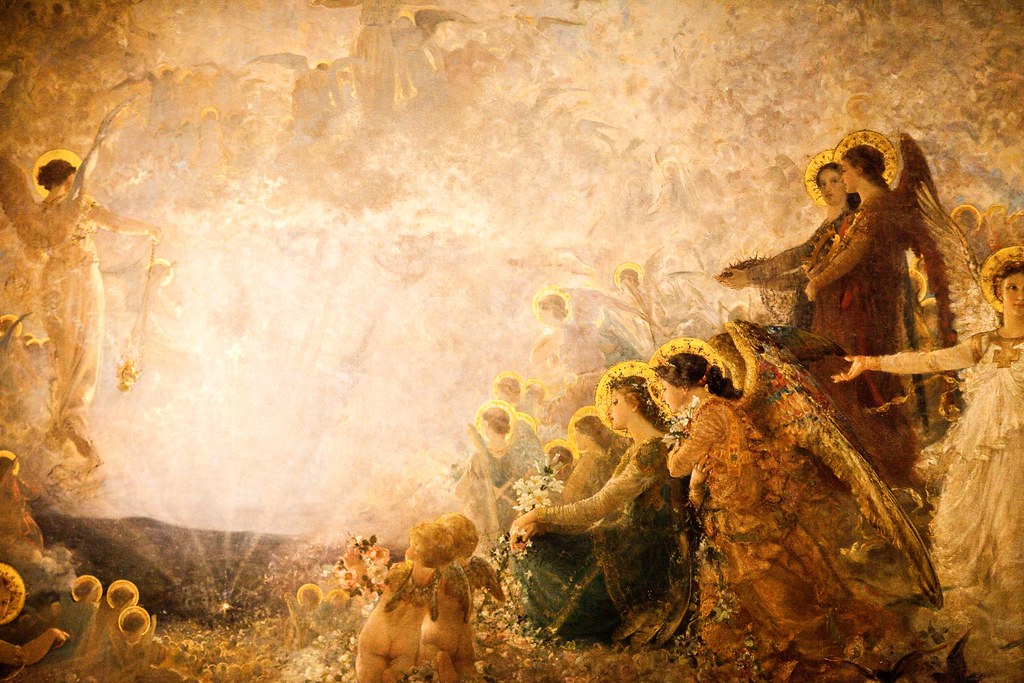
When I first saw this painting a few years ago at the Brooks Museum,
I thought it was amazingly beautiful.
It's huge (over 6.5 x 9.5 feet) and splendid, so you can't walk by without stopping to look.

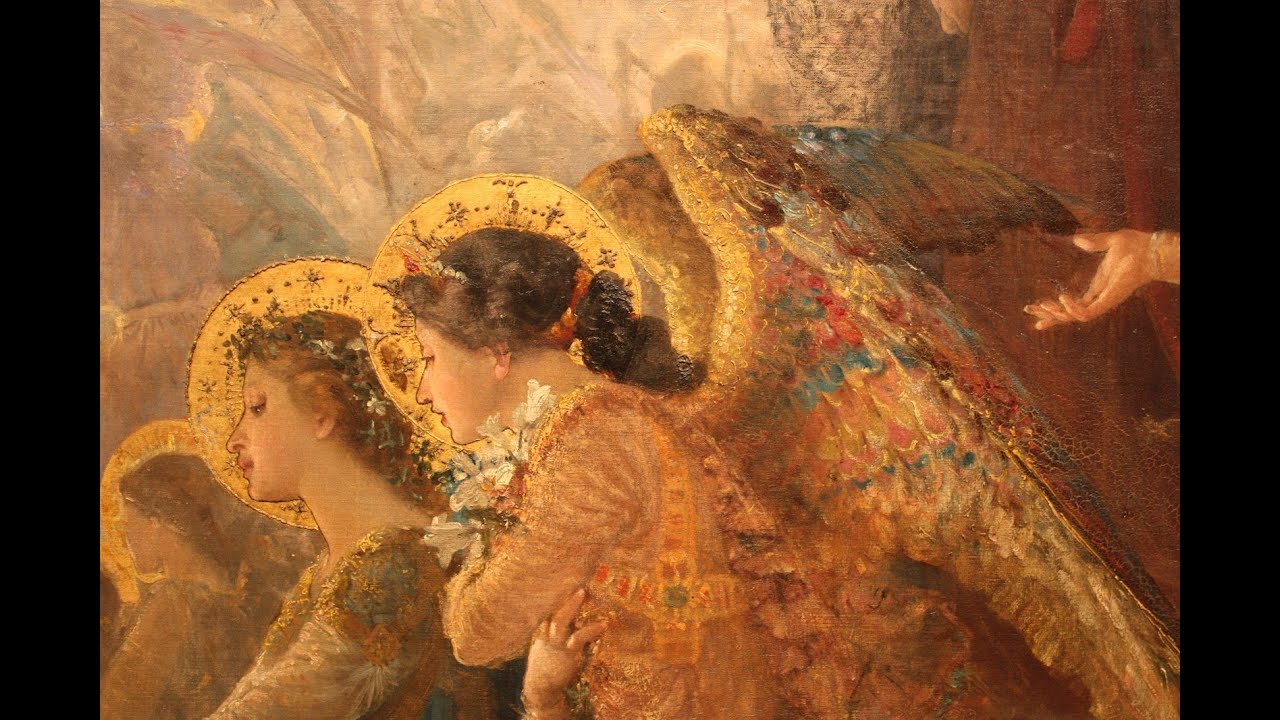
(It is so large, it is hard to find a full copy of it on the Internet. The first I've posted, which comes from this lovely blog, has the whole painting; the second has better lighting but not the whole thing.)


And when I stopped and looked, I saw the title was "Light of the Incarnation."
Only then was I able to see that (almost) all the angels are looking down, way down,
to the source of light in the left-hand lower corner.
And then the painting began to say more and more, beyond
"There's a bunch of beautiful angelic figures in lovely lighting."

It brought to mind the words from Luke's gospel, after one angel had appeared to the shepherds,
announcing the birth of a baby who was a Savior.

And suddenly there was with the angel a multitude of the heavnly host
praising God and saying,

"Glory to God in the highest,
and on earth peace among men with whom he is pleased!"

It brought to mind from John's gospel, "The light shines in the darkness,
and the darkness has not comprehended it."

And that fascinating passage in I Peter,
"It was revealed to them that they were serving not themselves, but you,
in the things which have now been announced to you by those
who preached the good news to you through the Holy Spirit sent from heaven,
things into which angels long to look."

And then, looking longer at the painting, I saw that
a crown of thorns is held out by one angel, symbolizing the crucifixion;
and a golden crown, symbolizing victory.


and lilies are held by another, symbolizing the resurrection;


and incense by another, symbolizing prayers and the holiness of the event.
(At least I think that's what it is....)


These symbols are powerful, representing the whole story to come,
set in motion long before the moment captured by the painting.

But I think the most powerful part for me when I've seen it is simply that you can't
look anywhere without seeing angelic forms. They fade in and out as you stand and look.
(Take time to enlarge the photo and look at it closely so you can see them.)

Granted, they are more representative of beautiful women with wings than they are of
the angels described in scripture, in those few places where they are described.
But even in this romanticized form, they serve an important purpose.

We so easily fall into thinking that only what we can see or hear or taste or touch is real, 
which our own scientific approach should warn us about, since before the magnifying glass,
many things that were not known by the senses were very much real, both making life possible (oxygen) and killing people (bacteria, germs, etc.)

The fact that we did eventually develop magnifying glasses, telescopes,
and all kinds of technologies that have expanded our ability to know things through our senses,
doesn't assure that we will be able to do that for every reality that exists.

And when I read things written by those who lived before all these technologies--
those who had access to all kinds of spiritual and philosophical writing,
but not to what we today consider scientific writing--
I often think that they saw and understood more than we do today.
They knew so much about life and love, humanity and hope, purpose and peace.
Some today may laugh at them for believing in angels.
But we really don't know who will have the last laugh, do we?
I only hope it will be laughter of joyful goodness, not the cynical laughter of "See, I was right."

The very word "Incarnation,"
signifying that something that was not made of flesh is being made into flesh,
assumes that there are realities beyond what we can experience in a purely fleshly way,
through those five senses we are taught to identify and name in elementary school.
It assumes a realm that is more than flesh, or beyond flesh,
a realm that can inhabit flesh at will but is not limited to it.

The new quotation under the title of my blog comes from a man who writes often about the realness of the realm that we cannot see with our eyes in the way we think we'd like to.

And here another author shares the story of a man who seems to have had the ability to see angels. The story of his life seems to indicate that perhaps we have lost the ability to see some things
by the way we have focused so intensely on seeing certain things in certain ways,
and creating strong rules about what is possible and what is not possible.
I urge you to take the time to read it.

We trust our eyes, our sight, so much. Perhaps too much?
Today I heard a car pull into our driveway. My husband said, "Oh, here comes your friend."
Because of the circumstances, I was thinking only of friends of a particular group, and when I looked out the window and saw this woman walking towards our door,
I actually had no idea who she was. I didn't recognize her.
I didn't see her. I saw a stranger.
Once she got to the door and came in, and I heard her voice,
I knew exactly who it was, and when I saw her face, I saw her, not my ideas about her.
(She is a dear friend but not part of the group I had in mind, not what I expected.)

And so this painting, this Light of the Incarnation, has become a favorite of mine
because it is a reminder that I cannot see everything, know everything,
understand everything, explain everything.
A reminder that forces are at work that I will never know about.
That my life is part of a huge painting that I could never paint on my own.
And it is a beautiful, light-filled painting.

Painted by Carl Gutherz, a man who was born in Switzerland and lived part of his life in Memphis.
About the painting, he wrote,
"Up to the moment of the birth of Christ, the light of God came from heaven to earth--
but, God here, the light glows back from earth to heaven,
increasing in glory throughout the ages.
Beholding this, the heavenly host unite in rejoicing over the world redeemed."

(from Carl Gutherz: Poetic Vision and Academic Ideals, ed. Masler and Macini.)

Joy to the World!


Sunday, November 08, 2015

One Hundred Years of Blessing

Dorothy Mildred Evans Christmas, my maternal grandmother, was born a century ago plus one day, on November 7, 1915.  Yesterday would have been her hundredth birthday.

I've written about her before. In case you want to read more about her, you can look at all these posts, and you'll see what I mean when I say how beautiful she was, both from the photos and from the way she wrote letters, gave gifts, and--well, I think you can just see that she was a beautiful person. You can see some of her Christmas decorations and the candle she put on the big dining room table where we always gathered for holidays, birthdays, and other special meals. You can see her Bible and the "Power for Today" devotional booklet she kept rubber-banded together with it, which she read or had one of us read each day. You can see her sturdy old deep freeze and some of the things that came from it, and you can imagine the hospitality that made possible.  You can see a rosebush that came from the rosebush in her garden, and pictures of the garage it was near.

And more.

Yesterday, in honor of her birthday, we ate grapefruit (something I did only at her house) from the green and white bowls that were hers. And used her grapefruit knife. And grapefruit spoons, too--not pictured, but made with pointy ends, just for eating grapefruit.


And I used her spoons while measuring baking soda and cream of tartar for biscuits . . .


and we set the table with her plates for biscuits and scarmbled eggs. My mom told me these were the first dishes my grandparents had, so I guess they are themselves now about eighty years old.


It was a lovely way to start the day.

And although it wasn't done intentionally in her honor, I think she would have been happy that later in the day I took a shoe to the shoe repair shop to have some velcro replaced, rather than giving up on the shoes.

Today I was able to spend a little time looking through pictures. Since she died in 2003, pre-digital cameras, and Granddaddy died in 1989, I don't have as many pictures of them as I feel like I ought to have. But a few minutes' searching turned up some that I hadn't seen in a long time.

What I haven't mentioned, something that strikes me each year as I turn the calendar to November, is that my granddaddy died on November 6, the day before her birthday. I wonder what the odds of that happening are. It's a strange coincidence. I was living in Italy when Granddaddy died. He had been ill for some time, and it was hard knowing whether to buy an extra ticket and come back to see, or to wait a few more weeks when I already would be coming back for Christmas. I took the chance (greatly influenced by not having money for another ticket)--and I didn't see him again. I haven't written so much about him; I hope to remedy that eventually.

For today, I found this picture of Granddaddy, one I was given in a bundle of pictures from the wife of one of my second cousins. I don't know for sure when it was taken, but I am guessing it was the sixties, judging by his apparent age. And I believe this may have been taken in the room that was once a screened-in porch, but before it was redecorated. I could be completely wrong, but that is my guess.

People who knew Granddaddy mention how he liked nice clothes and liked to dress up. So it was fun to find this picture of him with a bowtie and even a handkerchief in his pocket. I wonder what the occasion was, to call for a bowtie and a photo?


Recently I was at a farmers market here in the city. I saw a stall with a lot of pansies for sale. I had not yet bought pansies and was trying to decide whether to get them then and there, or to wait and buy them at one of the large stores where they would almost certainly cost less.

The man running the stall arrived from some errand, and I asked him where his flowers came from. He replied, "Brownsville," and that settled that. Brownsville is where my grandparents lived, and I knew that Grandmother used to buy plants at the small farm there, Willow Oaks Flower Farm. The man I was talking with turned out to be David Levy, the owner, and I learned that at one time he and his wife had lived across the street from my grandparents' house. He spoke fondly of Grandmother and used the word "character" referring to Granddaddy--which fit him, as I think anyone would say. As in "he was a real character." We talked for a nice little while, and I went home with plenty of pansies.

And as pansy comes from the word for "thoughts," it was fitting that I also went home with a lot of happy thoughts  and memories to savor.

Here is a picture of Grandmother from 1998, when she was in rehab after breaking her hip. This is not how I generally remember her. She looks tired. She was in good spirits that day, I do remember that; but perhaps she was in pain, too. At any rate, I like this picture because it reminds me of what determination she had--and I think it really brings out her Cherokee and Choctaw heritage.


The next two photos are from around the same time, but I can't be sure whether they are before or after the broken hip. She broke both hips in her life, and recovered from both and returned back home to live both times. Her habit of daily walks surely had a lot to do with that.

These are photos of photos, so forgive the quality of the image. But this is how I generally remember our beautiful Grandmother. She was a serious woman who read the newspaper, had quite a lot of books in her house, and cared deeply for people. She also tended to smile easily, and smiled a lot when surrounded by her large extended family, as she was in these two settings. I think both are from Christmas holiday gatherings.


In the one below, she is holding up a large Tennessee flag someone had given her.  This is why people who didn't even know her that well will tell you she was beautiful. Those of us who knew her well know that her beauty went way below skin deep.

It's hard to believe she's been gone twelve years. And that she was born 100 years ago.

What an amazing thing it is to be alive. And to realize that your being here is completely dependent on the lives of those who went before you. As the letter to the Corinthians puts it, "what do you have that you did not receive?" I'm thankful my life is connected to the lives of Charlie and Mildred Christmas. The longer I live, the more grateful I am for what I received from them. Their blessings continue to this day.

Happy birthday, our beautiful Grandmother.


Tuesday, October 20, 2015

Death Be Not Proud

Death, be not proud though the whole world fear you:
Mighty and dreadful you may seem.
But, death, be not proud, for your pride has failed you.
You will not kill me.
Though you may dwell in plague and poison,
You're a slave to fate and desperate men.

So, death, if your sleep be the gates to Heaven,
Why your confidence,
When you will be no more?
You will be no more.

Even death will die,
Even death will die.

Death, be not proud.
'Cause even death will die.


It's a beautiful rendition of John Donne's poem by Audrey Assad, and as I listened to it today while driving, I thought of the beloved one who died today three years ago.

Since her death, I've written about her on this blog, here and here.
Oh, and here.
And then one more here
She was my piano teacher, and she was so much more.


I wrote about her before her death, too, this post about autumn leaves and resurrection.
I had no idea then how much more those ideas of hers would come to mean,
more than they did my freshman year of college,
more than they did when I wrote about them years later.

Because she--who loved autumn so much and saw in it not only the ends of things
but also the beginnings of things,
an encounter with life at a new perspective,
at a new level of  meaning, of intensity--
she died in autumn.


So this morning I took a walk in the park and thought about her,
and this afternoon I took some pictures with the sun shining through the autumn leaves.
I remembered her (I'll never forget her; she's in my music, in my mind, in my heart,
in the way I hold my hands, in the Bible verses I read, in the words I give to my own students)
and I listened to this song.

Even death will die.


Even death will die.

Death's sleep is the gate to Heaven.

And there, or then, however we should speak of that existence--

"I like to think," my teacher said, "that in heaven we will be like the autumn leaves. Our true colors,
our real selves, will finally be revealed. All the things of earth that had to be a part of this season of lie won't be part of us anymore. Only the truest part of us will remain."

I think everyone who knew her knew they were seeing her truest parts.
Her kindness, her graciousness, her honesty, her compassion.
Her sense of humor, her hearty laugh.
Her love for God and love for others.

And remembering her,
we are helped to let go of unneeded parts of ourselves
so that our truest parts can be revealed,
little by little, day by day.

I know it's true for myself, and I see the things people are writing
on Facebook today.

Her light shone in many lives.


And for her life, and for her love, today I give thanks.
And this wasn't a planned-out decision--it just happened this way--
but it just hit me that her degree was in organ, not piano,
and tonight we had an organist over for dinner.

The first time we've ever had this friend over.
What a lovely gift, a way of connectiong with her
without even intending to.

Life is a funny and wonderful bunch of connections.


So in a minute, I'll go play her music,
the music she told me I just had to get and learn to play,
those last couple of years when she was delving into jazz. . .
because she never, never, never gave up.

When you believe that even death will die,
you never give up.


Good night.


Monday, September 21, 2015

How Out of It I've Been and Something Funny and Lovely

It seems I have now set a new record in the length of time between blog posts. From May 31 until now would be close to four months.

It's beyond my ability right now to remember whether or not I have said anything definitive on this blog about why I have written so little in recent months and even a couple of years or more.

A rather fascinating story lies behind just about everything in life, and that's true for this as well, but for now suffice it to say that around the same time I decided to return to school to work on a doctoral degree in ministry, my mom began to have significant health problems. The combination of these things has simply (and in quite complicated ways at times) demanded my focus, my time, my energy more than I could ever have anticipated.

In late April, I turned in my last paper for school. And at some point in the summer I turned in the official prospectus for my thesis. And after that all the paperwork for approval from the Institutional Review Board. I'm now officially in the thesis phase of the degree. Since I had "levelling" work to do (extra classes because I didn't go into the degree with a Master of Divinity degree already), this means I am now freer than I have been in three years. Not free, but not continually under the pressure of huge reading lists and deadlines.

So slowly, slowly, life has been shifting to a more liveable pace. I'm returning to the routines and rhythms that were interrupted pretty severely for almost three years.

And so, at some point in the late spring or early summer, I began noticing the straggling green things out in the pots on our deck, and I thought, oh, one of these days I will have time to plant flowers again. Planting flowers has not been completely neglected, but it has not been the regulary activity that it once was, so that something was blooming pretty much all year round. Where we live, it usually means pansies in the winter and impatiens and petunias for the spring and summer.

Of course I had to get that prospectus turned in and all the IRB paperwork. But in the back of my mind I was dreaming of buying and planting petunias, at least a few, to enjoy through the heat of the summer. I also remember noticing with the peripheral vision of my awareness that those plants out in the pots still had blooms, and it seemed awfully late and hot for that. Pansies don't generally make it into the summer heat in full sun.

On July 30, I finally actually walked out there and watered and weeded, thinking there was still time to plant some petunias, if I could find any for sale that late in the summer.

And for the first time, I realized . . . these were petunias!


Which meant they had been planted early LAST summer, and that I had never planted any pansies in the fall. These guys had made it through the winter and come back to life.

So, I did of course water them, and I pulled out the amazing little weeds that find their way through the air into the pots. And I pulled off the dead blooms.


And I laughed at myself and at how crazy life can get, and smiled at how beautiful it is that these flowers made it through with absolutely no help from me or anyone--just the sunshine, the soil and whatever rain fell on them over the course of most of a year. (And this was the coldest winter we've had since we've lived here.)


It felt as if they were saying, "Surprise! Welcome back!"


"We're still alive, and so are you. It's time to stretch and breathe and grow again."


I've been watering them and pulling the occasional weeds and the spent blooms, and they've continued to grow through the heat of the summer, and as the air has begun to turn toward fall's shorter days and cooler temperatures.


The spearmint from last year made it through, too, not surprisingly. Mmmmm.....


Maybe soon I'll even clean these pots so they can be as pretty as what grows in them.

And I even dare to hope that I may manage to get pansies planted for this fall and winter.

It's hard to know how to describe the past three years. A lot has happened, a lot has had to cease for a while. "Upheaval" comes to mind as a one-word description that avoids the extreme emotional content other words would carry with them.

But these flowers bring to mind other words, words that remind me in a comforting way that while my life matters, and each person's life matters in ways we surely cannot fathom, each life is also part of a whole that gives us meaning and hope and comfort beyond what we could ever come up with on our own. These beautiful words--

While the earth remains, seedtime and harvest, cold and heat, summer and winter, day and night, shall not cease.

After three years of pursuing a "Doctor of Ministry degree in missional and spiritual formation," I may have learned more about spiritual formation from these sweet petunias that came as "missionaries" to assure me of the good news that life is much bigger than my life, and strength and resilience and beauty are everywhere in the midst of it all. Even when I'm exhausted and oblivious.