Nothing actually stands between saying, “The river sang,” and “It was as if the river sang,” other than a set of rigid rules that forbids the former from being more than a metaphor. -Fr. Stephen Freeman
Friday, May 17, 2013
Towery City
It's been a long while since I quoted any Hopkins on my blog, and many readers may not even realize that the name of my blog comes from him.
Tonight I am for whatever reason thinking of the towers of Italy, Monteriggioni (above) being perhaps the most towery city I've seen there. San Gimignano may have more towers? not sure--but Monteriggioni has the most impressive arrangement of them, still intact.
Hopkins wasn't writing of either Italian city in his poem, but of Oxford, and was imagining the time when his hero, Duns Scotus, walked those streets and breathed that air. A man who "of all men most sways my spirits to peace."
For me, thoughts of Italy often sway my spirits to peace. It's not because Italy is perfect, or especially peaceful generally. Its cities can be chaotic and maddening at times. But because in recent years my trips there have been just that--trips--they have been peaceful. I wasn't working there, I wasn't going to teach a class or do a workshop, but just being there, seeing friends, taking it in. And of course in the countryside, it is breathtakingly beautiful, a peace-inducing sort of beauty.
A few years ago I spent three days in Assisi by myself and was able to follow the footsteps of Francis and Claire. Those were tiring days (I did a lot of walking! and much of it uphill!) but also very peace-filled days.
These days, I keep a photo on my desk at work of the view from Claire's prayer garden, a place where she used to pray, and a place where I stood briefly, once upon a time.
It's funny that I wrote "once upon a time." I only meant to say that some time back I stood there. But the phrase actually hints at what I want to say about why I keep the photo on my desk. It is a professional photo. a postcard I bought, and so as a photo it is quite close to perfect. And it is in a frame, which sets it apart. And so it is easy to see it there on my desk and think of it as "once upon a time in a land far, far away," as if it were not quite real.
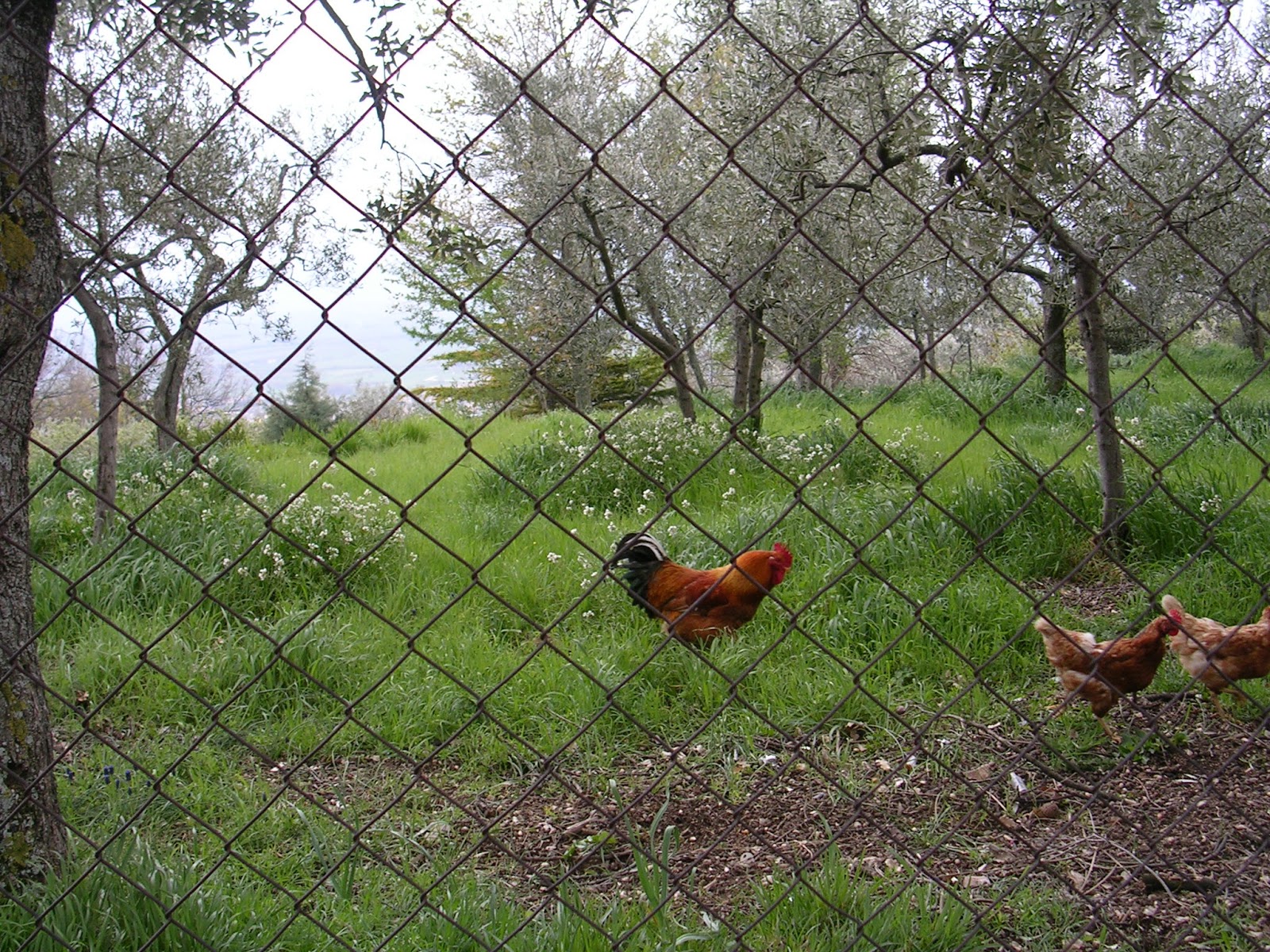
But the truth is that I stood in that very spot, could have taken that picture myself if there had not been other people around me. And it wasn't once upon a time. It was five years ago. It isn't a land far, far away. It's a real place. Francis and Claire were real people who really lived and prayed and worked there, and I really walked in that city, felt the wind blow in the olive grove, watched the chickens pecking at the grass just as they do in Arkansas or Croatia, and I really did feel the peace and exhilaration of those days in Assisi and of the rest of my trip five years ago.
So when I look at that photo on my desk, I use it as a discipline. For one thing, it reminds me to pray. For another, it reminds me that whatever is going on right now, whether in my own life or in the lives of my clients, that may be difficult, distressing, or downright awful--whatever may be going on here and now--that is only one part of reality.
I often tell my clients when they are overwhelmed by the present, or by parts of their past, that if they can remember some good time, some time when life was simpler, or more joyful, or more peaceful, then they really must believe that those times were just as real as what is going on now that is so hard. They may seem long ago and far away, but they were every bit as real as the difficult present.
And, I tell them, from a metaphysical standpoint, they may have even been more real. Because love and joy and peace are things that will last forever. Pain is not. Evil is not. Suffering is not. They will not last, so in a sense they are less real. And my clients owe it to themselves, and to truth, to remember that and be strengthened by it.
And that is why I keep that picture from Assisi on my desk.
(Even though the picture above is Monteriggioni. I suppose after going in the direction I did with my writing that I should include some of Assisi five years ago. It's a fairly towery city itself.)
And here, for those interested, is the poem from which my blog got its name:
Thursday, May 09, 2013
China, Marbles, and Memories
Our house was built in 1941. The tag on the plates in the antique shop said they were from 1941. I had been wanting some of these plates for years, and the price was better than many I had looked at over the past decade. It seemed meant to be, so I bought four of them.
I love them because they are beautiful. I love them because they are hand painted and simple. I love them because they are old. I love them because they are Franciscan.
And I love this picture because if you look closely, you can see one of my other favorite dishes in the reflection, upside down! I did not notice that when I was pressing the button on the camera!
In one photo, I am amazed at how much love I see. The wooden dish rack belonged to Grandmother. The plate reminds me of the love of St. Francis. The bowl reflected on the plate was a gift of love from my friend Carolyn, and was made in Italy, a country I love terribly much.
And even the little marble in the dish in the window has special memories of love. A few years after Grandmother's death, I was visiting the woman who now lives in her house. This woman's grandchild was playing in the room, and his toy car or ball or something rolled into the fireplace. When she (or I? I don't recall) went to retrieve the toy, looking into the far recesses of the fireplace, we found this marble. She was surprised and said they had never had any marbles since moving into the house. I said Grandmother kept marbles in this room, and they were played with quite a few years back.
So she gave the marble to me, and I treasure it as a reminder of my own childhood and the childhoods of cousins, nieces, and nephews who played in that living room over the span of decades.
Since 1941, in fact, because their house was built the same year as the one we now live in.
It pays to look closely. You perceive more love when you look closely. As Dostoevski wrote, "Love all God's creation, the whole and every grain of sand in it. Love every leaf, every ray of God's light. Love the animals, love the plants, love everything. If you love everything, you will perceive the divine mystery in things. Once you perceive it, you will begin to comprehend it better every day."
Thursday, February 28, 2013
Stripes and Lent
Lent started without me. I was out of town for a workshop, then got quite sick, and throughout this time was very involved in a rather intense effort to deal with a crisis situation in the life of someone very dear to me.
And although I was not raised in a church culture that practiced Lent, and in fact probably did not know the meaning of that word popping up every spring on my Hallmark pocket calendar until sometime in college, I have come to really appreciate the wisdom of this period of time leading up to Holy Week and Easter, and I look forward to it each year.
But this year I just wasn't able to enter into it fully. Unable to attend an Ash Wednesday service, I hadn't even had the time to think about how I would practice Lent this year, what form and structure my prayer, fasting, and giving might take.
Earlier in the month, however, I did go to St. Columba for a much-needed retreat of a day and parts of two days. And while there I was taken by the stripes of light one morning in the room when I woke up and opened the blinds to let in the sun. And then started noticing stripes everywhere.
So I got out the new camera my dear one had given me for Christmas, and I took pictures.
The wool blanket that was my Grandmother's. A lovely Lenten purple!
Stripes upon stripes.
The stripes of the rocking chair out on the porch (and the wonderful reflection of daffodils superimposed on it! And pens in the glass nearby.)
Stripes on the lampshade and all around.
Stripes on the side of the kitchen cabinet, stripes in the grain of the wood.
Stripes of light on the stripes of the dish drainer.
Light stripes kissing my little orange friends.
Stripes of light on the countertop and light working wonders through the curves of the glass.
And of course the stripes of the blinds themselves, the handmaidens of the morning sun, co-creating this visual display.
Stripes. Lent. "With his stripes we are healed." Everything connects to everything else eventually.
Today I was reading from the book Bread and Wine: Readings for Lent and Easter, reading back over pages I had missed because of everything else going on. Edna Hong writes about the need for Lent. "Our self-indulgent and self-flattering age looks upon the self-maltreating and self-hating practices of the monastic and desert ascetics as pathetic and futile." We think those practices were silly, laughable, and those who engaged in them woefully misguided, perhaps even sick. And of course they were extreme and perhaps not healthy.
But as Hong points out, our decision not to engage in such practices does not generally come from a place of already having arrived at such humility that we do not need such reminders. "It is rather our comfort-seeking spirits" that scorn those practices.
"But the spirit of truth does not seek comfort. The purpose of Lent is not to escape the conscience, but to create a healthy hatred for evil, a heartfelt contrition for sin, and a passionately felt need for grace.....There is no motivation for works of love without a sense of gratitude, no sense of gratitude without forgiveness, no forgiveness without contrition, no contrition without a sense of guilt, no sense of guilt without a sense of sin."
"In other words, a guilty suffering spirit is more open to grace than an apathetic or smug soul. Therefore, an age without a sense of sin, in which people are not even sorry for not being sorry for their sins, is in rather a serious predicament. Likewise an age with a Christianity so eager to forgive that it denies the need for forgiveness. For such an age, therefore, Lent can scarcely be too long!"
His stripes heal us. We don't need to stripe ourselves with self-flagellation like some of those ascetics.We could never heal ourselves, anyway. And yet most of us find we do need practices that challenge our apathetic and smug souls. Many who are not aware of that need, I have observed, engage in non-literal forms of self-flagellation. They beat themselves up for not being perfect, for mistakes they've made even years earlier sometimes. They whip themselves in order to perform better and castigate themselves when they fail. It's a routine I know well from earlier times in my life.
How much better to accept that we are imperfect, accept forgiveness, forgive ourselves, and live in love and gratitude. If Lent can help that happen, bring on the purple. And thank God for the stripes that heal. And for the light that brings life.
(I had not heard of Edna Hong before reading this today. But she lived an amazing life! Married a day after college graduation, hitchhiked to New York, sailed to Denmark, translated Kierkegaard, raised eight children, took in war refugees, wrote children's literature, lived over ninety years....Wow.)
Tuesday, February 19, 2013
Eat this Breakfast
When I grow up, I want to be like my friend Carolyn, at whose table I sat on the morning of Valentine's Day.
Carolyn doesn't just make the bed and set out towels for her house guest. She sets out books on the nightstand that connect with whatever event has brought me to town, or books that she knows relate to something I've been interested in lately. Sometimes she sets out a cross or other decorative object that I have given to her in years past.
She leaves a belated birthday card on the bed for me to find when I come "home" late after a long day at the workshop I'm attending.
And she sets a breakfast table with china, a Valentine napkin, and even a dignified cardinal to socialize with the little hoppy bird Valentine's card that I had left out for her the night before.
In these ways and in many others that go deeper, Carolyn makes love tangible. And I love her for that.
As my previous post, Eat this Book, talked about assimilating scripture into our very being, I want to assimilate Carolyn's hospitality into my being. Not just receive and enjoy it but find ways to imitate it, to share it. To take the time to think about another person and what would add joy, or interest, or beauty to their day--and then to actually make that happen.
What a beautiful way to start a day.
Sunday, January 27, 2013
Eat this Book
In the fall, I took a class on the book of Revelation. I don't think that I wrote about that here. I don't think I wrote much at all here in the fall, did I? And that's a big part of why I did not. I was reading my head off and my heart out. By that, I mean that it really did involve a lot of academic, mind-stretching reading, but the reading and learning reached into my heart and did some amazing things. I was also writing quite a lot, a long paper and a couple of exams.
I don't know why this thing will not let me align my text on the left, as I am telling it to do. But it won't.
Which takes my mind to the various forms that writing has taken over time, and to the title of the post, which comes from, or actually is, the title of a book by Eugene Peterson that I read a few years ago as part of another study adventure.
And Eugene Peterson took the words from the book of Revelation (with allusions to the writings and experiences of Isaiah the prophet), when John is told by the angel to "eat this book" that he has been given.by another angel. The word used for "book" is also translated "scroll," but Peterson uses the "book" translation in his work, obviously.
Peterson writes, "Eating a book takes it all in, assimilating it into the tissues of our lives. Readers become what they read. . . . The angel does not instruct St. John to pass on information about God: he commands him to assimilate the word of God so that when he does speak it will express itself artlessly in his syntax just as the food we eat, when we are healthy, is unconsciously assimilated into our nerves and muscles and put to work in speech and action. . . Words--spoken and listened to, written and read--are intended to do something in us, give health and wholeness, vitality and holiness, wisdom and hope. Yes, eat this book."
During the taking of that class, not long after the death of my beloved "Accompanist," I had an experience that I won't recount here, except to say that at a time when I really needed health and wholeness, wisdom and hope, they came to me in the form of seven precise words, words I had assimilated into my being-- words from the book of Isaiah, as it happens. And they changed my experience of her death, and my grief, and they even influenced the paper I was writing for the class on Revelation.
Those seven words changed me. Changed me for good.
Earlier in January, the week I was home with the flu, I read Ann Voskamp's One Thousand Gifts, which led me to find her blog, which led me to find her scripture memorization project.
Which has led me to accept her encouragement to recommence something that was once a regular part of my life--committing the Word to memory. Growing up as I did, going to church and attending a church-related school, memorizing scripture was something we did all the time. Usually a memory verse or two for church. Often a large chunk and even a whole chapter for school. In sixth grade, Meg Ireland at church on Wednesday nights had us memorizing more than I had before. And then in high school, singing in the chorus, I committed psalms and other passages to memory via music that stay with me to this day.
(As an aside, but closely related to my topic, I was pleased at Thanksgiving time, while driving to my parents' house and listening to an interview about John Donne, to poke around inside my mind and find that I could still recite all of Donne's sonnet "At the Round Earth's Imagined Corners," thanks to having learned it in chorus all those years ago!)
Recently I was listening to an interview with Melvyn Bragg, who grew up in a similar environment to mine, though his was rural England rather than rural Arkansas. He said that scripture "was like the lining of my mind." It was everywhere, and it was a huge part of what formed him. In the interview, he went on mainly to talk about how scripture, specifically the Authorized Version ("King James Version," as most Americans say) formed and influenced the entire British nation and beyond. Note: the link above is not to the same interview I listened to, but it covers some of the same material.
Somewhere along the way, somewhere in my college years, I stopped committing scripture to memory. But after college, when I was living in Croatia, living through the war going on around us, and harder yet the wars that went on deep inside me, I was so thankful for scriptures that came to mind when I needed them. They helped get me through those years, those battles, that war.
And yet I never did resume the discipline.
Until now.
I am at a time in my life of realizing that I want to have more say about what forms "the lining of my mind." I want to memorize music again, and I want to memorize scripture again. Maybe I'll eventually memorize important poetry again. I want my mind to be a place of health and wholeness, vitality and holiness, wisdom and hope. And it doesn't get that way by chance. In times of grief, or indecision, or sadness, or even joy, I want to have resources available for expressing what I need to express, for learning what I need to learn, hearing what I need hear, seeing what I need to see.
I want to "eat this book."
(The photos above are from the Bible I've had since my dad gave it to me when I was five years old. I'm glad no one ever told me not to underline in my Bible. I love going through it and seeing what I underlined at various times in my life. Psalm 103 happens also to be one of those passages I learned in chorus, too, and I still hear those words to that melody and in that rhythm.....)
Sunday, January 20, 2013
Daffadowndillies
I grew up in a small town. Since it was a university town, it gave me access to many interesting people from many places. And I had access to all kinds of books, and I read a lot. So it never felt like a too-small town to me, and I did not feel as if I were missing out on the world. Not at all.
And yet, somehow, it wasn't until I moved to Croatia that I learned one could grow daffodils in the middle of winter. Victoria magazine had just begun being published in the States before I moved over, and my sweet grandmother had them sent to me each month after she learned how much I enjoyed it.
And somewhere in one of those winter issues I saw yellow daffodils being grown inside, sitting in a windowsill with snow visible out the window. And with those long, freezing cold, gray Croatian winters, I dreamed of having daffodils in the middle of January. One issue even gave instructions on how to "force" the bulbs so that they would grow. I never got a chance to try it, since I didn't know where to get the bulbs, but, oh, how I looked longingly at those photos and dreamed of doing it and of seeing that spring beauty early.
Well, I never have done it. We moved to the States, and for the first few years we didn't have space in the apartment to do indoor projects that involved taking up space beyond what was needed for books and papers. And before long I discovered that you could buy them. Someone else had done the work of chilling the bulbs and forcing their growth to come early.
And I am so thankful!
I'm also thankful for the new camera given to me for Christmas by my techno-savvy husband, who got fed up when he tried to use my older camera (which was a hand-me-down from him, so I don't know how old it was!) and missed a shot because it took so long to get it to do what he wanted. He had been saying for a while that I needed a new camera, but I think his own experience with it must be what convinced him the time had come.
I am still getting used to it.
But I'll never get used to the wonder of having these beautiful flowers in the middle of winter. Even though it's not as cold here, and isn't gray for as long, and we don't look out the windows and see snow for days on end, it's still winter. And the sign of spring is more than welcome.
And yet, somehow, it wasn't until I moved to Croatia that I learned one could grow daffodils in the middle of winter. Victoria magazine had just begun being published in the States before I moved over, and my sweet grandmother had them sent to me each month after she learned how much I enjoyed it.
And somewhere in one of those winter issues I saw yellow daffodils being grown inside, sitting in a windowsill with snow visible out the window. And with those long, freezing cold, gray Croatian winters, I dreamed of having daffodils in the middle of January. One issue even gave instructions on how to "force" the bulbs so that they would grow. I never got a chance to try it, since I didn't know where to get the bulbs, but, oh, how I looked longingly at those photos and dreamed of doing it and of seeing that spring beauty early.
Well, I never have done it. We moved to the States, and for the first few years we didn't have space in the apartment to do indoor projects that involved taking up space beyond what was needed for books and papers. And before long I discovered that you could buy them. Someone else had done the work of chilling the bulbs and forcing their growth to come early.
And I am so thankful!
I'm also thankful for the new camera given to me for Christmas by my techno-savvy husband, who got fed up when he tried to use my older camera (which was a hand-me-down from him, so I don't know how old it was!) and missed a shot because it took so long to get it to do what he wanted. He had been saying for a while that I needed a new camera, but I think his own experience with it must be what convinced him the time had come.
I am still getting used to it.
But I'll never get used to the wonder of having these beautiful flowers in the middle of winter. Even though it's not as cold here, and isn't gray for as long, and we don't look out the windows and see snow for days on end, it's still winter. And the sign of spring is more than welcome.
Sunday, January 13, 2013
The Accompanist
As I sat down to write about the woman pictured above, I heard Garrison Keillor's voice, the way he reads for the noon "Writer's Almanac" program. . . ."Today is the birthday of . . . ." and had the thought that her life could never be fit into that short blurb given for the writers Keillor acknowledges--and I know that her life cannot be adequately described and appreciated here by me, either.
And yet today I feel compelled to write. I have wanted to write about her since her death on October 20 this past fall. It was impossible at the time, because I was severely pressed for time, and also because I had no tranquility to temper the emotion I felt; I needed some distance for recollection. Now I have the time, and I have had some time, and I will try.
And so . . . . Today is the birthday of Neva Jane Cram White, known to me first as Mrs. White and later as Mama Neva. She would have turned 78 today.
I'm not sure when I first became aware of her presence in the town I grew up in, but I know that by seventh or eighth grade, I was convinced that she was the best piano teacher in town. Her students just seemed to play a notch above the rest of us, at least several of them.
Once I turned pages for a friend who took lessons from her. Mrs. White's house had the largest living room I had ever seen, large enough for her long Baldwin grand piano, for a full set of furniture, for ample space around the furniture and piano, and for a few steps that went up into the dining room, where all the students, along with their page turners, stood and waited their turns. The "backstage."
It's ironic that this is my earliest clear memory of this remarkable woman; the irony will become clear as you read on. On that evening, being the shy wallflower that I was back then, I was standing, you guessed it, against the wall, by the door that went into the kitchen. I was trying to be invisible, as I felt intimidated by the mostly-older kids around me--her amazing, talented students.
It was an evening recital, and the lights in the living room had been turned out, except for around the piano, so there was kind of spotlight effect. The light in the dining room was off. Until it suddenly wasn't. It came on, out of nowhere, and I remember Mrs. White, this woman with the long piano and the huge living room and the competition-winning piano students, walking into the room with a perturbed look on her face, to figure out what was going on and why the light had come on. The way I recall it, she had a stern look, and back in those days a stern look from any adult was enough to make my heart race. My heart raced faster when it was discovered that I was the cause of the light coming on! I was leaning in such a way that I'd pushed the dimmer switch and not even been aware of it!
I must have gone into a mild state of shock, because I really don't remember anything after that. I wouldn't be surprised if I teared up, because I felt like I had ruined her beautiful recital. I also wouldn't be surprised if she assured me everything was okay, that it wasn't that big a deal....but I really don't remember. I do remember thinking, "She'll never want to have me as a student now!" (Yes, I fell prey to catastrophic thinking even more back then than I do now.)
Somehow I gathered the courage a year or two later, though, to inquire. And she did take me. I started with her in the fall of ninth grade and stayed with her for four years. Four years that changed my life.
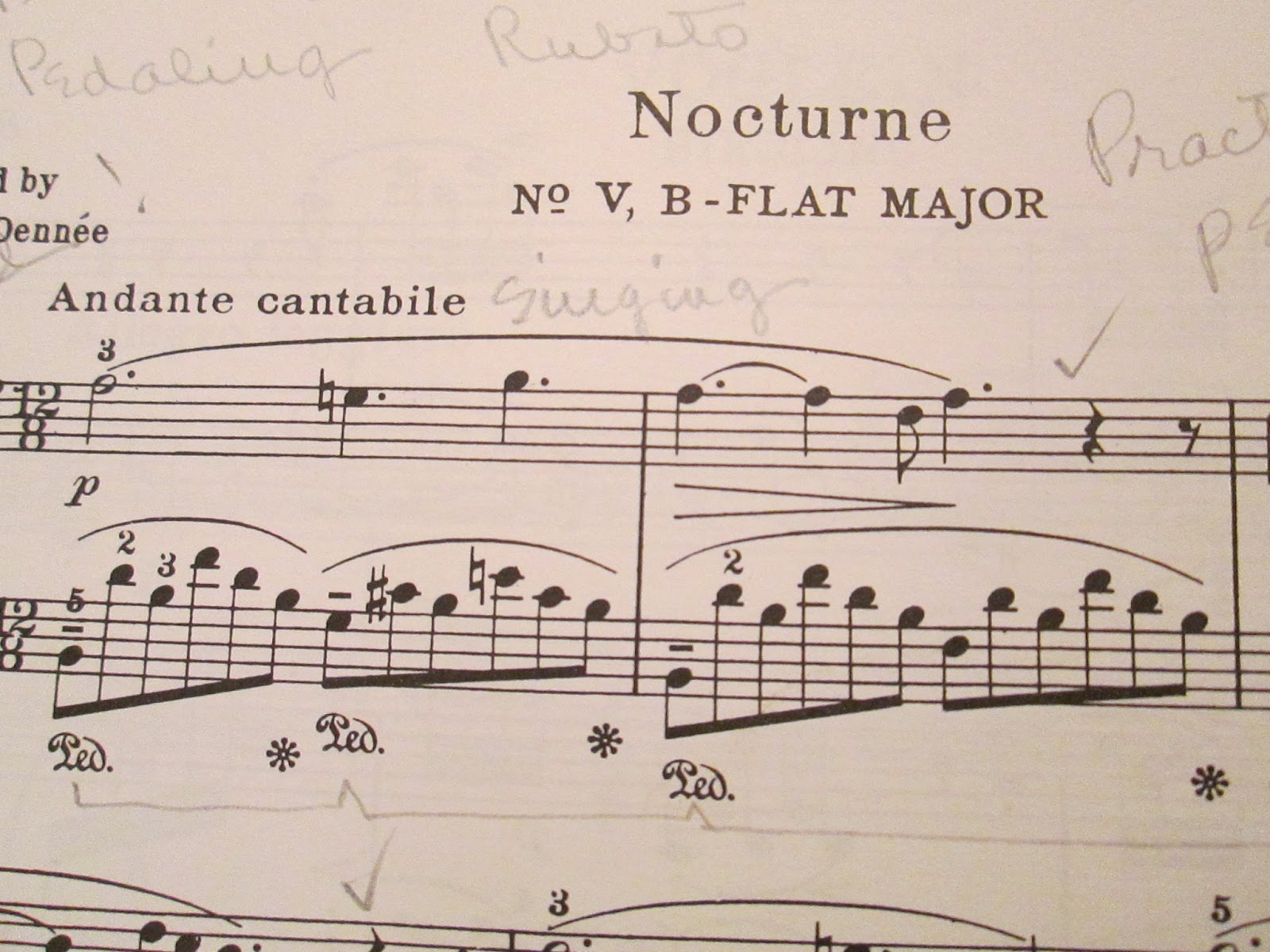
One of the first pieces I played that year was this nocturne by John Field. She chose it because I wanted to play Chopin but wasn't ready to play the pieces that I was attracted to. Field's nocturne has some style similarities to Chopin's and is not quite so demanding! I fell in love with this piece, and it wasn't long before I came to love Mrs. White.
She was in fact an excellent piano teacher. She had actually studied organ and voice in college and then went to Eastman on a voice scholarship . And she did have a beautiful voice. Later on, she taught voice lessons at the university along with piano.
But what happened at Eastman, according to her obituary, gives my post its title: "While there, her piano accompaniment ability was discovered, and she began to develop what came to be perhaps her greatest musical talent. She later was recognized by the National Association of Teachers of Singing with the Brotherton award as an outstanding accompanist." Who even knew that awards were given for accompanists? Obviously they are, and certainly should be, but I didn't realize they were, until she died.
Her excellence as a piano teacher had a huge influence on my life that has lasted for years. But her giftedness as an accompanist will last throughout my life, even if I lose the ability to play piano completely.
She accompanied me through those four years of my life like no one else could have. Those years were tumultuous in ways I won't go into here, because this is about her and not me. Suffice it to say that those four years were among the hardest of my life. As I look back at my decision to screw up my courage and ask her to take me as a student--despite my shyness, despite my uncertainty about paying for it, and despite what happened at that recital--and see what a gift she became to me, I wonder at the grace of it all, and I wonder if some Holy Spirit prompting had not been behind the strong determination I had to become her student.
She was perhaps the gentlest person I had ever known. Her voice was gentle, her teaching style was gentle, her corrections came gently. Of course she taught me how to play the keys gently and firmly--a challenge, since the piano I practiced on at home had nothing like the action of hers.
And like any good musician, she knew how to listen. I have no idea how it began. Perhaps I burst into tears at some point in a lesson, I don't know. I just know that before long, our time together was divided between musical instruction and life instruction. She would listen to me, comfort me, encourage me, sometimes hold me when I probably seemed likely to fall apart otherwise. My overall memory of piano lessons in those years is of sitting at the piano together with music in front of us always, but much more than music going on.
At some point, the money I had saved up for lessons was all gone, and I thought, with great sadness, that would be the end of it. But, no, she insisted that she would continue to teach me in exchange for my continuing to work as hard as I already did. Since her death, it has become known that she taught several of us at no charge--a minister's daughter, a friend whose widowed mother died, another friend whose single mom struggled to make ends meet. Back then, none of us told the others, but at her funeral and on Facebook, the stories came out. She was a generous as she was gentle.
When it was time to graduate and go to college, she felt it was best for me to try a new teacher, just to get a different perspective and have a fresh set of ears to hear me. So I did move to another teacher, though we continued to meet in her office (she began teaching at university the same year that I began, as I recall.)
One year I actually took her accompaniment class for credit. (I started out a music major but figured out that I didn't want to teach in a school system and wasn't likely to become a performer, so I switched majors but continued to do as much musically as I could.)
Well, Blogger has decided now that it will rotate pictures I am trying to post.....and it is getting late, and as I thought, there is no way to fit this all into one blog post. I guess it will have to be a mini-series. For now, I will share a poem I came across recently, and I'll come back for the continuation.
The Accompanist
I’ve always worried about
you—the man or woman
at the piano bench,
night after night receiving
only such applause
as the singer allows: a
warm hand please,
for my accompanist. At concerts,
as I watch your fingers on the
keys,
and how swiftly, how
excellently
you turn sheet music
pages,
track the singer’s notes,
cover the singer’s flaws,
I worry about whole
lifetimes,
most lifetimes
lived in the shadows of
reflected fame;
but then the singer’s voice
dies
and there are just your last
piano notes,
not resentful at all,
carrying us to the end, into
those heartfelt cheers
that spring up in little
patches from a thrilled audience
like sudden wildflowers
bobbing in a rain
of steady clapping. And I’m
on my feet, also,
clapping and cheering for the
singer, yes,
but, I think, partially
likewise for you
half-turned toward us,
balanced on your black bench,
modest, utterly
well-rehearsed,
still playing the part you’ve
made yours.
Tuesday, January 08, 2013
Lucy, Liam, and la Luce
Thanks to encouragement from Lucy and the carrying out of the idea by my husband, I am now using Google Chrome for blogging, and voila, I can put pictures here!
So, this is what I wanted to post in the midst of the saga of the Italian journey. Even though it's been months since the trip, I had a nice little visit to Tuscany the other day when the sun fell on this painting in our living room and caught my eye.
I walk by this multiple times daily, but seeing the light and taking these photos made me see things I had never noticed before, all the little houses and windows, the slats of the door, the branches of the tree.
As I mentioned, one benefit of being home sick was that I got to experience the house in lighting that I miss when I'm at work or otherwise out and about during the day. I saw all kinds of things that I see everyday but don't really see.
It's really (really!) nice to feel better now, though I'll kind of miss this time I've had at home and the things it has allowed me to do.
And a benefit of the browser issue is that I went ahead and blogged, even without the photos I wanted, and I feel freer now to kind of go with the flow, rather than only documenting the trip--though I intend to continue doing that, too.
Allora, arrivederci!
Monday, January 07, 2013
Manifestation Moment
All right. I can't upload photos yet, so here's another one from the archives. Getting close to five years since this photo was taken. My sister and I were on a train, leaving Paris.
It's not everyday I go to Paris. In fact, this was my first time there. (I say it that way not because I've had a second time, but because I fervently hope to....)
And it's not everyday I see a double rainbow.
And to see a double rainbow and visit Paris all in one week--wow!
I've been reading a book lately while recovering from the flu. I may say more about it later, but for now only that it has reminded me of how important it is to look at life with openness and gratitude, and to really see the many blessings all around.
If I had been doing anything other than looking out the window at this point..... this beautiful moment, so real and so meaningful, would be for me as if it had never happened. I would never have seen it, never felt the awe, never had the picture, never enjoyed the memory.
I wonder how many such manifestations of beauty and grace I have missed in my life, just because I wasn't looking? Because I was so focused on either something I was doing or something I was thinking (probably worrying about) that I didn't see what was in front of me?
The "wise men" were looking, apparently. Looking for a long time, most likely, being observers of the stars and having come from far away. They looked, they searched, they found, and they followed.
But first, they looked. They had their eyes open. They weren't too busy to miss it. They had eyes to see.
I want to, too.
Sunday, January 06, 2013
Take Two
All right, I'm back with the hope of sharing the photos I wanted to share last night.
It's the evening of Epiphany, a word I knew only as a word for something like "a comprehension or perception of reality by means of a sudden intuitive realization" (thank you, thefreedictionary) until about a decade ago, when I began learning how the word with a capital "E" fit into Christian history and the liturgical calendar.
Interestingly, I had actually learned about longer ago than that, when I was living in Italy. Except that there I heard mainly of "la Befana," a sort of female cross between Santa Claus and a witch, who leaves lumps of coal and/or goodies for children on this evening. "Befana" is thought to be a sort of corrupted pronunciation of "Epifania," which was surely explained to me back then. But as I had no context for meaning of that term, it didn't stick.
It's very interesing to me that according to information from the book pictured above, Epiphany was celebrated by the Eastern church circa a century earlier than Christmas was added to the Roman church's calendar.
I'm not the one to go into a in-depth explanation of what Epiphany is, but I think it's a beautiful idea to celebrate the events from the gospels in which it was revealed that Jesus had come to make salvation possible, to Gentiles as well as Jews, events worth pondering and studying, enjoying and being thankful for.
When I have been to Epiphany services, candles and light played a role, with the idea being that just as Jesus came to bring light into the world, so we are do go out and do the same.
And light is what originally caused me to take these pictures, not knowing at the time that I would link them to my life in Italy twenty-something years ago. Now, crossing my fingers that Blogger is going to let me post them.....
Okay, this is hilarious. We live in such a funny world, with our technology dependence. It is still not working. So, what did I do but go to Google, hoping for an epiphany....or at least an answer. A shot in the dark, I thought--but wouldn't you know it? I typed in "why is Blogger...." and it filled in for me "not uploading photos." Obviously I'm not the first!
Well, I found several suggestions but am not competent to carry out any of them. So until I am able to consult with my more techno-savvy husband, I guess I'm stuck.
So.....here's another picture from an earlier post on my blog. It's the moon over our former home. Maybe, just maybe, something like the star that led the magi to Bethlehem. How I would like to know more about that story....
And how I imagine the magi would have liked to know more about what it was they were following, and what it was they found. How I wonder what became of them and how this journey affected their lives. Much to ponder, much to wonder.
And I hope soon to be back with new photos.
It's the evening of Epiphany, a word I knew only as a word for something like "a comprehension or perception of reality by means of a sudden intuitive realization" (thank you, thefreedictionary) until about a decade ago, when I began learning how the word with a capital "E" fit into Christian history and the liturgical calendar.
Interestingly, I had actually learned about longer ago than that, when I was living in Italy. Except that there I heard mainly of "la Befana," a sort of female cross between Santa Claus and a witch, who leaves lumps of coal and/or goodies for children on this evening. "Befana" is thought to be a sort of corrupted pronunciation of "Epifania," which was surely explained to me back then. But as I had no context for meaning of that term, it didn't stick.
I'm not the one to go into a in-depth explanation of what Epiphany is, but I think it's a beautiful idea to celebrate the events from the gospels in which it was revealed that Jesus had come to make salvation possible, to Gentiles as well as Jews, events worth pondering and studying, enjoying and being thankful for.
When I have been to Epiphany services, candles and light played a role, with the idea being that just as Jesus came to bring light into the world, so we are do go out and do the same.
And light is what originally caused me to take these pictures, not knowing at the time that I would link them to my life in Italy twenty-something years ago. Now, crossing my fingers that Blogger is going to let me post them.....
Okay, this is hilarious. We live in such a funny world, with our technology dependence. It is still not working. So, what did I do but go to Google, hoping for an epiphany....or at least an answer. A shot in the dark, I thought--but wouldn't you know it? I typed in "why is Blogger...." and it filled in for me "not uploading photos." Obviously I'm not the first!
Well, I found several suggestions but am not competent to carry out any of them. So until I am able to consult with my more techno-savvy husband, I guess I'm stuck.
So.....here's another picture from an earlier post on my blog. It's the moon over our former home. Maybe, just maybe, something like the star that led the magi to Bethlehem. How I would like to know more about that story....
And how I imagine the magi would have liked to know more about what it was they were following, and what it was they found. How I wonder what became of them and how this journey affected their lives. Much to ponder, much to wonder.
And I hope soon to be back with new photos.
Subscribe to:
Posts (Atom)